Ford CEO Jim Farley’s $5 Billion EV Gamble: ’No Guarantees’ - Is Ford Stock a Risk Worth Taking?

Ford's electric revolution comes with a stark warning from the top.
BETTING THE BLUE OVAL
Jim Farley drops the corporate speak—admits their massive $5 billion EV push carries zero safety nets. No sugarcoating, no investor placation. Just raw automotive truth.
VOLTAGE MEETS VOLATILITY
Traditional automakers playing catch-up with Tesla face brutal economics. Battery costs, charging infrastructure, consumer adoption curves—all variables that could torch even the biggest war chests.
LEGACY AUTO'S LAST STAND?
Ford's gamble represents everything wrong with old-school manufacturers trying to innovate. They're building electric vehicles while still paying pensions—like trying to win a Formula 1 race with a minivan engine.
THE INVESTOR CALCULUS
Massive upside if they crack the code. Total obsolescence if they don't. Wall Street's already pricing this like a coin flip—because frankly, that's what it is.
Remember: this is the same industry that needed a government bailout to survive last time they misread the market. Some lessons are apparently too expensive to learn.
Tackling the problems at Ford
Even though the Ford F-150 Lightning pickup is the best-selling electric truck in America right now, and the Mustang Mach-E crossover is one of the best-selling EVs overall, Ford's "Model E" EV division has been hemorrhaging money for years. It lost $2.2 billion in the first half of this year alone.
That's partly due to the company's manufacturing processes: Even when the company uses an existing gas-powered design as the basis for an EV design, the fundamental structural differences between battery-powered and internal combustion assemblies often result in production problems and vehicle recalls.
Farley's solution is a $5 billion effort to convert the company's Louisville production facility into a full-time EV production facility. In doing so, Ford will completely rework the existing assembly line into an "assembly tree" in which three different vehicle sections are produced on three different lines that then converge into one for the final assembly.
In theory, this reconfigured assembly process will reduce the number of parts required by 20% and speed up production times by as much as 40%, allowing Ford to profitably manufacture an electric pickup truck that it can sell at around $30,000 by 2027. Ford believes it could eventually produce eight different EV models using this new line configuration.
That WOULD be a feat no other manufacturer has managed. If Ford can pull it off, it could dramatically reshape the company's prospects.
But that's a big "if."
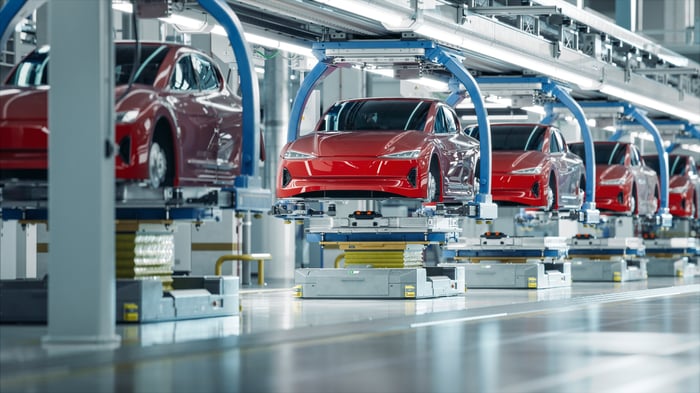
Image source: Getty Images.
What could go wrong
Just about anything and everything could go wrong with this plan.
First of all, the timing of Ford's announcement -- which comes as President Donald TRUMP is doing away with the federal EV subsidies that have helped boost demand -- is really unfortunate. If consumer demand for EVs slides, Ford could be stuck with a reconfigured plant churning out affordable vehicles that not enough people are buying.
Even if EV demand persists, unforeseen circumstances could prevent the new assembly process from fully delivering the expected efficiency and cost savings, which would mean Ford had sunk an additional $5 billion into its Model E division with nothing to show for it.
It won't happen soon
These changes won't happen overnight: Ford is suggesting that it will be 2027 before the first vehicle made at the reconfigured Kentucky plant rolls off the assembly line. That seems like a pretty optimistic timeline, and it's the earliest investors would likely see any boost to the company's stock as a result of this announcement.
So, even if Ford can make it happen, it means we won't get a clear sense of whether this $5 billion investment will pay off until then.
In an ideal world, the new process will be wildly successful and Ford will be able to undercut its competitors on the prices of its electric vehicles, thus stopping the bleeding from its EV division, but as Farley said, that's far from a guarantee.
Investors would be wise to hold off on buying shares of this longtime market dud until the case for its turnaround is much stronger.
