Palantir CEO Alex Karp Drops 4 Words That BigBear.ai Investors Need to Hear Now

When Palantir's CEO speaks, markets listen—especially when his words could send shockwaves through AI rivals like BigBear.ai.
Here's why these four words matter more than earnings calls.
The AI Power Play You Missed
Karp’s cryptic phrasing—whether a taunt or a teaser—comes as defense-tech AI stocks ride a volatile wave. BigBear.ai bulls just got fresh ammunition… or a warning shot.
Decoding the CEO’s Game Theory
No slide decks, no jargon. Just four words that cut through the noise like a trading algo spotting weak hands. Institutional money’s already parsing the subtext.
The Cynic’s Take
Another ‘strategic vision’ from a billionaire who profits whether you FOMO or panic-sell. But this time, the stakes smell like defense contracts—and taxpayer billions.
Palantir is setting the pace to become the AI backbone for military operations
During the second quarter, Palantir's revenue surged 48% year over year to $1.0 billion. While that growth is impressive on its own, the finer details reveal just how deeply Palantir has embedded itself in the military operations pocket of the AI landscape.
The company's government segment grew 49% year over year, slightly outpacing overall growth. Drilling down further, Palantir's U.S. government revenue ROSE by an even stronger 53% -- reaching $426 million in the quarter. This momentum is supported by a string of high-profile Pentagon deals.
In March, Palantir partnered with defense contractorsand, along with autonomous systems specialist Anduril, in a $178 million U.S. Army deal to help build the Tactical Intelligence Targeting Access Node (TITAN) ground transportation system.
Just months later, the Army extended its relationship with Palantir, awarding a $795 million extension to continue using the company's Maven Smart System(MSS) platform -- bringing the total deal value above $1.2 billion.
More recently, Palantir further strengthened its public sector footprint with two additional contracts: a multiyear contract with the Army worth up to $10 billion, as well as a separate award to help develop a surveillance system for Immigration and Customs Enforcement (ICE).

Image source: Getty Images.
Why is this important for BigBear.ai investors?
During BigBear.ai's second-quarter earnings call, CEO Kevin McAleenan acknowledged that the company has "seen disruptions in federal contracts from efficiency efforts this quarter, most notably in programs that support the U.S. Army, as they seek to consolidate and modernize their data architecture."
Given the details outlined above, there's a strong possibility that the "disruptions" McAleenan referenced reflect Palantir winning these contracts. While BigBear.ai operates in some of the same broad fields as Palantir, such as AI analytics and machine learning, I think the comparison between the two companies is increasingly lopsided.
Each new government contract awarded to Palantir deepens its competitive moat. The company's Foundry and Gotham platforms are evolving into a comprehensive, integrated ecosystem for the public sector -- supporting a range of mission-critical needs.
Rather than true "network effects," Palantir is enjoying a cumulative competitive edge that's compounding with each deployment of its software -- ultimately broadening the company's footprint, strengthening its relationships, and making the cost of switching to competing platforms more costly.
These dynamics have effectively given Palantir a mini-monopoly on certain pockets of public sector deal flow, beyond the capacities of traditional defense contractors specializing in manufacturing hardware or equipment.
Is BigBear.ai stock a buy?
Karp's soundbite wasn't just swagger, nor was it merely aimed at short-sellers who have been betting against Palantir for years. It was a direct shot at every competing platform.
The 2025 stock chart reflecting Palantir and BigBear.ai tells a very different story.
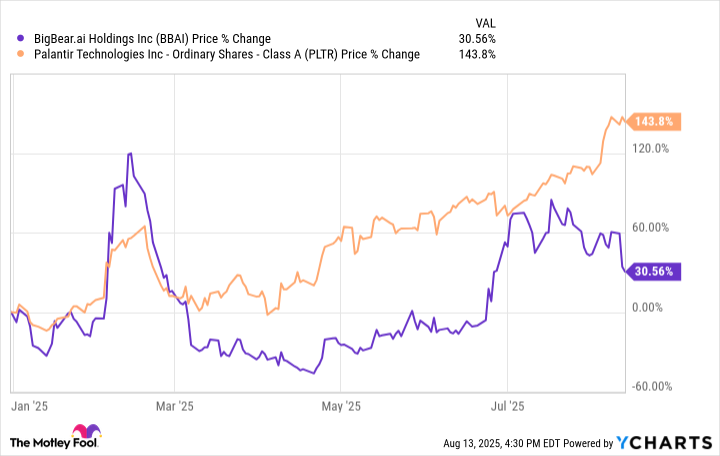
BBAI data by YCharts
Palantir has built steady momentum on the back of rising deal flow, translating directly into accelerating revenue and profitability. BigBear.ai, by contrast, has seen far more volatile price swings, with its moves often driven by HYPE and the hopeful narrative that it could one day become the "next Palantir."
That outcome appears increasingly improbable. Each new government contract Palantir secures widens the gap between it and smaller rivals struggling to keep pace.
For investors seeking exposure to AI's role in military operations, Palantir offers a proven track record over speculative counterparts such as BigBear.ai, whose traction remains more aspirational than tangible.
