Is Slate’s Electric Truck Already Obsolete Before Hitting the Road?

Another 'revolutionary' EV hits the skids before leaving the prototype phase. Slate's electric truck promised to disrupt—now it's just another cautionary tale in the graveyard of overhyped green tech.
Battery blues and production nightmares
Range anxiety meets Wall Street's short attention span. Slate's specs looked solid on paper, but real-world testing exposed fatal flaws. Meanwhile, Tesla's Cybertruck keeps eating their lunch—and the competition's margins.
Investors left holding the bag (again)
Another 'sure thing' EV play goes up in smoke—literally, if those thermal management rumors are true. But hey, at least the VC bros got their exit liquidity before the SEC filings dropped.
Bad timing
It sure seems like a rough time to launch an EV start-up company, with the TRUMP administration's steadfast desire to roll back EV incentives and even remove penalties for companies not meeting emissions standards. On the flip side, you could argue that it's a great time for Slate Auto to launch, as it tackles the industry's primary hurdle: Affordability.
As previously mentioned, Slate Auto became the latest company to raise the price of its vehicles before even delivering its first. One of the big selling points of the Slate truck was that you could configure a vehicle for under $20,000, including incentives and tax credits. However, with the EV tax credit going away, and the increased cost from tariffs on imported parts, the cost is now in the mid-$20,000s.
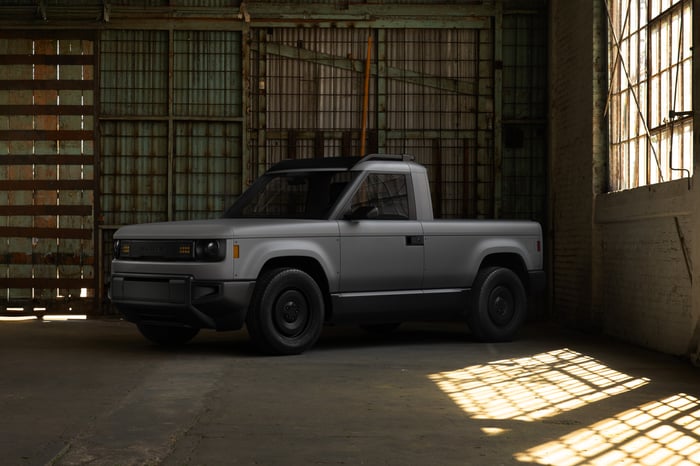
Image source: Slate Auto.
"People are looking at Slate because it's a throwback, with roll-up windows and no radio," said Sam Fiorani, vice president of global vehicle forecasting at AutoForecast Solutions, according to Automotive News. The company hopes buyers "will pay a little more for a better wrap, accessory panels, or anything that adds profit."
It's an impressive feat to produce a truck at such a price tag, much less an electric truck. Slate Auto deserves its applause, but in losing the EV tax credit and raising its price tag, it's now going to compete with a selection of combustion engine vehicles and hybrids at or around $30,000 with far more technology and equipment packed in.
One big-time example
If you're wondering what some of the competition could look like, take a quick glance at what(F -0.04%) has been up to recently. The company developed a small "skunkworks" team based in California that was dedicated to making a universal low-cost EV platform.
Ford is certainly hyping what's to come, calling Monday's announcement and unveiling a "Model T moment." Ford's first vehicle to launch on the new EV platform will be a midsize electric truck, closer to the size of the Maverick than the Ranger, due in 2027. It will be the first of potentially eight EV models to launch on the platform, and -- most importantly -- Ford says the $30,000 four-door electric truck will be profitable.
The company also made massive adjustments to its production process and changed its assembly line to be an "assembly tree," where three sub-assembly lines will run simultaneously before combining the parts at the end. It's a process that, along with other optimizations, should enable the plant to assemble the new EV platform 15% faster than current vehicles. It reduces parts by 20% versus a typical vehicle, with 25% and 40% fewer fasteners and workstations in the plant. This is important to generate profits from such a low-priced vehicle.
Dead on arrival?
Slate Auto and its vehicle are an intriguing development within the EV industry. Its bare-bones approach was refreshing, and there's little doubt it'll find a target consumer, although it's possible that it'll be more niche than mainstream. Slate said it has over 100,000 reservations in the U.S., but as reservations are secured with only a $50 refundable deposit, there's a good chance only a small percentage will be converted into orders.
Not only is Ford soon to release a highly competitive electric truck in 2027, bothandare launching electric crossovers next year at prices between $45,000 and $50,000, tens of thousands of dollars lower than their original models.
So, is Slate's truck dead on arrival? Without Slate being able to hold its core marketing selling point of a sub-$20,000 electric truck, the young EV Maker might find it really difficult to gain traction in the increasingly competitive and more affordable EV market. It's not dead on arrival, but there are serious reasons for concern.
