Warren Buffett Doubles Down: Why He’s Loading Up on Wall Street’s Most Undervalued Legal Monopoly (Again)

Buffett's latest move screams conviction—he's back for another bite of Wall Street's most overlooked cash cow.
### The Oracle's Unshakable Bet
No IPOs, no hype—just a boring, bulletproof business printing money under the radar. While crypto bros chase memecoins, Buffett quietly hoards shares like a squirrel before winter.
### Legal Moats Beat Volatility
Forget Bitcoin's rollercoaster—this monopoly controls a financial pipeline with zero competition. Regulators locked the door behind them decades ago. Now Buffett's collecting the keys.
### The Cynic's Footnote
Of course it's cheap—Wall Street ignores anything that can't be pumped on Twitter. But hey, those 10-K filings don't retweet themselves.

Berkshire Hathaway CEO Warren Buffett. Image source: The Motley Fool.
In instances when Berkshire Hathaway holds a 10% or greater stake in a public company, it's required to file Form 4 any time shares are acquired or disposed. Whereas a 13F simply provides the total number of shares purchased, sold, and held during a quarter, Form 4 allows investors to see how many shares were bought and sold, and at precisely what average price those shares were added to or sent to the chopping block.
Based on a fresh round of Form 4 filings, billionaire Warren Buffett is back to buying shares of his favorite (and cheapest) legal monopoly: satellite-radio operator(SIRI 0.38%).
Sirius XM's stock is historically inexpensive -- and there are reasons why
Based on a Form 4 filing with the SEC on Aug. 4, Buffett purchased 5,030,425 shares of Sirius XM stock from July 31 through Aug. 4, at an average price of $21.16 per share. For those you without calculators, we're talking about a roughly $106.5 million purchase for a company that's sitting on more than $344 billion in cash, cash equivalents, and U.S. Treasuries, as of the end of June.
With this latest purchase, Berkshire's stake in Sirius XM has grown to more than 124.8 million shares, or approximately 37.1% of its outstanding shares.
One of the lures of Sirius XM stock (I'll touch on potential catalysts in a bit) is its historically cheap valuation. With the "Buffett Indicator" (the market-cap-to-GDP ratio) recently hitting an all-time high, and the's Shiller price-to-earnings (P/E) Ratio achieving its third-priciest multiple when back-tested 154 years, finding value has been virtually impossible for Berkshire's brightest investment minds. However, Sirius XM's forward P/E ratio of 7 has proven tempting for the Oracle of Omaha.
But Sirius XM stock didn't lose 68% of its value over the trailing-three-year period by accident. It's declined because tangible headwinds have taken hold.
To begin with, Sirius XM is contending with a multiquarter decline in self-pay subscribers. Though this drop was only 68,000 in the June-ended quarter, which is an improvement over the prior-year period, this recent trend of declining self-pay subscribers has brought top-line growth to a halt.
Another clear concern for Sirius XM is weakness in the advertising arena. President Trump's tariff and trade policy is leading to uneasiness in the corporate realm and may be coercing some companies to pare back their marketing budgets. The end result for Sirius XM has been stagnant sales and profit during a rip-roaring bull market.
Warren Buffett's favorite legal monopoly has clear-cut competitive advantages
Make no mistake about it -- Sirius XM isn't the growth story it was in the late 1990s and early 2000s. But this doesn't mean it's ceded its competitive advantages.
Although it continues to vie for listeners with terrestrial and online radio providers, it remains the only licensed satellite-radio operator. Being a bona fide legal monopoly does afford Sirius XM a level of subscription pricing power that its peers can't match. Even though the number of self-pay subscribers has modestly declined in recent quarters, Sirius XM has levers it can pull to improve its sales through its pricing.
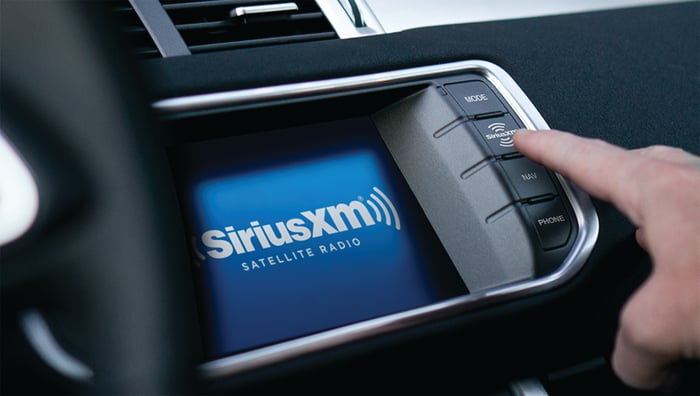
Image source: Sirius XM.
A second competitive edge Sirius XM Holdings has over other radio operators is its revenue mix. Nearly all terrestrial and online radio providers rely on advertising as their primary source of revenue. While this works great during long-winded periods of economic expansion, inevitable recessions can take their toll on traditional radio operators.
Through the first six months of 2025, Sirius XM generated roughly 20% of its net sales from advertising (via Pandora, which it acquired in 2019), while 77% of net sales traced back to subscriptions. When economic uncertainty creeps into the picture, businesses are more likely to cut back their marketing budgets than self-pay subscribers are to cancel their service. This leads to fewer peaks and valleys in Sirius XM's operating cash FLOW on a year-to-year basis than its peers.
Something else Sirius XM brings to the table that's unique from other radio operators is the partial predictability of its cost structure. Though royalties and talent acquisition costs are going to change from one quarter to the next, equipment and transmission costs are relatively static regardless of how many self-pay subscribers the company has. Assuming Sirius XM can reverse course with its self-pay subscriber count, this is a recipe for margin expansion.
While not a unique advantage, the final piece of the puzzle that makes Sirius XM an attractive stock to own is its capital-return program. Following a 68% slide in its share price, Sirius XM is supporting a 5% dividend yield. Furthermotr, its shares are being repurchased on a fairly regular basis, which should provide a lift to earnings per share over time.
