Warren Buffett Drops $344 Billion Bombshell on Wall Street—Will Anyone Listen?

Oracle of Omaha sounds the alarm—again. But will Wall Street’s dopamine-chasing traders care?
Buffett’s warning echoes like a gong in an empty trading floor. The $344 billion figure isn’t just a number—it’s a flashing neon sign over the casino.
Meanwhile, crypto traders shrug and buy the dip. Because nothing says ‘financial responsibility’ like leverage and memecoins.
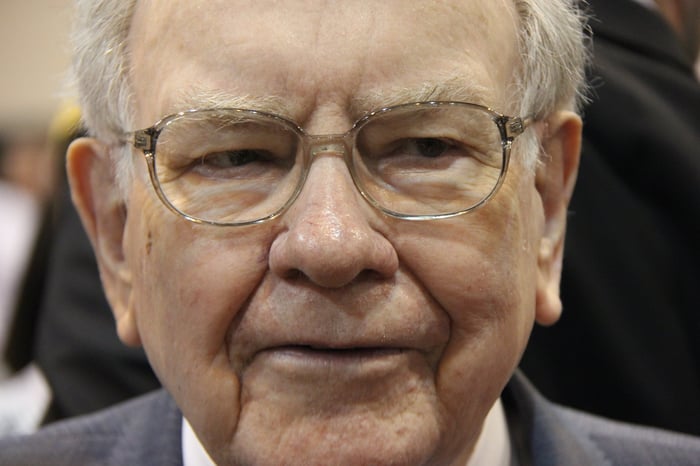
Berkshire Hathaway CEO Warren Buffett. Image source: The Motley Fool.
The Oracle of Omaha's warning to Wall Street is unmistakable
Berkshire Hathaway's more than 5,600,000% gain spanning six decades didn't occur by accident. It's a reflection of Buffett and his team, which included trusted right-hand man Charlie Munger until his passing in November 2023, laying the foundation for a business that can thrive in virtually any economic climate.
Since taking the lead role, the Oracle of Omaha has overseen in the neighborhood of five dozen acquisitions. He's also responsible for managing a $293 billion portfolio, which is spread across more than three dozen stocks. It's this portfolio that investors eye like a hawk.
Buffett has snagged some incredible deals hiding in plain sight during his tenure as CEO.,(BAC 0.25%),, andhave individually generated tens of billions of dollars in unrealized gains, to go along with bountiful dividend income. There's an expectation from investors that Berkshire's billionaire chief will continue to put his company's treasure chest to work in great businesses.
However, this expectation has fallen flat for nearly three years -- and it serves as an unmistakable warning to the investing community.
When Berkshire Hathaway lifted the hood on its quarterly operating results on Aug. 2, the company's cautious tone on tariffs took center stage. But there's another figure in Berkshire's report that's far more ominous and telling: $344.1 billion. This is the total cash, cash equivalents, and U.S. Treasuries Berkshire Hathaway had on its balance sheet when June ended.
Though this figure is actually 1% below the all-time high of $347.7 billion in cash, cash equivalents, and U.S. Treasuries reported at the end of March, it's more than triple the $105.4 billion that was on the balance sheet when June 2022 came to a close.
While positive operating cash FLOW from Berkshire's roughly five dozen owned businesses has provided a boost to the company's mammoth cash pile, being a net seller of stocks for 11 consecutive quarters, to the tune of $177.4 billion, is the primary culprit. Berkshire Hathaway's growing cash pile is plain-as-day evidence that Buffett is struggling to find value amid a historically pricey stock market.
Buffett's favorite valuation measure, the market-cap-to-GDP ratio (commonly known as the "Buffett Indicator"), hit an all-time of more than 210% in late July, which represents a nearly 150% premium to its average reading when back-tested to 1970. Berkshire's $344 billion treasure chest is a not-so-subtle warning from Buffett that premium stock valuations probably aren't sustainable.
Image source: Getty Images.
Patience is one of the most-powerful tools on Wall Street
There's certainly justification to the premise that stocks are incredibly pricey, beyond just the Buffett Indicator. The S&P 500's Shiller price-to-earnings (P/E) ratio, which is also known as the cyclically adjusted P/E Ratio, or CAPE Ratio, hit its third-priciest multiple during a continuous bull market when back-tested 154 years! It's truly become challenging to find price dislocations on Wall Street.
Though some investors are probably irritated by the Oracle of Omaha's lack of buying activity since October 2022, being patient and waiting for stock valuations to fall into his wheelhouse is a foundational aspect of Buffett's investing strategy.
Spanning 60 years, Buffett has seen a lot. He's navigated his fair share of bubbles and premium valuation events, as well as numerous bear markets and a handful of stock market crashes. Throughout these ebbs-and-flows, he's stuck to his thesis of never betting against America and has focused his attention on buying stakes in great businesses at a fair price.
At the end of the day, Buffett and his investment team are well aware that the U.S. economy and stock market tend to grow over time, which is why Berkshire Hathaway's investment portfolio is angled to take advantage of these disproportionately long periods of economic growth.
One of the best examples of Buffett's patience paying off handsomely for his company occurred in the summer of 2011. Shortly after the depths of the financial crisis, Berkshire's chief infused $5 billion into Bank of America in return for BofA preferred stock that yielded 6% annually. Though $300 million in annual dividend income was great, the real value in this deal was the BofA stock warrants Berkshire received.
During the summer of 2017, Berkshire exercised its warrants for 700 million shares of Bank of America common stock at $7.14/share. The day these warrants were exercised, Berkshire enjoyed a $12 billion windfall -- and shares of BofA have continued to climb since these shares were purchased.
Though there's uncertainty as to when Buffett or CEO successor Greg Abel will put a good chunk of Berkshire Hathaway's capital to work, there's no mistaking that this patient approach has been fruitful for the company and its shareholders.
