2 No-Brainer ETFs to Park $1,000 in Today and Forget About Until Retirement

Wall Street's worst-kept secret? These ETFs print money while you sleep.
The 'Set It & Forget It' Portfolio Starter Pack
Forget stock-picking—institutional money flows into these liquidity monsters daily. The $1,000 entry ticket gets you instant diversification (and better returns than most hedge funds charging 2-and-20).
Why Your Broker Hates These Two Tickers
They undercut active management fees by 90%—no overpaid analysts required. Perfect for investors who prefer compound growth over funding some fund manager's third vacation home.
Pro tip: The real magic happens when you stop checking your portfolio every 5 minutes.
Image source: Getty Images.
1. Vanguard S&P 500 ETF
The(VOO 0.73%), which mirrors the, is my largest holding and one I always recommend to investors of all types. The S&P 500 tracks 500 of the largest American companies on the stock market and has been one of the most consistent investments for decades.
The appeal of VOO to me is its diversification, proven results, and low cost. It's a trifecta that makes for a great long-term investment. With VOO giving more weight to larger companies (by market cap), it has become tech-heavy, but you can still count on it holding blue chip stocks from virtually every major sector.
These are the sectors represented in VOO:
- Information technology: 33.1%
- Financials: 13.9%
- Consumer discretionary: 10.4%
- Communication services: 9.8%
- Healthcare: 9.3%
- Industrials: 8.6%
- Consumer staples: 5.5%
- Utilities: 2.4%
- Real estate: 2.1%
- Energy: 3%
- Materials: 1.9%
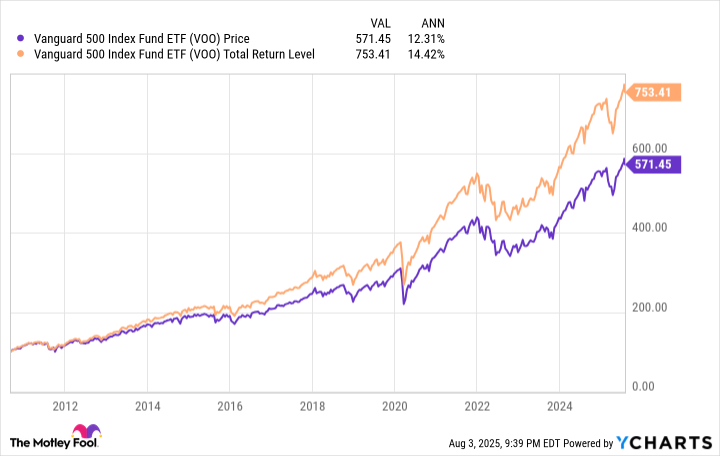
In these sectors, you have time-tested, well-established companies like,,,,, and plenty of others. This is a large reason for VOO's (and the S&P 500 in general) impressive long-term returns. The S&P 500 has averaged around 10% annual returns over the long term, but they have been higher since VOO's inception.
VOO data by YCharts
Even if VOO regresses to the S&P 500's historical average, its returns have been high enough to make investors meaningful money. And with its low 0.03% expense ratio, you can ensure most of these gains stay in your pocket, not Vanguard's.
2. Vanguard Dividend Appreciation ETF
Having a dividend-focused ETF can work wonders for your portfolio, especially if you're holding on to it for the long haul and letting compound earnings work its magic. That's why the(VIG 0.43%) is a good go-to.
It's one thing for an ETF to have dividend stocks; it's another (more lucrative) thing when those dividend stocks are intentional about increasing their annual payouts. VIG focuses on the latter. To make the cut for the ETF, companies must have increased their annual dividend for 10 consecutive years.
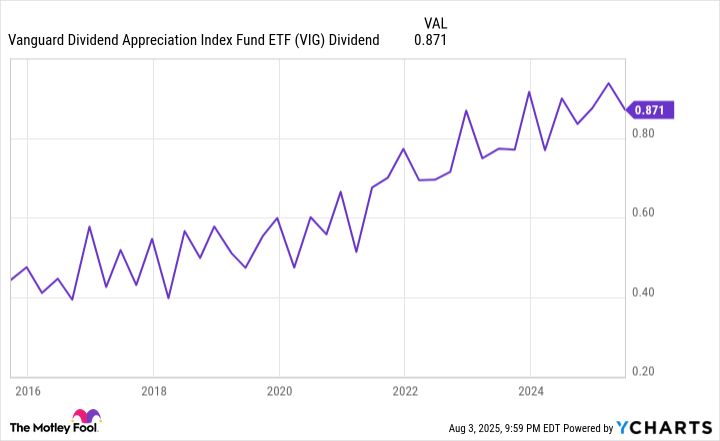
VIG has averaged a modest 1.88% dividend yield over the past decade, but its dividend payout has nearly doubled in that time. The amount of the payouts will vary because the different companies in the ETF have different pay schedules, but the overall trend has remained upward.
VIG Dividend data by YCharts
The tech sector is still the most represented in VIG, but financials (22.7% of the ETF), healthcare (15.1%), industrials (11.2%), and consumer staples (10.4%) round out the top five.
VIG's total returns have lagged behind the S&P 500's over the past decade -- 209% versus 254% -- but it's well-suited for investors looking for reliable income and less volatility (at least historically).
At the current pace of its dividend increases, I wouldn't be surprised if VIG's dividend payouts double over the next decade, as they have in the past decade.
