Interest Rates Set to Make Historic Move Since December 2024 – Brace for Stock Market Shockwaves

Buckle up, traders. The Fed's about to flip the script.
For the first time in eight months, interest rates are poised to do something unprecedented—and Wall Street isn't ready. When central bankers last pulled this maneuver in December 2024, the S&P 500 ripped 15% in six weeks. History doesn't repeat, but it sure loves rhyming.
The coming rate pivot could spark the mother of all liquidity rotations. Tech stocks? Crypto? Old-school value plays? The market's about to place its bets—and somebody's retirement fund is getting sacrificed at the altar of monetary policy.
Funny how 'data-dependent' decisions always seem to benefit the same hedge funds, isn't it?
Image source: Getty Images.
Interest rate cuts could resume in September
The inflation surge in 2022 was driven by a combination of factors stemming from the pandemic. The U.S. government injected trillions of dollars into the economy during 2020 and 2021 to offset the negative effects of lockdowns and social restrictions. At the very same time, the Fed slashed the federal funds rate down to a historic low of 0.13%. The central bank also launched a multi-trillion-dollar quantitative easing (QE) program to support the financial system.
To top things off, everyday products were in short supply as factories closed all over the world to stop the spread of the virus, which sent prices surging.
The Fed started raising the federal funds rate in March 2022, and it reached a two-decade high of 5.33% at the time of the last hike in August 2023. The central bank hoped this policy shift WOULD bring inflation down by reducing economic activity, and it seems to have worked. The CPI increased by 4.1% in 2023 and then by 2.9% in 2024, so it was clearly trending toward the Fed's 2% target.
That's why the central bank felt confident in cutting interest rates three times between September and December last year, bringing the federal funds rate down to 4.33%. But with the CPI now at an annualized rate of 2.7%, the's FedWatch tool suggests that there could be additional rate cuts in September, October, and December this year.
In fact, FedWatch suggests that Wall Street is pricing in an 81.5% chance of a cut in September, up from a 64% chance just one month ago. What changed? On Aug. 1, the Bureau of Labor Statistics (BLS) released its monthly non-farm payrolls report, showing that the U.S. economy added just 73,000 jobs during the month of July.
It was much lower than the 110,000 jobs economists were expecting, and to make matters worse, the BLS revised the May and June numbers down by a combined 258,000 jobs. In other words, the U.S. economy might be performing far worse than most Wall Street analysts and economists thought, hence the growing calls for lower interest rates.
Interest rate cuts often send jitters through the stock market
Conventional wisdom suggests lower interest rates are good for the stock market. They allow companies to borrow more money to fuel their growth, and smaller interest payments can boost their profits. Moreover, declining interest rates reduce the yield on risk-free assets like cash and Treasury bonds, pushing investors into growth assets like stocks. All of these things are tailwinds for the S&P 500.
However, a rapid decline in interest rates can also make investors nervous, because it would be a sign of weakness in the economy. Businesses might halt capital investments in that scenario, especially if they see cracks in consumer spending. That would be bad news for corporate earnings and potentially send the stock market lower.
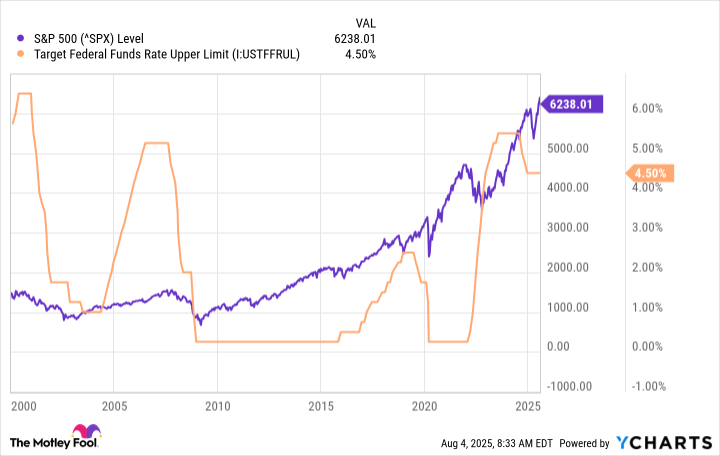
In fact, every time the Fed cut interest rates sharply over the last 25 years, a correction in the S&P 500 followed.
^SPX data by YCharts.
There were unique circumstances surrounding each of the above easing cycles from the Fed. The dot-com internet bubble burst in 2000, followed by the global financial crisis in 2008, and then the pandemic in 2020, so interest rate cuts didn't cause the stock market declines. However, it's clear that many investors will temporarily exit the market in the face of economic uncertainty, even with interest rates coming down.
Look out for more economic weakness
Economic crashes are difficult to predict, and so are garden variety recessions. But economists atrecently said a decline in labor demand of the magnitude we saw in the July jobs report on Aug. 1 -- along with the revisions for May and June -- is a recession warning signal.
Economist Mark Zandi from Moody's Analytics is even more concerned, saying outright that the U.S. economy is on the precipice of a recession following last week's employment report. He also points to flat consumer spending, and declines in construction and manufacturing spending, to support his view.
If those experts are right, then the Fed is likely to continue cutting interest rates in September. If the economic weakness flows through to corporate earnings, then we could see a sharp correction in the S&P 500 at the very same time.
I'm not suggesting investors should sell stocks right now. The index enters a bear market (a decline of 20% or more) once every six years, on average, so volatility is a normal part of the investing journey. History proves that the S&P always recovers to set new highs given enough time. So any weakness will probably be a buying opportunity for long-term investors, rather than a reason to panic.
