Uber’s Bold Autonomous Gamble: How Self-Driving Tech Could Reshape Its Destiny by 2025

Uber's doubling down on autonomy isn't just about ditching drivers—it's a high-stakes pivot that could flip its entire business model. The ride-hailing giant's quietly been funneling millions into self-driving R&D while Wall Street obsesses over quarterly earnings.
The silent revolution under the hood
While investors fret about profitability, Uber's autonomous division has been clocking millions of test miles. The play? To eventually slash the 70-80% of fares that currently go to human drivers—a margin boost that'd make even the most cynical VC drool.
Regulatory speed bumps ahead
Don't expect robotaxis overnight. Cities are pushing back, safety concerns linger, and that pesky 'humans are unpredictable' variable won't disappear. But if Uber cracks the code? They'll have built the ultimate moat—one that even Lyft's copycats can't easily bridge.
The bottom line: This isn't just about replacing drivers—it's about rewriting the rules of urban mobility. And for once, Silicon Valley's 'move fast and break things' mantra might actually pay off. (Unless, of course, they break the wrong things—then it's just another line item in their impressive history of burning cash.)
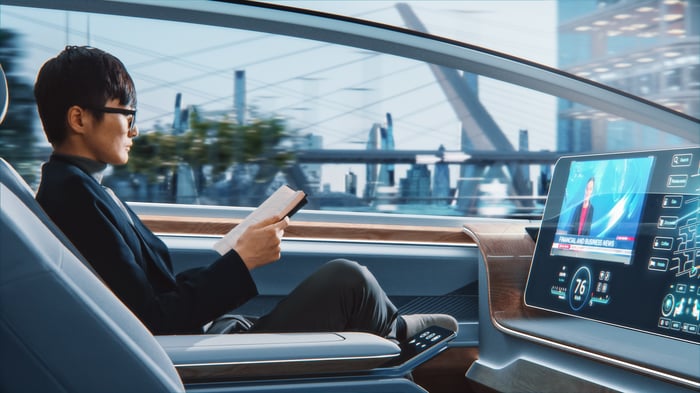
Image source: Getty Images.
Uber's strategic pivot on autonomous driving
Uber's original plan for autonomous driving was bold -- to develop its self-driving technology to replace human drivers. However, that strategy proved too challenging to achieve due to the huge requirements for capital and talent. In 2020, Uber sold its Advanced Technologies Group to, signaling a pivot toward a more focused, asset-light approach.
Instead of creating its technology, Uber now partners with leading autonomous vehicle (AV) companies, including Waymo, Pony.ai, Wayve, and's Apollo Go. These partnerships enable Uber to deploy autonomous rides in major global cities across the U.S., U.K., China, and the Middle East. For instance, Uber and Waymo have started offering autonomous ride-hailing services in Austin and Atlanta, and are likely to launch services in more cities soon.
This shift isn't just pragmatic -- it's strategic.
Uber is betting that the real value in autonomy lies in aggregating demand, not building AVs. By focusing on its platform -- including the rider experience, matching algorithms, routing, and payments -- Uber becomes the layer that autonomous vehicle providers plug into to reach riders. If AVs succeed at scale, Uber stands to benefit without owning the risk or cost of building them.
Autonomy could reshape Uber Mobility's long-term profitability
Today, Uber's most significant cost -- by far -- is driver payouts, accounting for around 70% of the cost of each ride. If even a small portion of ride volume shifts to autonomous vehicles, Uber could unlock dramatically higher margins over time.
Think of it this way: Every driverless mile is a chance for Uber to retain more of the fare. Combine that with the scalability of AV fleets and the ability to operate 24/7, and Uber's transition to AVs could significantly boost its long-term take rate.
Of course, Uber will share the additional revenue with partners like Waymo and also cover other costs, such as maintenance. Still, the transition from driver-operated vehicles to driverless vehicles is likely to be beneficial in the long term, given their lower cost structure and productivity gains.
Autonomy beyond ride-hailing
Uber isn't limiting autonomy to ride-hailing. It's also deploying robotic delivery bots to deliver food and products through partnerships with Avride, Coco, and Serve across multiple cities, including Miami, Dallas, and Jersey City.
The idea is straightforward: In densely populated urban areas, where short deliveries are common and labor costs are high, robots can deliver food and small packages more efficiently than humans. These bots are cheap to operate, don't require tips, and can run around the clock.
While it is still early days for Uber as it experiments with robotic delivery, the potential implications for Uber Eats are significant. Delivery has always been a tricky business with low margins. Therefore, with robots handling low-complexity, short-haul deliveries -- such as coffee and snacks -- Uber could significantly reduce its last-mile costs and improve delivery profitability.
And just like its AV strategy, Uber doesn't need to build the bots. It just needs to integrate them into its platform and optimize delivery flows using the data and infrastructure it already owns. Over time, this could enable scalable, autonomous logistics that go beyond food -- including pharmacy, retail, and even hyperlocal e-commerce.
Uber's ambitions don't stop at passengers or burritos. It's also piloting autonomous freight with Aurora to deploy driverless truck trips on public roads. While still early, it signals Uber's vision to automate the entire logistics stack -- from the first mile to the last.
What it means for investors
Uber's bet on autonomy prepares it for its next growth stage. Instead of trying to outperform the AV companies, Uber is positioning itself to profit no matter who wins the AV race. By closely anchoring itself to end users, Uber ensures it remains indispensable in the transportation value chain, with or without drivers.
Investors looking to bet on the rise of autonomy should closely track Uber.
