QUBT Uncovered: What’s Behind the Hype – and Should You Buy the Stock Now?

Quantum computing just got a ticker symbol. QUBT—Quantum Computing Inc.—claims it's bringing quantum power to the masses. But is this stock a quantum leap or just another speculative bubble?
The Quantum Pitch: QUBT sells itself as the 'democratizer' of quantum computing, offering cloud-based access and software tools. No PhD required—just a credit card and a dream.
The Reality Check: While quantum computing could revolutionize everything from drug discovery to portfolio optimization (Wall Street's already salivating), most experts agree we're years away from practical applications. QUBT's revenue? As entangled as Schrödinger's cat—both there and not there.
Why Traders Care: The stock's been bouncing like a qubit between energy states—perfect for day traders who think 'decoherence' is a new technical indicator. Meanwhile, institutional investors treat it like quantum superposition: they're both long and short until you measure their 13F filings.
The Bottom Line: In a market where 'blockchain' and 'AI' stocks print money until they don't, QUBT offers the ultimate speculative cocktail: futuristic tech plus unproven business model. Just remember—in quantum physics and penny stocks, observation changes the outcome. (And by 'observation,' we mean that SEC filing coming next Tuesday.)

Image source: Getty Images.
What does Quantum Computing Inc. actually do?
Quantum Computing Inc. (QCI) is developing photonic technology that leverages light and its quantum mechanical properties for high-performance computing applications, including quantum computing, machine learning, cybersecurity, and others.
The company states that photonic technology is capable of high bandwidth and fast processing while consuming low amounts of energy, and can operate in room-temperature environments. That could make it more practical and affordable than some traditional quantum computers, which often require low temperatures or lab-controlled environments.
QCI's long-term goal is to become anof sorts, selling chips integrated with photonic circuits for various real-world applications.
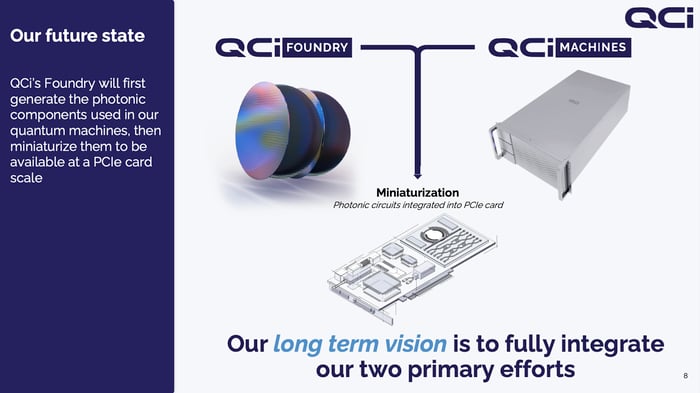
Image source: Quantum Computing Inc.
Most of today's chips are made from silicon. QCI is building with thin-film lithium niobate (TFLN). The company recently established a foundry to produce the TFLN components for its quantum machines. Eventually, it aims to refine the technology and miniaturize it to the size of an Nvidia GPU.
The business is far more potential than tangible results, at least for now
Now might be a good place to pump the brakes a bit, as Quantum Computing Inc. is an extremely early-stage company.
QCI recently completed construction of its foundry and has received only five orders as of the first quarter of 2025. The company offers hardware products and software services, but QCI's current customer base is primarily limited to government and academic researchers.
As a result, the business has generated about $385,000 in total revenue over the past year. Yes, that's less than half a million dollars. There is no quick ramp-up looming, either. Wall Street analysts expect Quantum Computing Inc. to finish 2025 with $600,000 in revenue and just $2.9 million the following year.
Research by Mordor Intelligence estimates the addressable market for photonic integrated circuits was $15.4 billion in 2024 and projects it will grow to $38.4 billion by 2029. Given QCI's virtually non-existent revenue, it's clear that the company is not yet ready to capitalize on the opportunity.
Meanwhile, QCI has numerous competitors in the space, including,, and.
Is the stock a buy now? Putting all of this together
It may take at least a few more years to gain a clear understanding of Quantum Computing Inc.'s position in the Photonic Integrated Circuit industry or the broader quantum computing market. That means investors who buy the stock today are taking a massive leap of faith in the company.
Such limited revenue makes the stock's current $2.6 billion market cap, roughly 90 times next year's revenue estimate, tough to stomach. It leaves investors at risk of severe losses if something happens to the company that sours the market's sentiment.
Quantum Computing Inc. may be trying to replicate Nvidia's business, but its limited revenue suggests it's lagging in the Photonic Integrated Circuit field, rather than leading it. Consider allowing Quantum Computing Inc. to prove itself, establish a larger revenue base, and then reevaluate the stock's investment potential. It's just not there yet.
