Fed’s Powell Drops Bombshell Warning - History Reveals Stark Pattern of What Comes Next

Jerome Powell just sent shockwaves through financial markets with his starkest warning yet. The Federal Reserve chair's message cuts through Wall Street's usual optimism like a chainsaw through butter.
Markets Brace for Impact
Historical patterns don't lie. When central bankers speak this bluntly, markets typically react within 48 hours. We've seen this movie before - and the ending rarely surprises anyone paying attention.
The Crypto Wildcard
While traditional assets shudder, digital currencies often march to their own beat. Bitcoin's decoupling from mainstream finance could prove decisive here. Smart money's already positioning for volatility.
Wall Street's Selective Hearing
Bankers will nod solemnly while quietly doubling down on risky bets - because nothing teaches lessons like losing other people's money. The real question isn't if markets will react, but how severely they'll overcorrect.
One thing's certain: when the Fed talks this tough, everyone should listen. Even the crypto rebels.

Image source: Getty Images.
The Fed's latest moves
Let's consider the Federal Reserve's latest moves. For months, investors had been monitoring both the stock market and economic data and hoping for a fresh cut in interest rates. The Fed initially took action last year, beginning a series of rate cuts in September, but didn't continue that movement until this month. In the first cut this year, on Sept. 17, the Fed lowered its key rate by a quarter point and indicated that two more may be coming before the end of the year.
Investors generally appreciate such moves because lower interest rates are supportive of corporate earnings and overall economic growth. Lower lending rates cut costs for companies that take on debt, and may ease the pressure on individuals who have mortgages or credit card debt, for example. So, this current interest rate momentum, with rates heading lower, is favorable for companies and the stock market.
Amid this positive backdrop, though, trouble could be brewing. In fact, Powell recently pronounced six words that may be seen as a warning to Wall Street.
Speaking about financial conditions, Powell said: "Equity prices are fairly highly valued." Though he added that right now isn't "a time of elevated financial stability risks," the warning rings out loud and clear. Stocks have become expensive.
The S&P 500 Shiller CAPE ratio
We can see this in the S&P 500 Shiller CAPE ratio, an inflation-adjusted look at stock prices in relation to earnings over a 10-year period. The ratio has reached beyond 37 twice this year -- it's only reached that level two other times since the S&P 500 launched as a 500-company index in the late 1950s.
What happens next? History shows us that every time the Shiller CAPE ratio has reached such a high, the S&P 500 has gone on to fall.
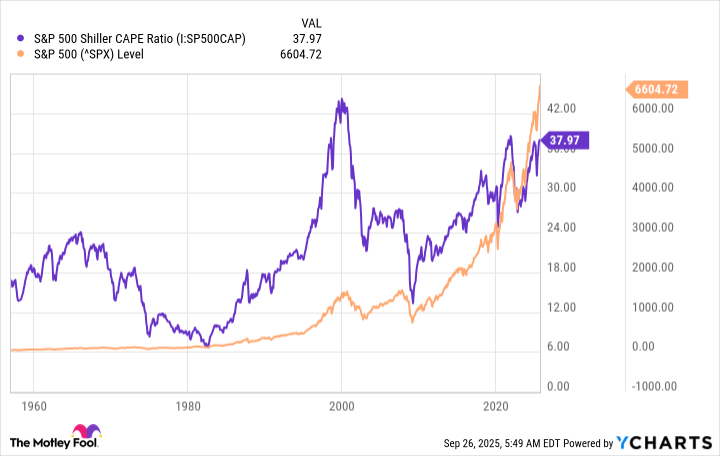
S&P 500 Shiller CAPE Ratio data by YCharts.
In some instances, this has been a short correction, while in others, it's taken a while for the index to recover and advance. So, if history is a guide, with stocks at historically pricey levels, the S&P 500 could be heading for a decline.
The silver lining
But before you worry about your portfolio losing value, read on. A couple of silver linings exist in this potentially dark cloud. First, we don't know exactly when a pullback will happen -- it could be right around the corner or a year from now -- and it could be short-lived. So, it may not represent a near-term risk, and when it eventually happens, the effects may be limited.
Second -- and this is the most important point -- whenever the next big decline hits, it will be temporary. History also shows us that after every market downturn, and even after major crashes, the S&P 500 has always recovered and eventually climbed to new record highs. We've seen those record highs in recent days.
All of this is fantastic news for long-term investors, because it means that even if your portfolio suffers during a market decline, if you hold on, your investments are likely to recover and deliver positive results over time. This should ease your mind, even after Powell's warning to Wall Street.
