Is Uphold a Crypto Wallet? Understanding Digital Asset Management in 2026

- What Exactly Is a Crypto Wallet?
- Custodial vs. Non-Custodial: Understanding the Key Differences
- Uphold's Unique Hybrid Approach
- Hot vs. Cold Storage: Understanding Wallet Security
- Why Wallet Choice Matters in 2026
- How Uphold Compares to Other Wallet Solutions
- Making the Right Wallet Choice for Your Needs
- The Future of Crypto Wallets
- Frequently Asked Questions
The world of digital finance and cryptocurrencies is rapidly changing, and so understanding crypto wallets are crucial for anyone interested in working with virtual coins. While Uphold has gained a singularity in creating a bridge between the world of traditional finance and digital assets, could it really be called crypto wallet? This guide dives deep into everything you need to know about the wallet capabilities of Uphold, security aspects and how it holds up against other solutions in 2026.
What Exactly Is a Crypto Wallet?
Crypto Wallet — Your gateway to the blockchain ecosystem These digital interfaces do not contain physical paper cash like traditional wallets; rather they represent the cryptographic key that establishes ownership of your assets and allows them to be transferred across many different blockchain networks. Now, crypto wallets serve not only as storage tools but financial management platforms in their own right.
The key to any crypto wallet is how it handles your private keys: unique pieces of cryptographic information that allow you to authorize transactions on the blockchain. There are generally two key forms namely private keys; which should be kept confidential and public keys (which is your wallet address that everyone uses to send you coins). These are now often merged into a more user-friendly recovery seed phrase that is typically of 12-24 words in order.
Key Wallet Components
| Component | Function |
|---|---|
| Private Key | Authorizes outgoing transactions (like a digital signature) |
| Public Key | Your public wallet address for receiving funds |
| Recovery Seed | Backup phrase to restore wallet access if lost |
Contemporary wallets offer far more than just storage. Many now integrate with decentralized applications (dApps), support staking operations, and provide portfolio tracking across multiple blockchains. The wallet you choose significantly impacts your security, convenience, and access to various blockchain services.
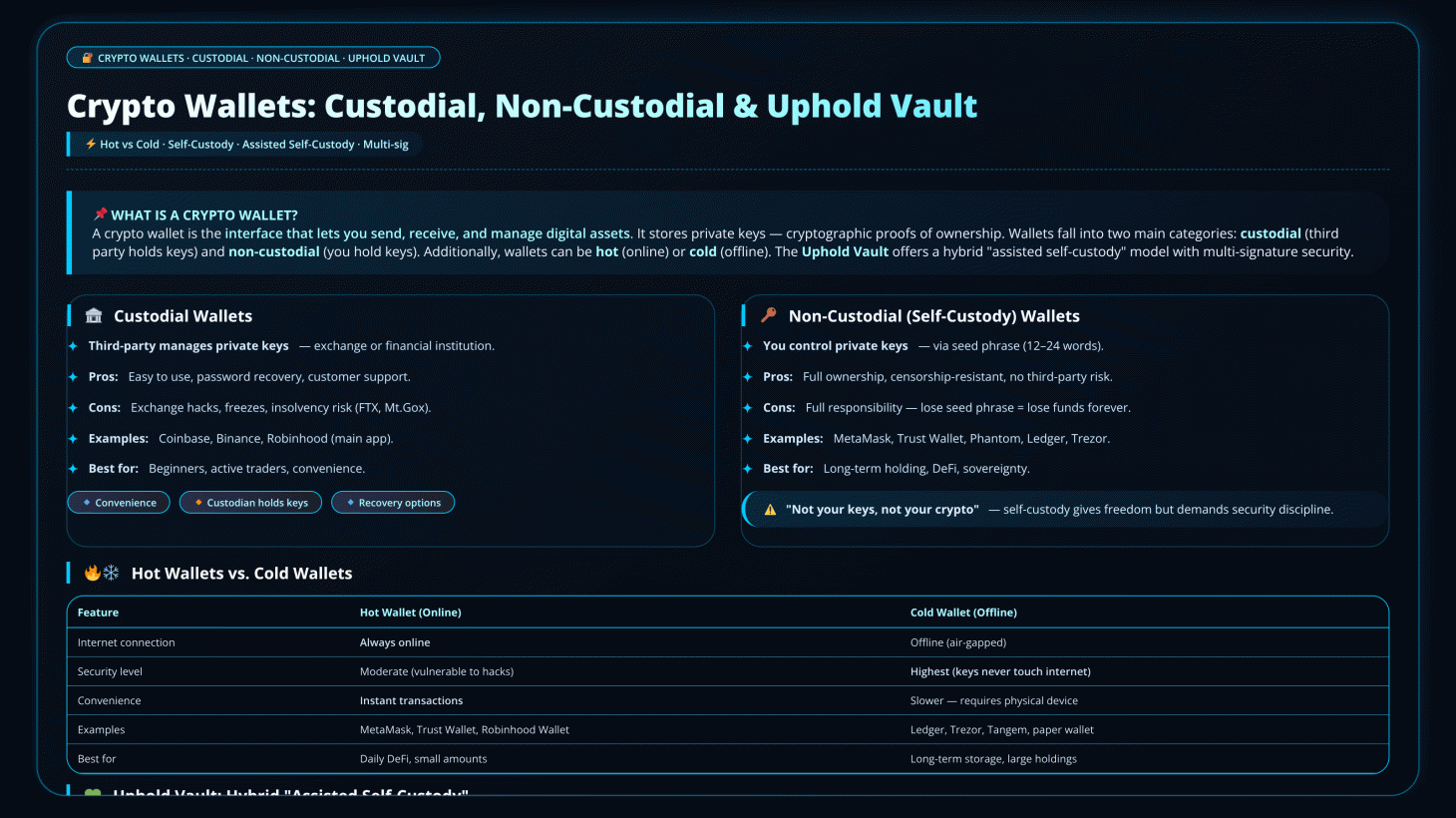
When selecting a wallet, consider these critical factors: security features, supported assets, user interface complexity, and integration with other services you might use. The right wallet balances security with convenience based on your technical expertise and how actively you manage your crypto assets.
Custodial vs. Non-Custodial: Understanding the Key Differences
The cryptocurrency wallet ecosystem presents users with two fundamentally different approaches to asset management: custodial and non-custodial solutions. These models represent opposite ends of the convenience-control spectrum, each with distinct advantages and trade-offs that cater to different user needs and technical competencies.
Custodial Wallets: The Beginner-Friendly Option
Custodial wallets are like banking services — they keep your private keys for you, trusting a third party. This is the type of model used by most major places like Coinbase, Binance and even Uphold's standard wallet. The main advantages are easier account recovery (via custodian channels) and less individual responsibility for security management. But this convenience does not come without sacrifice; users are forced to put faith in the platform's security protocols and operational ux. Records from CoinMarketCap show that nearly 65% of new cryptocurrency merchants to begin with use custodial solutions due to their higher interface and anonymous recovery instrumentality.
| Feature | Custodial Wallets |
|---|---|
| Key Management | Handled by service provider |
| Recovery Options | Password reset through support |
| Security Responsibility | Primarily with the platform |
| Best For | Beginners and casual investors |
Non-Custodial Wallets: Full Financial Sovereignty
For true ownership of your cryptocurrency, you will want to use some non-custodial solution like MetaMask / Ledger devices (follow on this topic most likely) or Uphold's vault feature. These systems give users seed phrases (normally 12–24 words) that are the final key to their assets. This alternative allows the complete independence of capital from a central authority while also creating no counterparty-risks, however it does come with higher technical knowledge and personal accountability. Thus, if a seed phrase is lost on the blockchain, it literally and permanently locks out that money. According to TradingView data, experienced traders and long-term holders steadily choose non-custodial formats — adoption grows about 40% annually compared with the preceding year since 2021.
| Feature | Non-Custodial Wallets |
|---|---|
| Key Management | User-controlled via seed phrase |
| Recovery Options | Only through personal backup |
| Security Responsibility | Completely with the user |
| Best For | Advanced users and self-custody advocates |
The decision really comes down to what your personal priorities are. Users who prefer convenience and ease-of-use generally go for custodial solutions while users whose priority is security & control, lean towards non-custodial. Hybrid solutions such as Uphold's Vault provide a possible bridge between both worlds by utilizing multi-signature to make the users majority owners, but also providing some platform insurance.
Uphold's Unique Hybrid Approach
Uphold's innovative Vault system redefines digital asset management through a unique multi-party authorization framework. This advanced security model operates on three distinct cryptographic layers:
The system's architecture delivers several operational benefits:
| Characteristic | Practical Advantage |
|---|---|
| Distributed authorization | Eliminates reliance on any single authentication element |
| Contingency access | Assets remain available during service interruptions |
| Security framework | Balances user autonomy with institutional safeguards |
This solution represents a significant evolution in digital asset management, combining the security advantages of decentralized control with the practical benefits of institutional infrastructure. The Vault's design specifically addresses the challenges of key management that often deter mainstream adoption of cryptocurrency technologies.
The platform's integration enables seamless transitions between secure storage and active trading environments, creating a unified financial ecosystem. This represents a departure from traditional wallet models that require manual transfers between separate storage and trading platforms.
Uphold's approach demonstrates how financial technology can adapt blockchain principles to create more accessible yet secure digital asset management solutions for diverse user needs.
Hot vs. Cold Storage: Understanding Wallet Security
Cryptocurrency storage solutions can be broadly categorized based on their connectivity, with each type offering distinct advantages for different use cases. The fundamental distinction lies in their operational environment and corresponding security implications.
Comparative Analysis of Storage Methods
| Feature | Connected Solution | Disconnected Solution |
|---|---|---|
| Accessibility | Immediate transaction capability | Requires physical connection |
| Vulnerability | Exposed to network threats | Isolated from online attacks |
| Transaction Speed | Real-time execution | Delayed processing |
Connected storage solutions maintain constant network accessibility, facilitating rapid transfers and exchange operations. These platforms are particularly suited for active market participants who require instantaneous execution of trades. The trade-off for this convenience is heightened exposure to potential security breaches.
Disconnected storage mechanisms provide the highest security tier by completely isolating cryptographic keys from online environments. This category includes specialized hardware devices and physical documentation methods. While offering superior protection against digital threats, these solutions introduce latency in fund accessibility that may not suit time-sensitive operations.
Modern platforms have developed intermediate solutions that incorporate elements from both approaches. These hybrid systems employ advanced cryptographic techniques to maintain security while preserving reasonable accessibility. Such implementations often feature multi-factor authentication protocols and distributed authorization frameworks to mitigate risks.
Security experts generally advocate for a tiered storage strategy, allocating assets across different solutions based on usage frequency and value. This approach optimizes both protection and operational flexibility, allowing users to balance security requirements with transactional needs.
Why Wallet Choice Matters in 2026
The cryptocurrency landscape has evolved dramatically, making wallet selection a critical decision for both novice and experienced users. Security remains paramount as hacking techniques grow increasingly sophisticated. Modern wallets now serve as essential gateways to decentralized finance (DeFi) applications, while also offering advanced asset management features like staking, swapping, and comprehensive portfolio tracking.
Uphold's hybrid solution stands out in this competitive space by combining traditional financial services with cutting-edge crypto functionality. Their platform allows seamless management of fiat currencies alongside precious metals and digital assets, creating a unique value proposition for users seeking diversified financial tools in one interface.
| Wallet Feature | Traditional Finance | Crypto-Native Solutions | Uphold's Approach |
|---|---|---|---|
| Asset Types | Limited to fiat | Crypto-only | Multi-asset integration |
| Security Model | Bank-level | Self-custody | Hybrid key management |
| DeFi Access | None | Full access | Selective integration |
When evaluating wallet options, users should consider several key factors. The interface should match their technical proficiency, with clear navigation and intuitive controls. Asset support must encompass all cryptocurrencies of interest, plus any traditional assets they wish to hold. Most importantly, users must find the right balance between convenience and control, as these factors often exist in tension within wallet design.
The BTCC team notes that wallet technology continues advancing rapidly, with new solutions emerging regularly. However, fundamental principles of security and usability remain constant. Users should prioritize wallets with proven track records and transparent operational practices, while still considering innovative features that enhance functionality.
How Uphold Compares to Other Wallet Solutions
When comparing Uphold to other cryptocurrency platforms in 2024, several distinctive features emerge that set it apart from competitors. The platform's unique combination of asset diversity and flexible custody options creates different value propositions compared to both exchange-based services and specialized wallet solutions.
Uphold Compared to Exchange Platforms
Unlike conventional exchange services, Uphold offers integrated access to multiple asset classes beyond digital currencies. This includes precious metals and foreign exchange markets, providing users with broader investment opportunities within a single account structure.
| Platform Aspect | Uphold Characteristics | Exchange Characteristics |
|---|---|---|
| Supported Markets | Multi-asset ecosystem | Primarily crypto-focused |
| Conversion Options | Cross-asset trading pairs | Crypto-to-crypto only |
| Account Structure | Unified asset management | Separate trading accounts |
Traditional exchanges often provide more sophisticated trading interfaces and analytical tools, catering to active market participants. However, Uphold's streamlined conversion system between different asset types offers convenience that specialized exchanges can't match.
Uphold Versus Specialized Wallet Solutions
Dedicated wallet applications focus primarily on blockchain interaction capabilities, particularly for decentralized applications and smart contract platforms. These solutions typically offer more extensive customization options for network fees and transaction parameters.
Uphold's platform emphasizes accessibility and financial integration, providing:
- Simplified fiat currency gateways
- Automated conversion services
- Hybrid security models
Market data indicates that Uphold supports a curated selection of digital assets compared to the open-ended compatibility of wallet solutions with certain blockchain standards. This reflects Uphold's positioning as a managed financial platform rather than a pure blockchain interface tool.
The decision between these platforms depends largely on user objectives. Those seeking comprehensive financial management with diverse asset exposure may prefer Uphold's approach, while users requiring direct blockchain interaction capabilities will likely choose specialized wallet applications.
Making the Right Wallet Choice for Your Needs
Navigating the cryptocurrency wallet landscape in 2024 demands strategic decision-making based on your investment goals and technical expertise. The BTCC research team has identified optimal wallet solutions tailored to different user profiles in the current market environment.
For those new to digital assets, managed wallet services provide the most accessible entry point. These solutions abstract away cryptographic complexities while offering customer support channels, making them ideal for first-time users who prioritize ease-of-use over complete control.
Intermediate users who engage in regular trading activities should evaluate multi-signature solutions that blend security with operational flexibility. These platforms enable faster asset movement between storage and trading environments while maintaining robust protection mechanisms through distributed key management.
Security-conscious investors with substantial holdings should prioritize air-gapped storage mechanisms. Physical devices that completely isolate cryptographic operations from networked environments offer the highest protection tier for assets intended for long-term preservation.
Critical selection criteria include:
| Usage Pattern | Optimal Solution | Primary Benefits | Considerations |
|---|---|---|---|
| Initial Exploration | Managed Services | User-friendly interfaces | Dependent on provider policies |
| Active Management | Multi-signature Platforms | Balanced security/access | Requires basic key management |
| Value Preservation | Offline Storage Devices | Maximum security | Reduced transaction speed |
Advanced key management systems represent a significant evolution in digital asset protection, offering configurable security parameters that adapt to different risk profiles. These solutions particularly benefit users who require periodic access to stored assets while maintaining strong safeguards against unauthorized transactions.
A diversified wallet strategy often proves most effective, allocating assets across multiple storage methods based on frequency of use and value. This approach combines the accessibility needed for active trading with the ironclad security required for long-term holdings, creating a comprehensive digital asset management framework.
The Future of Crypto Wallets
As we progress through 2026, several key trends are reshaping the cryptocurrency wallet landscape. The industry is witnessing significant advancements in both security and usability, driven by evolving regulatory frameworks and technological innovations. Three major developments stand out in particular:
- Regulatory clarity is accelerating the development of institutional-grade custody solutions, with more compliance-focused features being integrated into wallet designs.
- User interface improvements are making wallets more intuitive without compromising security, lowering barriers to entry for mainstream adoption.
- Cross-chain functionality has transitioned from being a premium feature to an industry standard, allowing seamless asset management across multiple blockchain networks.
These trends reflect the maturation of the cryptocurrency sector as it moves toward broader financial integration. Wallet providers are increasingly focusing on creating solutions that balance security with accessibility, while also addressing the growing demand for institutional-grade services. The standardization of cross-chain capabilities has been particularly transformative, eliminating many of the friction points that previously hindered multi-chain asset management.
Uphold's Vault technology exemplifies these industry shifts, combining elements of both custodial and non-custodial approaches to create what they term "Assisted Self-Custody." This hybrid model offers users greater control while maintaining robust security measures, positioning the platform well to meet evolving market demands. The multi-signature architecture and key recovery features address common pain points in self-custody, potentially setting a new benchmark for wallet security standards.
Looking at adoption metrics, the number of active cryptocurrency wallet users has grown steadily, with recent data showing:
| Year | Global Crypto Wallet Users | Year-over-Year Growth |
|---|---|---|
| 2023 | 85 million | 18% |
| 2024 | 102 million | 20% |
| 2025 | 125 million | 23% |
This growth trajectory suggests increasing mainstream acceptance of cryptocurrency wallets as essential financial tools. The industry's focus on improving user experience while maintaining strong security protocols appears to be paying dividends in terms of adoption rates. As wallet technology continues to evolve, we can expect to see further innovations in areas like decentralized identity management and integration with traditional financial services.
Frequently Asked Questions
Is Uphold a wallet or an exchange?
Uphold functions as both - it's a multi-asset platform that includes wallet functionality alongside exchange services for cryptocurrencies, fiat currencies, and commodities.
How secure is Uphold's Vault?
The Vault's multi-signature setup provides security comparable to many hardware wallets, while maintaining greater accessibility for regular transactions.
Can I use Uphold for DeFi applications?
While Uphold doesn't directly connect to DeFi protocols, you can transfer assets to compatible wallets that do support DeFi interactions.
What happens if Uphold goes out of business?
With the Vault's design, users retain control of their assets even if Uphold ceases operations, as only two of the three keys are needed to move funds.
Does Uphold insure cryptocurrency holdings?
Uphold maintains full reserves for all user assets and undergoes regular audits, but unlike FDIC insurance for cash deposits, cryptocurrency holdings aren't federally insured.
This article does not constitute investment advice. Cryptocurrency investments are volatile and high-risk.
References:https://uphold.com/learn/beginner/what-is-crypto-wallet
https://www.investopedia.com/terms/u/uphold.asp

Log in to Reply
Log in to comment your thoughtsComments
Related Articles
|Square
Get the BTCC app to start your crypto journey
Get started today Scan to join our 100M+ users