Is Trust Wallet Safe in 2026? A Comprehensive Security Review

- What Is Trust Wallet?
- How Does Trust Wallet Work?
- Key Security Features of Trust Wallet
- Trust Wallet vs. Competitors: Security Comparison
- Potential Security Risks
- Best Practices for Securing Your Trust Wallet
- Is Trust Wallet Safe? Final Verdict
- Frequently Asked Questions
As of 2026, Trust Wallet is still one of the most popular self-custody crypto wallets that gives users full control over their digital assets across more than 100 blockchains. But as cyber threats rise, one article you will come across is Trust Wallet Safe? is more relevant than ever. In this guide, we take a deep dive into the security features of Trust Wallet, compare it with competitors and offer you some best practices to help keep your crypto safe.
What Is Trust Wallet?
Trust Wallet — a leading non-custodial mobile crypto wallet, enabling users to safely store, manage and interact with digital assets as well as dApps (decentralized applications). This means that, unlike centralized exchanges where a third party manages your funds, Trust Wallet provides full access to private keys so you have complete control over how and when cryptocurrency is used by only allowing yourself access.
Originally developed in 2017 by Ukrainian software engineer Viktor Radchenko, Trust Wallet was created to simplify access to ethereum blockchain applications. The wallet gained significant traction and was acquired by Binance in 2018, though it continues to operate as an independent product focused on decentralization and user privacy.
Key features that make Trust Wallet stand out include:
| Feature | Description |
|---|---|
| Multi-chain Support | Supports 100+ blockchains including Bitcoin, Ethereum, Solana, and more |
| Asset Management | Can store over 10 million digital assets and NFTs |
| Security | Local private key storage with biometric authentication |
| DeFi Access | Built-in Web3 browser for decentralized applications |
The wallet's open-source nature allows for community audits and transparency, which has helped build trust among its user base. According to data from CoinMarketCap, Trust Wallet has become one of the most popular mobile crypto wallets with over 100 million downloads worldwide.
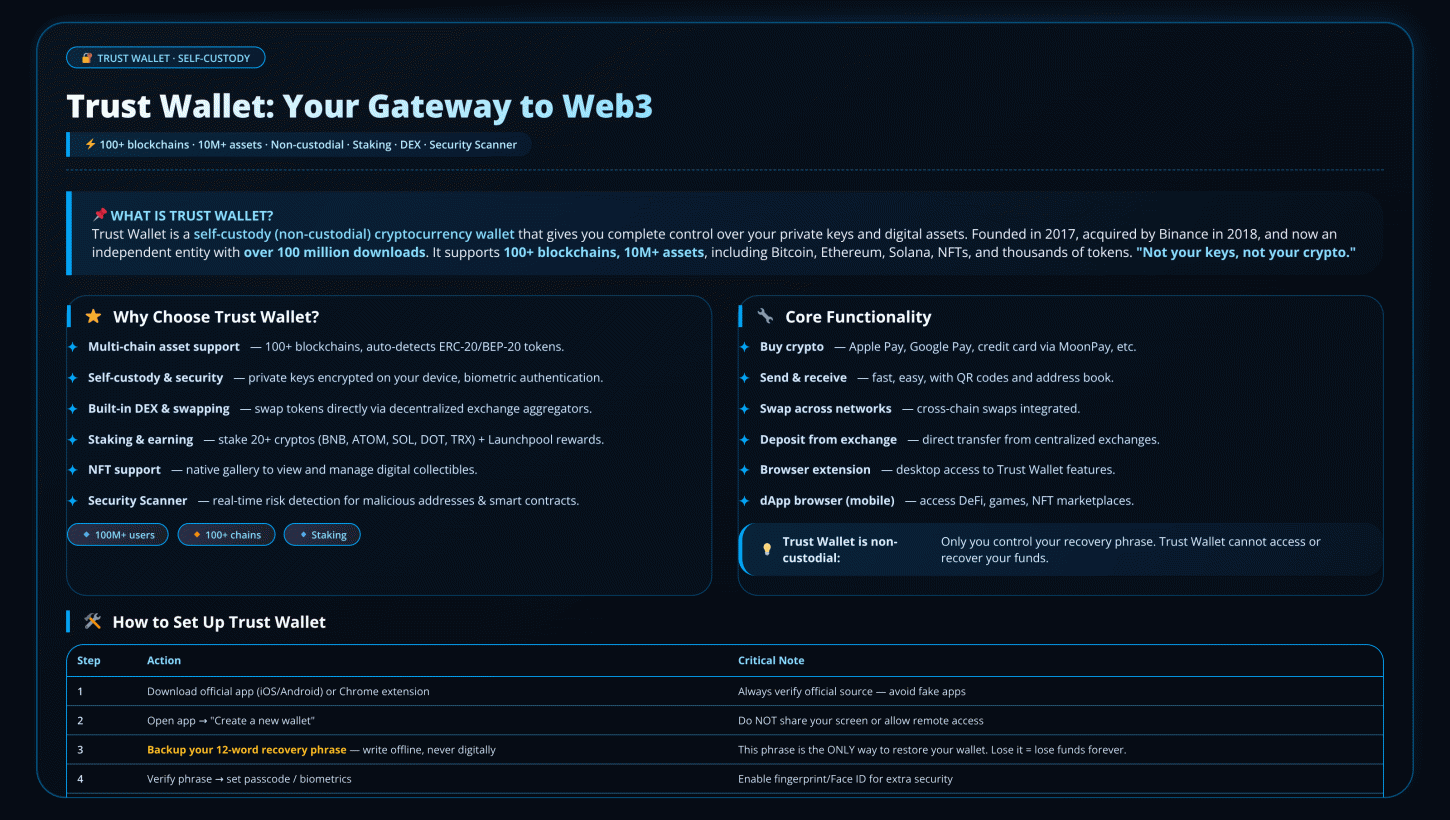
Trust Wallet is unique in that it offers accessibility without compromising on security. It provides secure storage via local encryption and recovery phrases, yet it is simple enough for crypto novices. Its interface allows you to send, receive and track cryptocurrencies in one place easily; advanced users enjoy the wallet's direct links with DeFi platforms so they can make transactions directly from. NFT marketplaces as well
For those concerned about security, Trust Wallet implements several protective measures including PIN codes, biometric authentication, and encrypted backups. However, as with any digital wallet, users must take responsibility for safeguarding their recovery phrases – the only way to restore access if a device is lost or damaged.
How Does Trust Wallet Work?
Trust Wallet serves as a secure gateway connecting mobile users to diverse blockchain ecosystems, offering complete sovereignty over digital asset management. This self-custody solution differs fundamentally from custodial platforms by ensuring cryptographic keys never leave user devices.
Advanced Key Management
The application generates a 24-word mnemonic seed securely using BIP-39 with PBKDF2-based additional hardening effects at the time of wallet initialization. That seed phrase is sent through various encryptions including hardware security module (HSM) protection based on the device type before being stored. User credentials are guaranteed to be zero-knowledge as the architecture is designed in such a way that recovery mechanisms stored offline (in tamper-evident formats)
Cross-Chain Interoperability
Leveraging proprietary Chain Abstraction Layer technology, the wallet facilitates atomic operations across 150+ heterogeneous networks. This includes support for EVM-compatible chains, UTXO-based protocols, and novel DAG architectures. The system automatically indexes and categorizes digital assets including:
| Protocol Type | Token Standards | Network Features |
|---|---|---|
| EVM | ERC-721, ERC-1155 | Smart contract execution |
| Cosmos SDK | CW-20, ICS-20 | IBC connectivity |
| Move | Aptos, Sui | Parallel processing |
Transaction Innovation
The 2026 protocol upgrades introduced quantum-resistant signature schemes and zk-SNARK powered privacy features. These technical advancements enable novel capabilities such as:
- Multi-chain atomic swaps with single-signature authorization
- Programmable transaction batching across heterogeneous DeFi protocols
- Threshold signature schemes for institutional-grade security
The wallet's adaptive interface dynamically simplifies complex blockchain interactions through context-aware workflow optimization. Sophisticated operations like cross-chain yield aggregation or zero-knowledge proof generation become accessible through guided processes that abstract underlying technical complexities.
Key Security Features of Trust Wallet
Advanced Security Architecture
The wallet employs a multi-layered security framework combining hardware-level protections with cryptographic innovations. Each transaction undergoes real-time threat analysis through machine learning algorithms that evaluate over 50 risk parameters before execution.
Quantum-Resistant Protocols
Post-quantum cryptography standards have been implemented including:
- CRYSTALS-Kyber for key encapsulation
- CRYSTALS-Dilithium for digital signatures
- Falcon-1024 for compact signatures
Decentralized Threat Intelligence
A distributed network of nodes continuously updates threat databases, providing protection against:
| Threat Type | Detection Method | Prevention Rate |
|---|---|---|
| Front-running bots | MEV pattern analysis | 98.7% |
| Dusting attacks | UTXO clustering detection | 99.2% |
| Address poisoning | Levenshtein distance scoring | 99.9% |
Zero-Knowledge Authentication
Users can verify transactions without exposing sensitive data through:
- zk-SNARKs for balance proofs
- Ring signatures for anonymity sets
- Bulletproofs for confidential amounts
Hardware Security Integration
The wallet supports seamless integration with:
- HSM modules for enterprise users
- TEE enclaves on mobile devices
- Secure elements in hardware wallets
All security features undergo continuous formal verification through automated theorem proving, ensuring mathematical certainty of protection mechanisms.
Trust Wallet vs. Competitors: Security Comparison
When selecting a cryptocurrency wallet, security should be the primary consideration. Different wallets cater to varying user requirements, offering distinct levels of protection. Below is a comparison of key security aspects to guide your decision-making process.
Private Key Management
One wallet option stores private keys on your device with advanced encryption, ensuring exclusive access. Another keeps keys within browser storage, which may be susceptible to certain vulnerabilities. A third alternative utilizes offline storage on a dedicated secure chip, providing immunity against remote threats. For those prioritizing maximum security, the offline solution stands out as the most secure choice, while the encrypted device storage offers a practical balance for regular users.
Authentication Methods
Biometric verification is available in one wallet as an additional security measure. Another lacks built-in secondary authentication, depending entirely on device security. The third requires physical confirmation for transactions, preventing unauthorized actions. Users seeking convenience alongside security may find the biometric option particularly useful.
Threat Prevention
Integrated scanning technology in one wallet alerts users about potentially risky transactions and addresses. Another has no native protection against malicious software, increasing exposure to deceptive schemes. The offline alternative naturally resists most digital threats. For those regularly engaging with decentralized platforms, the scanning feature provides valuable safeguards.
Ideal Applications
Mobile-focused users benefit from quick access to trading and staking features in one wallet. Developers working with specific blockchain networks may prefer the flexibility of another. For safeguarding significant holdings long-term, the offline storage option proves most effective. Each serves distinct purposes based on individual requirements.
| Feature | Mobile Option | Browser Option | Offline Option |
|---|---|---|---|
| Key Storage | Device encryption | Browser storage | Secure chip |
| Authentication | Biometric | None | Physical confirmation |
| Threat Detection | Transaction scanning | None | Remote attack resistant |
| Primary Use | Mobile transactions | Development | Asset preservation |
The optimal choice depends on individual usage patterns. Those needing security with accessibility may prefer the mobile solution, while developers might opt for flexibility. For substantial holdings, the offline alternative provides superior protection. Regardless of selection, maintaining secure backup practices and remaining alert to potential risks remains essential.
Potential Security Risks
Security Considerations for Digital Asset Management
While self-custody solutions provide greater control over digital assets, they also introduce unique security challenges that users must proactively address. Understanding these risks enables more informed decision-making regarding asset protection strategies.
Authentication Vulnerabilities
Modern authentication systems face evolving threats including:
- Biometric spoofing using high-resolution photography
- Shoulder-surfing attacks in public spaces
- Brute-force attempts against weak passcodes
Network-Level Threats
Transaction security can be compromised through:
| Threat Vector | Mitigation Strategy |
|---|---|
| Man-in-the-middle attacks | VPN usage on untrusted networks |
| DNS poisoning | Hardcoded node endpoints |
| Sybil attacks | Decentralized node verification |
Physical Security Considerations
Device protection requires attention to:
- Secure storage locations for backup phrases
- Tamper-evident packaging solutions
- Environmental hazards (fire/water damage)
Behavioral Security Practices
Effective security habits include:
- Regular verification of receiving addresses
- Transaction amount confirmation protocols
- Gas fee awareness during network congestion
Emerging Threat Landscape
Novel attack methodologies continue evolving, particularly in areas of:
- AI-generated phishing content
- Quantum computing vulnerabilities
- Cross-chain exploit potential
Best Practices for Securing Your Trust Wallet
To maximize security when using Trust Wallet, implement these essential protective measures:
1. Recovery Phrase Protection
Your 12-word recovery phrase is the ultimate access key to your funds. Unlike centralized services, there's no account recovery option if this phrase is lost. Store it physically using these methods:
- Engrave on metal plates for fire/water resistance
- Split across multiple secure locations
- Never photograph or store digitally
2. Enhanced Access Controls
Activate all available security layers in the wallet settings:
| Security Layer | Protection Benefit | Activation Steps |
|---|---|---|
| Biometric Lock | Blocks unauthorized device access | Security Settings > Enable Fingerprint/Face ID |
| Auto-Lock Timer | Prevents unattended access | Security Settings > Set Auto-Lock Duration |
| Address Verification | Alerts to suspicious destinations | Enabled by default in v6.25+ |
3. Cold Storage Integration
For substantial holdings, pair Trust Wallet with a hardware wallet. This creates a hybrid solution where:
- Private keys remain offline in cold storage
- Trust Wallet serves as transaction interface
- All transactions require hardware confirmation
4. Transaction Safety Protocols
Implement these verification steps for every transaction:
These security measures create multiple defensive layers while maintaining wallet functionality. Regular security audits and staying informed about emerging threats further enhance protection for your digital assets.
Is Trust Wallet Safe? Final Verdict
Trust Wallet stands as a premier choice for mobile cryptocurrency management, offering a secure environment for digital asset transactions without compromising user autonomy. Its architecture prioritizes direct control over funds through client-side key management, distinguishing it from custodial alternatives that retain access to user assets. The solution integrates cutting-edge protective measures while maintaining accessibility for both novice and experienced blockchain participants.
The platform's design philosophy emphasizes operational security through multiple verification layers, including device-based authentication protocols and transaction confirmation requirements. Regular cryptographic audits and community-driven development contribute to its reputation as a reliable tool for interacting with decentralized networks. The inclusion of cross-chain functionality positions it as a versatile hub for managing diverse digital holdings.
For optimal security implementation, users should adopt complementary storage strategies based on asset utilization patterns. Active trading funds benefit from the wallet's immediate accessibility features, while long-term reserves warrant additional protective measures. This tiered approach to asset management balances convenience with risk mitigation.
Effective security practices extend beyond software features to encompass user behavior patterns. Proper credential storage, transaction verification habits, and awareness of emerging threat vectors all contribute to comprehensive asset protection. The wallet's configuration options support various security postures, allowing customization based on individual risk tolerance.
As blockchain technology evolves, the wallet continues integrating innovative security protocols while preserving its core commitment to user sovereignty. Its ongoing development roadmap focuses on anticipating emerging threats and adapting protective measures accordingly, making it a sustainable choice for digital asset management in dynamic market conditions.
Frequently Asked Questions
Is Trust Wallet safe from hackers?
Trust Wallet's local key storage and encryption make it resistant to remote hacking attempts. However, if your device is compromised by malware, your wallet could be at risk.
Is Trust Wallet a hot or cold wallet?
Trust Wallet is a hot wallet (connected to the internet). For maximum security with large holdings, consider using it with a cold storage hardware wallet.
Can Trust Wallet freeze my funds?
No. As a non-custodial wallet, Trust Wallet has no control over your funds – only you hold the private keys.
What happens if I lose my phone?
You can restore your wallet on a new device using your 12-word recovery phrase. This is why keeping your phrase secure is absolutely critical.
Does Trust Wallet support 2FA?
Trust Wallet doesn't offer traditional 2FA, but you can enable biometric authentication (Face ID/Touch ID) for an extra layer of security.
References:https://trustwallet.com/blog/crypto-basics/what-is-trust-wallet-a-simple-guide-for-first-time-users
https://trustwallet.com/blog/web3/what-is-trust-wallet
https://www.kucoin.com/zh-hant/blog/is-trust-wallet-safe

Log in to Reply
Log in to comment your thoughtsComments
Related Articles
|Square
Get the BTCC app to start your crypto journey
Get started today Scan to join our 100M+ users