How to Create a Cold Wallet: The Ultimate Guide to Offline Crypto Storage (2026)

- What is a Cold Wallet?
- Why You Need a Cold Wallet in 2026
- Types of Cold Wallets in 2026
- How to Create a Hardware Cold Wallet
- Advanced: Creating an Air-Gapped Cold Wallet
- Securing Your Recovery Seed
- Cold Wallet Security Checklist for 2026
- FAQ: Frequently Asked Questions
With cryptocurrency gaining momentum and competition in the crypto ecosystem increasing, it is important more than before to secure all your holdings. Cold wallets offer the highest security level because it keeps your private keys is 100% offline. This guide will tell you everything necessary about using a cold wallet in 2026, starting from choosing the best hardware to implementing bullet-proof security measures.
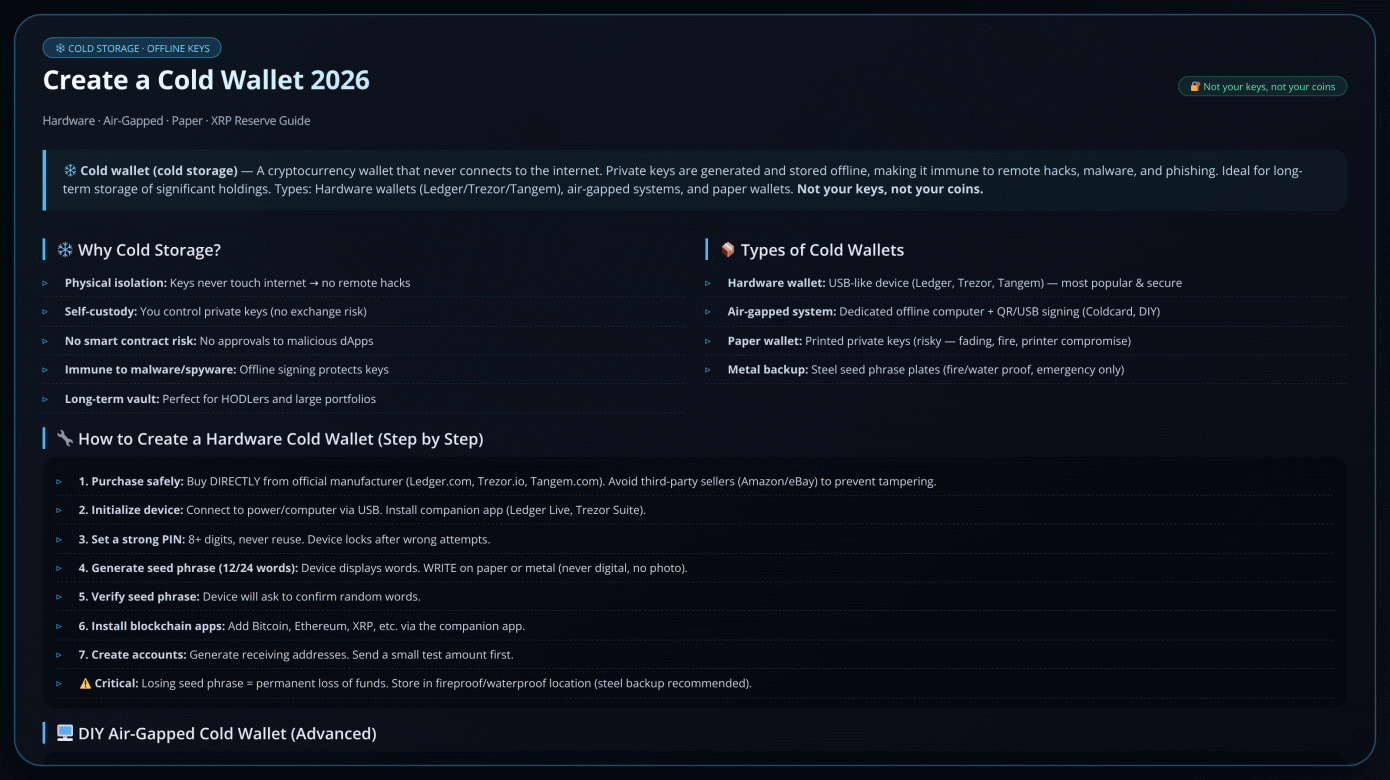
What is a Cold Wallet?
A cold wallet (or "cold storage") refers to a cryptocurrency wallet that never connects with internet directly and thus considered to be the most secure method of storing digital assets. Hot wallets are constantly connected to the internet so they can be hacked, while cold wallets store private keys in an isolated environment (in this case not vulnerable to phishing attacks – malware or remote access). By storing your private keys (i.e., the all-important identifiers necessary for accessing and managing your crypto holdings) offline, you guarantee that they will never be vulnerable to hacking.
A cold wallet can be hardware wallets (such as Ledger and Trezor), paper wallets, air-gapped systems. Hardware wallets become the most go to solution for securing token storage as a balance of security and convenience. These generate and store a private key on an offline device, which is only connected to the internet shortly when signing transactions. Paper wallets, remain the same idea but is as simple or at least in concept printed private keys on paper which subsequently become less secure considering it can be damaged where ever you are. Air-gapped systems involve using a dedicated offline computer to do key management and is an additional level of security.
They are immune to remote attacks, which is one of the biggest advantages cold wallets wise. Private keys never come in contact with online networks which means hackers are not able to capture it using digital approaches. Cold wallets also do not get exposed to malicious smart contracts, one of the most common attack vectors in decentralized finance (DeFi). As such, they are perfect for storing high-value assets like Bitcoin (BTC) and ethereum (ETH).
On the other hand, cold wallets must be handled with caution. Users then are required to store their recovery seed phrases, generally 12 − 24 words long on fire-resistant and waterproof materials such as stainless steel. Loss of this backup would result in permanent loss of access to funds stored within. Additionally, they still require a connected device to sign any transactions offline and broadcast them in order to create an additional layer of security over Hot Wallets but also making the user go through extra steps.
In summary, cold wallets are the gold standard for crypto security, offering unparalleled protection against digital threats. Whether you're a long-term investor or managing significant holdings, using a cold wallet ensures that your private keys—and by extension, your assets—remain safe from online vulnerabilities.
Why You Need a Cold Wallet in 2026
Protecting your crypto holdings has never been more vital than now in our rapidly changing world of digital assets. Supported on devices with large storage capacity Like Magnetic Drives, Hdd Solid State Drive Cold wallets (Also Known as cold Storing Solution) Gives You the highest protection level by storing Private keys Offline in a completely secured environment only drived and executed by you. The looming deadline for the 2026 data protection deadlines has resulted in smarter and potentially dangerous cyber threats targeting cryptocurrency users.
The Growing Importance of Cold Wallets
And cold wallets are basically a high-security vault for your crypto in digital form. Where hot wallets are always connected to the internet, cold ones work in full-blown isolation and so provide near-100% resistance to hacking from a distance. Such separation is increasingly important in an age where billions worth of crypto are lost yearly due to phishing scams, malware and attacks on exchanges.
Three fundamental advantages make cold wallets essential for serious cryptocurrency investors:
| Advantage | Description |
|---|---|
| Complete Immunity to Online Threats | By never connecting to the internet, cold wallets eliminate exposure to hacking, phishing, and malware attacks that frequently target online wallets and exchanges. |
| Full Asset Control | Cold wallets give you complete ownership of your private keys, removing reliance on third-party custodians that could freeze accounts or suffer operational failures. |
| Ideal for Long-Term Storage | The offline nature of cold wallets makes them perfect for securely holding significant cryptocurrency investments over extended periods without active management. |
Evolution of Cold Wallet Technology
There has been significant improvement in cold wallet solutions over the past few years. More recently, the latest hardware wallets include military-grade security chips, biometric authentication and air-gapped communication methods such as QR codes instead of unsecured USB Connectors. Top brands have even focused on user interfaces, bringing cold storage closer to average users retain compliance for security.
As cryptocurrency adoption grows and regulatory frameworks develop, cold wallets will likely become standard practice for anyone holding substantial digital assets. The peace of mind they provide against both digital threats and exchange insolvencies makes them an indispensable tool in any crypto investor's security arsenal.
Types of Cold Wallets in 2026
By 2026, the advances in crypto security make a great leap giving an investor more advanced technology to protect their digital assets than ever before. Cold wallets remain the gold standard for security, and existing solutions have matured to fit different user needs or threat models. Here is an exhaustive analysis of the safest cold wallets that exists today, all with unique features for a range of use cases.
| Type | Best For | Security Level | Key Features |
|---|---|---|---|
| Hardware Wallets | Most users | ★★★★★ | Physical devices with secure elements, PIN protection, and recovery phrases. Examples include Ledger and Trezor models. |
| Air-Gapped Wallets | Maximum security | ★★★★★ | Completely offline operation, using QR codes or microSD cards for transaction signing. Ideal for high-value storage. |
| Paper Wallets | Emergency backups | ★★★☆☆ | Printed private keys stored physically. While simple, they are vulnerable to physical damage and require careful handling. |
In terms of market share, hardware wallets are winning when it comes to security and convenience. Modern Devices Feature Bio Auth, Tamper-Proof Chip and Firmware Verification Self-contained wallets are common among institutionals and high-net-worth individuals who want their coins entirely isolated from online invaders. Paper wallets although becoming a rarer option now then before – as long back up with the correct storage methods such as fireproof safes, wrapped in plastic etc or safety deposit boxes are your solution.
Well, choosing a cold wallet depends on the value of your holdings vs the frequency with which you transfer funds and how much tech chop one has. The BTCC team suggests hardware wallets to almost everyone because of their shallow learning curve and ability for strong security. To prevent supply chain tampering, buy devices only from manufacturers and apply firmware updates regularly to keep them safe against new threats.
How to Create a Hardware Cold Wallet
Setting up a hardware cold wallet involves a meticulous process to ensure your cryptocurrency remains secure from digital threats. This guide walks through the essential steps to create an offline storage solution that safeguards your private keys from potential breaches.
Step 1: Source Your Device Securely
Obtain your hardware wallet exclusively from the manufacturer’s official channels to eliminate risks of tampering. Avoid marketplaces where devices might be compromised before reaching you. Leading options include models from Ellipal, BitBox02, and SafePal, each catering to different security preferences.
Step 2: Offline Initialization
Power up the device in an environment free from internet connectivity. During setup, it will produce a unique 12- to 24-word recovery phrase. Document this phrase using a method resistant to physical damage—consider engraving or specialized metal plates—and store it in multiple secure locations.
Step 3: Enhanced Backup Strategies
Move beyond paper backups by utilizing encrypted digital storage or splitting your recovery phrase across multiple secure locations. Some advanced users employ Shamir’s Secret Sharing to distribute phrase fragments among trusted parties.
Step 4: Validation Procedure
Conduct a comprehensive recovery test by wiping the device and restoring access using your backup phrase. This critical step verifies your ability to recover funds if the primary device becomes unavailable.
Step 5: Software Maintenance
After establishing the offline setup, connect briefly to update the device’s firmware through the manufacturer’s verified application. Install only the cryptocurrency applications you require, removing unnecessary ones to minimize potential vulnerabilities.
Step 6: Fund Transfer Protocol
Begin with a small test transaction to confirm wallet functionality. Always cross-verify receiving addresses between your hardware display and connected device to prevent man-in-the-middle attacks. For significant transfers, consider breaking them into smaller amounts.
Advanced Protection Measures
- Geographical Distribution: Store backup components in separate physical locations to protect against localized disasters.
- Transaction Verification: Implement a multi-device approval system for critical transactions.
- Periodic Audits: Schedule regular checks of your storage setup and backup accessibility.
This comprehensive approach to cold wallet creation provides robust protection for your digital assets, combining advanced security practices with practical usability for long-term cryptocurrency storage.
Advanced: Creating an Air-Gapped Cold Wallet
For cryptocurrency holders prioritizing maximum security, an air-gapped cold wallet represents the gold standard in digital asset protection. Unlike standard hardware wallets that occasionally connect to the internet, air-gapped solutions maintain complete physical isolation from online networks at all times. This method eliminates virtually all remote hacking vectors while providing robust protection against both digital and physical threats.
The process begins with selecting a dedicated offline computer - preferably a brand-new device or one that has been thoroughly wiped and disconnected from all networks. Many security experts recommend using a Raspberry Pi configured specifically for this purpose, as its low cost and minimal hardware reduce potential attack surfaces. The operating system should be installed from verified media in an offline environment, with all wireless capabilities physically removed or disabled.
Key generation occurs entirely offline using open-source wallet software like Electrum or AirGap Vault. These applications create cryptographic key pairs without ever exposing them to internet-connected devices. For added security, some users employ dice or other physical random number generators to enhance entropy during the creation process. The resulting private keys never exist in digital form on networked systems.
Transaction signing follows a meticulous multi-step process:
| Step | Action | Security Consideration |
|---|---|---|
| 1 | Create unsigned transaction on online device | Verify all address details carefully before transfer |
| 2 | Transfer to air-gapped device via QR code or USB | Scan QR codes manually rather than using file transfer |
| 3 | Sign transaction on offline device | Double-check amounts and addresses on secure screen |
| 4 | Transfer signed transaction back to online device | Use one-way transfer methods to prevent data leakage |
| 5 | Broadcast transaction to network | Monitor transaction status through block explorers |
Physical security measures prove equally important as digital precautions. The BTCC team recommends storing backup seed phrases on corrosion-resistant metal plates rather than paper, with multiple copies kept in geographically separate secure locations like bank vaults or private safes. Some advanced users employ tamper-evident bags and security cameras to monitor their cold storage setups.
While air-gapped wallets offer unparalleled security for long-term holdings, they do present certain usability tradeoffs. Transaction times increase significantly due to the manual processes involved, making this solution impractical for active traders. Additionally, maintaining proper operational security requires constant vigilance against potential physical breaches and careful management of the signing devices.
For those managing substantial cryptocurrency portfolios, the added effort of an air-gapped system often justifies itself through dramatically reduced risk exposure. As blockchain analytics firm Chainalysis reported in their 2023 Crypto Crime Report, not a single verified case of air-gapped wallet compromise appeared among the billions lost to crypto thefts that year. This track record makes the approach particularly attractive for institutional investors and high-net-worth individuals.
Securing Your Recovery Seed
Your recovery seed phrase is the single most important piece of information when it comes to securing your cryptocurrency assets. This 12-24 word mnemonic phrase acts as the master key to your entire wallet, allowing anyone who possesses it to gain complete control over your funds. Unlike traditional banking where you can recover accounts through customer service, cryptocurrency operates on the principle of "not your keys, not your coins" - meaning if you lose your recovery phrase, you permanently lose access to your assets.
To properly secure your recovery seed, consider these essential practices:
Physical Storage Solutions
The most secure method involves using specialized stainless steel backup plates designed specifically for crypto storage. These plates offer superior protection compared to paper because they are:
| Feature | Benefit |
|---|---|
| Fireproof | Withstands temperatures up to 1,500°F |
| Waterproof | Protects against floods and water damage |
| Corrosion-resistant | Maintains integrity for decades |
Popular options include Cryptosteel and Billfodl, which use either engraved tiles or punch systems to permanently record your seed words.
Geographic Redundancy
Security experts recommend creating multiple copies of your recovery phrase stored in separate secure locations. This protects against:
- Natural disasters (fire, flood, etc.) affecting a single location
- Theft or loss of a single backup
- Accidental destruction of one copy
Consider storing copies in a home safe, safety deposit box, or with trusted family members in different geographic areas. However, be extremely cautious about who you trust with this information.
Digital Security Risks
Never store your recovery phrase in any digital format, including:
- Photos on your smartphone
- Cloud storage services (Google Drive, iCloud, etc.)
- Password managers
- Email or messaging apps
These methods expose your seed to potential hacking, data breaches, or unauthorized access. The only truly secure method is physical, offline storage.
Additional Security Layers
For advanced protection, consider implementing a passphrase (sometimes called a 25th word). This optional feature:
- Creates a hidden wallet that can't be accessed with just the 24-word seed
- Provides plausible deniability if forced to reveal your seed
- Adds an extra encryption layer to your funds
Remember that if you forget this passphrase, there is absolutely no way to recover it - the security cuts both ways.
By implementing these security measures, you significantly reduce the risk of losing your cryptocurrency assets while maintaining complete control over your funds. The small upfront investment in proper storage solutions pays enormous dividends in long-term security and peace of mind.
Cold Wallet Security Checklist for 2026
As we progress through 2026, safeguarding cryptocurrency assets demands rigorous security protocols. This updated checklist outlines critical measures for maintaining secure cold storage, incorporating the latest advancements in digital asset protection.
| Security Protocol | Execution Method | Priority Tier |
|---|---|---|
| Multi-Device Verification | Require confirmation from at least two independent devices for transaction authorization | Essential |
| Biometric Authentication | Implement fingerprint or facial recognition for wallet access where supported | High |
| Geofenced Transactions | Configure wallet to only approve transfers from predetermined secure locations | Medium |
| Quantum-Resistant Encryption | Upgrade to wallets supporting post-quantum cryptography algorithms | Critical |
| Decoy Wallet Systems | Maintain secondary wallets with minimal funds to divert potential attacks | Medium |
Advanced protection strategies now include temporal transaction limits that automatically block transfers exceeding predetermined thresholds without secondary approval. Environmental monitoring sensors can detect physical tampering attempts on hardware wallets, triggering immediate security lockdowns. The emergence of decentralized identity solutions allows for non-custodial recovery options without compromising private key security.
Operational security has evolved to include automated transaction pattern analysis that alerts users to anomalous activity. Many institutional holders now employ dedicated security teams to conduct regular penetration testing of their cold storage systems. For individual investors, subscription-based monitoring services provide real-time threat intelligence specific to their wallet configurations.
Physical security measures have advanced with the introduction of smart storage solutions that combine biometric access with environmental hardening. These systems automatically maintain optimal temperature and humidity levels while providing intrusion detection. Some models now incorporate emergency destruction mechanisms for extreme scenarios, securely wiping sensitive data when triggered.
Staying ahead of emerging threats requires continuous education. Participate in security webinars hosted by blockchain foundations and monitor vulnerability disclosures from wallet manufacturers. Remember that effective cryptocurrency protection in 2026 requires both technological solutions and disciplined operational practices working in concert.
FAQ: Frequently Asked Questions
Is a cold wallet better than keeping crypto on an exchange?
Absolutely. Cold wallets give you full control of your assets, eliminating exchange risks like hacks or insolvency. Remember: "Not your keys, not your coins."
What happens if I lose my hardware wallet?
As long as you have your recovery phrase, you can restore your funds on any compatible device. The physical wallet itself is just an access tool.
Are paper wallets still safe in 2026?
While better than nothing, paper wallets are vulnerable to physical damage. Modern hardware or metal backups offer much better protection.
Can I use a cold wallet for frequent transactions?
Cold wallets are designed for storage, not daily use. For frequent transactions, consider using a hot wallet with only what you need.
How do I get a cold wallet for XRP?
Many hardware wallets support XRP. Just remember the XRP Ledger requires a 10 XRP reserve when creating a new wallet address.
References:https://safeheron.com/blog/how-to-create-a-cold-wallet/
https://www.ledger.com/academy/topics/security/what-is-a-cold-wallet

Log in to Reply
Log in to comment your thoughtsComments
Related Articles
|Square
Get the BTCC app to start your crypto journey
Get started today Scan to join our 100M+ users