Fiat Wallet: The Complete Guide to Digital Fiat Management in 2026

- What is a Fiat Wallet?
- Types of Fiat Wallets Available in 2026
- Fiat Wallets vs. Crypto Wallets: Key Differences
- How Fiat Wallets Work in 2026
- Benefits of Using Fiat Wallets
- Potential Risks and How to Mitigate Them
- Popular Fiat Wallet Options in 2026
- Bridging Fiat and Crypto Worlds
- Fiat Wallet FAQs (Frequently Asked Questions)
Thanks to innovation, financial tools today are changing the very way we manage our money and fiat wallets have never made it easier. Fiat Wallets are part of personal finance in the digital age, whether you're shopping online, sending cash to a buddy or diving into dummy money. The Definitive Guide to Fiat Wallets in 2026: Everything You Need To Know Including Definition, Key Features and Crypto vs.
What is a Fiat Wallet?
Fiat wallet is a digital application user can use to store, send and receive any government-regulated currencies such as USD, EUR or GBP. On the other hand, crypto wallets were more dedicated to cryptocurrencies such as Bitcoin or Ethereum and operations with them; however fiat wallets target only traditional currencies in electronic form. These wallets work just like internet bank accounts but are often more flexible and have additional features. They are accessible via mobile apps, web interfaces or as part of banking services — making them a versatile modern financial management solution.
Fiat wallets support various currencies depending on the provider and region. For example, a wallet might handle USD for American users while offering EUR support for European customers. Some advanced wallets even allow multi-currency holdings, enabling seamless international transactions without constant currency conversion.
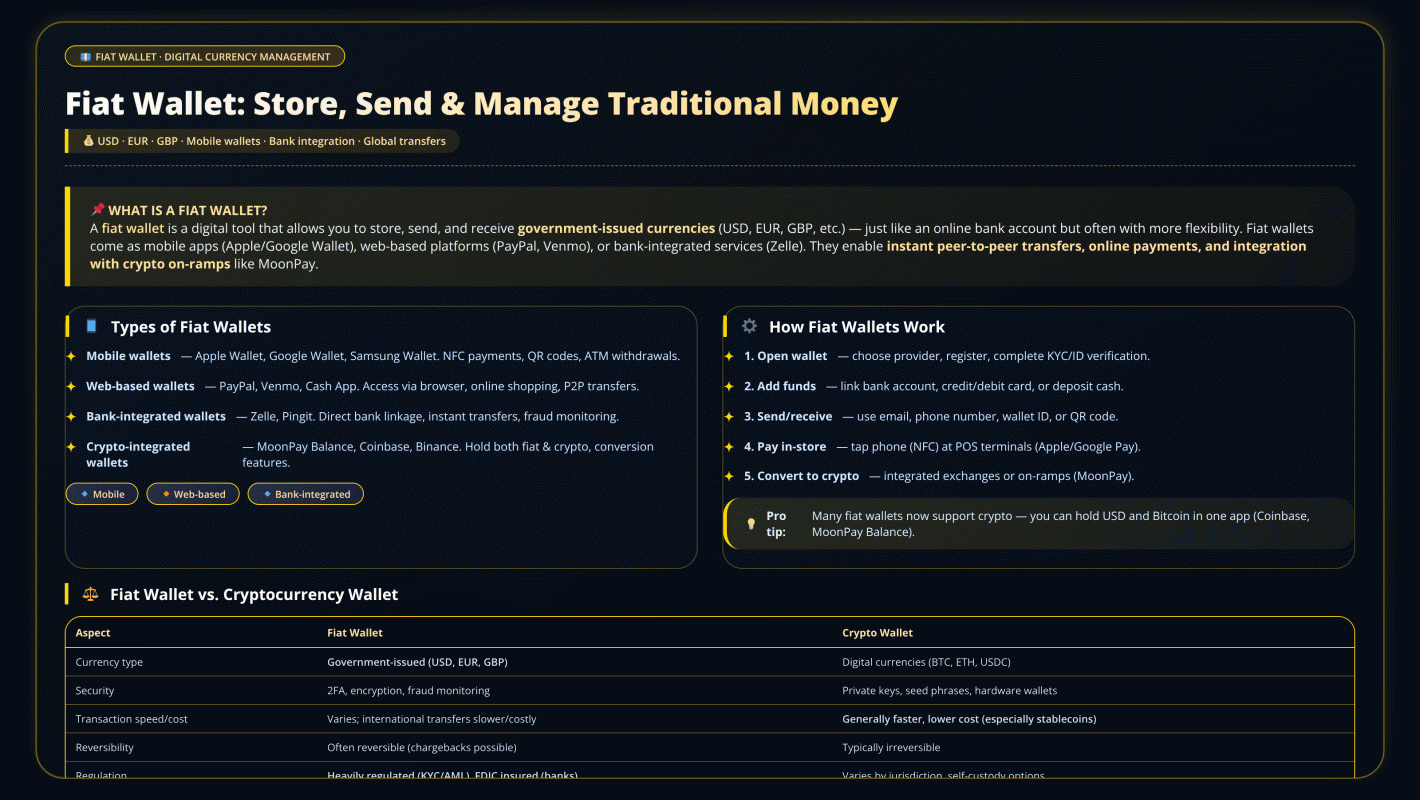
Key Features of Fiat Wallets
- Digital Storage: Securely holds government-backed currencies in electronic form.
- Transaction Capabilities: Enables instant transfers, payments, and remittances.
- Multi-Platform Access: Available via mobile apps, web interfaces, or bank-linked systems.
- Currency Support: Often includes major global currencies with exchange functionality.
These wallets have become essential tools in today's digital economy, bridging the gap between traditional banking and modern financial technology. Their convenience and accessibility make them particularly valuable for frequent travelers, online shoppers, and anyone needing quick access to their funds without traditional banking limitations.
Comparison with Traditional Banking
| Feature | Fiat Wallet | Traditional Bank Account |
|---|---|---|
| Accessibility | 24/7 digital access | Limited by banking hours |
| Transaction Speed | Instant transfers | Often requires processing time |
| International Use | Multi-currency support | Typically single-currency |
| Account Requirements | Minimal documentation | Extensive verification |
The evolution of fiat wallets represents a significant shift in how people interact with money. By combining the reliability of government-issued currencies with the convenience of digital technology, these tools have become indispensable for modern financial activities. Their continued development suggests an increasingly digital future for personal finance management.
Types of Fiat Wallets Available in 2026
The digital wallet ecosystem in 2026 has matured significantly, presenting users with sophisticated financial tools that extend far beyond basic currency storage. These modern platforms now serve as integrated financial hubs, combining payment functionality with value-added services that cater to diverse consumer needs.
Smart Device Wallets
Nevertheless, leading tech giants have turned their payment solutions into full-fledged digital ecosystems. Now, these platforms offer cutting-edge features such as biometric authentication, in-depth spending analysis powered by real-time data analytics algorithms and automated budget-setting capabilities. Wearing technology has particularly transformed contactless payments — most users pay just by tapping their smartwatch or fitness tracker at checkout terminals.
Cloud-Based Financial Platforms
Modern web wallet solutions have matured into fully-fledged fintech dashboards that allow their users to centralize control over every financial activity they make. These platforms offer features like automation of cross border payments, creation of smart invoices and AI driven financial advice. Key features, such as automatic categorizations of expenses and financial reports directly formatted for tax statements will reduce administrative overhead considerably — something that business owners have come to appreciate.
Institutional Digital Payment Solutions
Established financial institutions have evolved their digital services into hybrid solutions that fuse established banking stability with fintech ingenuity. All of the sites have exceptional security methods, fraud detection algorithms and assure that your funds are protected. According to a recent report from the industry, these institution-backed solutions currently handle more than half of all high-value digital transactions in existence and are known for their frameworks surrounding solving disputes and compliance with regulation.
| Platform Type | Distinctive Advantages | Primary User Base |
|---|---|---|
| Smart Device Wallets | Wearable integration, spending insights, automated savings | Tech-savvy consumers and frequent shoppers |
| Cloud-Based Platforms | Financial automation, business tools, multi-currency management | Freelancers and small business owners |
| Institutional Solutions | Regulatory protections, large transaction support, credit integration | Professionals and corporate users |
Choosing the right digital financial platform is all about thinking through your own unique socio-economic behaviours and security needs. Cloud platforms allow for better financial management, even if wallets built into devices create a seamless mode of transacting daily. Solutions remain the best choice for users who want to protect their assets and handles a lot of transaction volume. Most people with an active interest in their finances use accounts across the categories to take advantage of those unique benefits while offsetting the weaknesses inherent to each account.
Fiat Wallets vs. Crypto Wallets: Key Differences
While both fiat wallets and cryptocurrency wallets serve the fundamental purpose of storing and managing digital assets, they operate on fundamentally different principles and cater to distinct financial ecosystems. Understanding these differences is crucial for anyone navigating today's hybrid financial landscape where traditional banking meets decentralized finance.
| Aspect | Fiat Wallets | Cryptocurrency Wallets |
|---|---|---|
| Currency Type | Government-issued currencies (USD, EUR, GBP, etc.) regulated by central banks | Decentralized digital assets (Bitcoin, Ethereum, stablecoins) operating on blockchain networks |
| Security | Primarily uses institutional security measures like 2FA, biometrics, and bank-grade encryption | Relies on cryptographic principles including private keys, seed phrases, and sometimes hardware storage |
| Transaction Speed/Cost | Varies significantly by institution and transaction type; international transfers often slow and expensive | Typically processes transactions within minutes (varies by network) with substantially lower fees |
| Usability | Nearly universal acceptance for retail and commercial transactions worldwide | Growing but still limited acceptance, primarily in tech-forward businesses and specific industries |
| Regulatory Oversight | Heavily regulated with consumer protections like FDIC insurance (in some countries) | Emerging regulatory frameworks with varying degrees of protection across jurisdictions |
Choosing between these wallet types comes down to your financial needs and technological comfort level. Fiat wallets are a remnant of the world of traditional finance with their stable value and high degree of acceptance, whereas crypto wallets represent access to new systems that give users more control over their funds. It's common for modern users to keep both types of wallets, using them for their respective strengths. For example, you could have a fiat wallet for daily expenses and another cryptocurrency wallet solely for international transfers or investments in digital assets. The increasing interconnectivity of these systems, via crypto on-ramps and the like, is making it easier than ever to transition between traditional finance ecosystems that have historically been at odds with one another.
How Fiat Wallets Work in 2026
By 2026 our user experience for setting up and using a digital currency account has become extremely friendly — modern platforms offer an intuitive design together with certain protections. The implementation process is usually broken down into three simple steps users can complete quickly, but the time it takes to authenticate may vary based on location and provider requirements.
Account Creation
Account opening today appears to be significantly better than previous years. The first stage includes the selection of a certified authorized service provider with special focus on security certifications and operational transparency. Getting on the platform starts with submitting some basic personal information, and then continuing through identity confirmation processes which now often involve machine learning validation systems able to verify accounts nearly in real-time. Some advanced services have implemented biometric pattern recognition that references multiple IDs at the same time.
Capital Allocation
Modern platforms provide various currency on boards which have grown tremendously. Electronic fund transfers are being processed over encrypted channels interfaced to established financial institutions, with the more forward looking services providing instant liquidity options. These physical currency conversion points became common due to commercial partnerships, specializing in providing services for the transition from tangible [money] [currency] to digital. There are forward looking operators who have introduced predictive cash flow features to study income patterns in order to improve availability balance timing.
Financial Operations
Modern systems display significant technological sophistication in transaction execution capabilities. Automated payment scheduling lies across comprehensive financial planning tools; proximity-based commercial exchanges employ sophisticated wireless protocols. However, Matrix code transactions have gone mainstream in commercial spaces; from short-run retail setups to entrenched businesses. AI integration in collaborative expense management functions is automating the dynamic calculation and distribution of shared finances among user groups. While they now have a processing speed that crosses borders at records, their cost structures still depend on the particulars of each corridor.
Common developments and benchmarks of operational efficiency suggest ongoing enhancement being witnessed as current systems demonstrate significant progress in comparisons made to performance indices over a retrospective timescale, unbroken by any apparent steps backward or rhetorical sustains. Integrated financial monitoring suites allow for run-of-the-mill visualisation of granular turnover, and platform interoperability has increased to include alternative methods for the conversion of asset classes driving careful due diligence around tertiary service use.
Benefits of Using Fiat Wallets
Modern fiat wallets have transformed personal finance management through innovative features that address real-world financial challenges. As an experienced user of various digital wallet platforms, I've witnessed firsthand how these solutions have evolved to meet diverse financial needs with remarkable efficiency.
Personalized Financial Control
Modern-day fiat wallets have a level of customization that personalizes them into financial experiences. These platforms do not have a hard banking interface and rather learn from individual spending habits engaged to tailored services. I've especially utilized those which are able to automatically categorize expenses by payment method, highlighting the characteristics of my spending. The personalization features that have the biggest impact are those including:
- Adaptive budgeting tools that learn from your spending behavior
- Customizable savings goals with automated contributions
- Personalized spending alerts based on your financial patterns
- Tailored reward programs that match your frequent purchases
Seamless Payment Integration
The ability to consolidate various payment methods into a single interface has dramatically simplified my financial transactions. Modern wallets seamlessly integrate with:
| Payment Method | Wallet Integration Benefit |
|---|---|
| Contactless payments | Single-tap transactions across devices |
| Online shopping | One-click checkout with stored payment details |
| Peer-to-peer transfers | Instant money sharing via phone contacts |
| Subscription services | Centralized management of recurring payments |
This consolidation has eliminated the need to carry multiple physical cards or remember numerous account details, while maintaining robust security through tokenization technology.
Financial Wellness Tools
Beyond basic transactions, today's fiat wallets incorporate sophisticated financial health features. The analytics dashboard in my current wallet provides actionable insights that have helped me improve my financial decision-making. Notable wellness features include:
Predictive algorithms analyze your cash flow to anticipate future balances, helping avoid overdrafts or insufficient funds.
Integrated tools track liabilities across connected accounts and suggest optimized repayment strategies.
Some platforms now offer seamless links to brokerage accounts, enabling quick transfers between spending and investment funds.
These advanced capabilities demonstrate how fiat wallets have evolved from simple payment tools into comprehensive financial management platforms that actively contribute to users' economic well-being.
Potential Risks and How to Mitigate Them
While digital fiat wallets offer significant convenience in managing money, users should remain aware of potential security risks that come with these financial tools. In today's increasingly digital financial landscape, understanding these vulnerabilities is crucial for protecting your funds and personal information.
Security Threats in Digital Finance
Modern fiat wallets, despite their robust security measures, still face several types of security threats that users should guard against. Phishing attempts have become more sophisticated, with scammers creating convincing fake websites and emails that mimic legitimate financial institutions. These fraudulent communications often try to trick users into revealing login credentials or personal information. Data breaches also remain a concern, as cybercriminals target financial service providers to access customer databases containing sensitive information.
Other advanced threats include SIM swapping attacks, where criminals transfer a victim's phone number to a new SIM card to intercept two-factor authentication codes. Social engineering techniques are also on the rise, with scammers manipulating individuals into voluntarily giving up access to their accounts through psychological manipulation.
Essential Protection Strategies
Implementing strong security practices can significantly reduce your vulnerability to these threats. Always create complex passwords that combine uppercase and lowercase letters, numbers, and special characters—and never reuse passwords across different financial accounts. Enabling two-factor authentication adds an essential extra layer of security, requiring both your password and a secondary verification method for account access.
Maintain constant vigilance when interacting with financial platforms. Be skeptical of unsolicited communications requesting personal information, and always verify website URLs before entering login details. Most reputable wallet providers now offer real-time transaction notifications—a feature users should absolutely enable to monitor account activity closely.
Regularly reviewing your account statements and setting up account alerts for unusual activity can help detect potential security issues early. When available, use biometric authentication methods (like fingerprint or facial recognition) as they provide more secure access than traditional passwords alone.
Popular Fiat Wallet Options in 2026
The digital wallet ecosystem in 2026 has diversified significantly, offering specialized solutions tailored to different financial behaviors and geographic markets. These platforms have evolved beyond simple payment tools into comprehensive financial management systems with distinct competitive advantages across various segments.
Market Leaders
Established platforms have solidified their positions through continuous innovation and ecosystem expansion. Industry reports indicate that leading services now process trillions in annual transaction volume, with particular strength in specific regions. These dominant players differentiate themselves through:
- Extensive merchant networks with near-universal acceptance
- Advanced financial planning tools integrated directly into payment platforms
- Seamless cross-border functionality with optimized currency conversion
- Robust loyalty programs tied to spending categories
Emerging Challengers
Newer entrants have carved out market share by addressing underserved needs and demographics. These platforms frequently outperform incumbents in specific areas:
| Platform Type | Key Innovation | Adoption Rate |
|---|---|---|
| Neobank hybrids | Combined banking and investment features | 35% YoY growth |
| Social payment apps | Integrated group finance tools | 50M+ active users |
| Vertical specialists | Industry-specific payment solutions | 200% growth in SMB sector |
Regional Dynamics
Local market characteristics continue to shape wallet adoption and functionality. Payment preferences vary dramatically by region, with successful platforms adapting to:
Dominated by super-app ecosystems combining payments with social and commercial services. QR-code based systems maintain strong preference over NFC technologies.
Open banking regulations have spurred innovation, with many wallets offering account aggregation and automated savings features.
Credit-based systems remain prevalent, though next-generation wallets are gaining traction through installment payment options and cashback rewards.
The competitive landscape continues to evolve rapidly, with platform selection increasingly dependent on users' specific financial behaviors, geographic location, and integration needs with other financial services. Future developments are expected to focus on enhanced AI-driven financial management and deeper integration between traditional and decentralized finance systems.
Bridging Fiat and Crypto Worlds
With MoonPay Balances, you can experience the convenience of moving between fiat and crypto in one place. Top up your account in major currencies, then transact with faster approval rates and zero-fee withdrawals to your bank account when cashing out.
Fiat Wallet FAQs (Frequently Asked Questions)
What is the difference between a fiat wallet and a bank account?
A fiat wallet is a digital tool that stores and manages money like a bank account. However, they are generally more flexible with additional features such as instant money transfers, international payments, and integration with cryptocurrencies. Unlike bank accounts, they are not tied to a specific bank and can be accessed through various platforms and devices.
Are fiat wallets safe to use?
A fiat wallet may be considered safe if it is provided by a reputable provider and employs security measures such as encryption, two-factor authentication, and fraud detection systems to protect funds. However, it's important to follow best practices to secure your wallet, like using strong passwords and being cautious of phishing attacks.
Can a fiat wallet hold cryptocurrencies?
Some fiat wallets, particularly those integrated with crypto platforms (like on-ramps and crypto exchanges), allow you to hold both fiat currencies and cryptocurrencies. Providers like MoonPay offer the convenience of managing all your digital assets in one place and often include features for converting between fiat and crypto.
Can I use a fiat wallet internationally?
Yes, many fiat wallets support international transfers, allowing you to send and receive money across borders. Some wallets also offer multi-currency support, enabling you to hold and exchange different fiat currencies. However, users should be aware of any fees or exchange rates that may apply to international transactions.
Do fiat wallets require regulatory compliance?
Fiat wallets must comply with various regulations designed to protect users and ensure the integrity of financial systems. For example, most fiat wallets require users to complete KYC and AML procedures to verify their identity to help prevent illegal activities such as money laundering.
How do I withdraw money from a fiat wallet?
To withdraw funds from a fiat wallet, you typically need to transfer the funds to your linked bank account or debit/credit card. However, depending on the wallet provider, it may take up to several days for the funds to appear. Some wallets also allow physical cash withdrawals at ATMs or partner locations.
References:https://www.moonpay.com/learn/cryptocurrency/what-is-a-fiat-wallet
https://remitano.com/br/forum/5544-what-is-a-fiat-wallet-and-how-to-use-it

Log in to Reply
Log in to comment your thoughtsComments
Related Articles
|Square
Get the BTCC app to start your crypto journey
Get started today Scan to join our 100M+ users