What is ERC20? The Complete Guide to Ethereum’s Token Standard in 2026

- Understanding the ERC-20 Standard
- How ERC-20 Tokens Work
- The Purpose and Impact of ERC-20
- ERC-20 vs Other Token Standards
- Security Considerations for ERC-20 Tokens
- The Future of ERC-20 in 2026 and Beyond
- Frequently Asked Questions
Right behind ERC-20, it is also the part of Ethereum that fuels almost all token on its network from stablecoins to governance tokens. This technical standard still reigns supreme over the ethereum blockchain to this day as of 2026, with more than 1.4 million token contracts employing it. Understanding ERC-20 is an important fundamental for anyone in the Web3 space from a developer building their own token to an investor trying to wrap your head around crypto assets held professionally.
Understanding the ERC-20 Standard
ERC-20, which stands for Ethereum Request for Comment 20, is the backbone of tokenization on the Ethereum blockchain. This technical standard, proposed in 2015 by developer Fabian Vogelsteller has transformed the nature of digital assets within decentralized ecosystems. Essentially, ERC-20 provides a standard that allows tokens to be interoperable with each other and dApps by default; wallets can support multiple ERC-20 assets without custom development.
Its brilliance is in simplicity — the standard's definition consists of six required functions and two optional features any compliant token must implement. This also helps define basic functionalities like; transfer token from address to another, check and see balances et cetera. ERC-20 solves the problem by standardizing these fundamental operations to remove compatibility issues and allow for smoother token adoption.
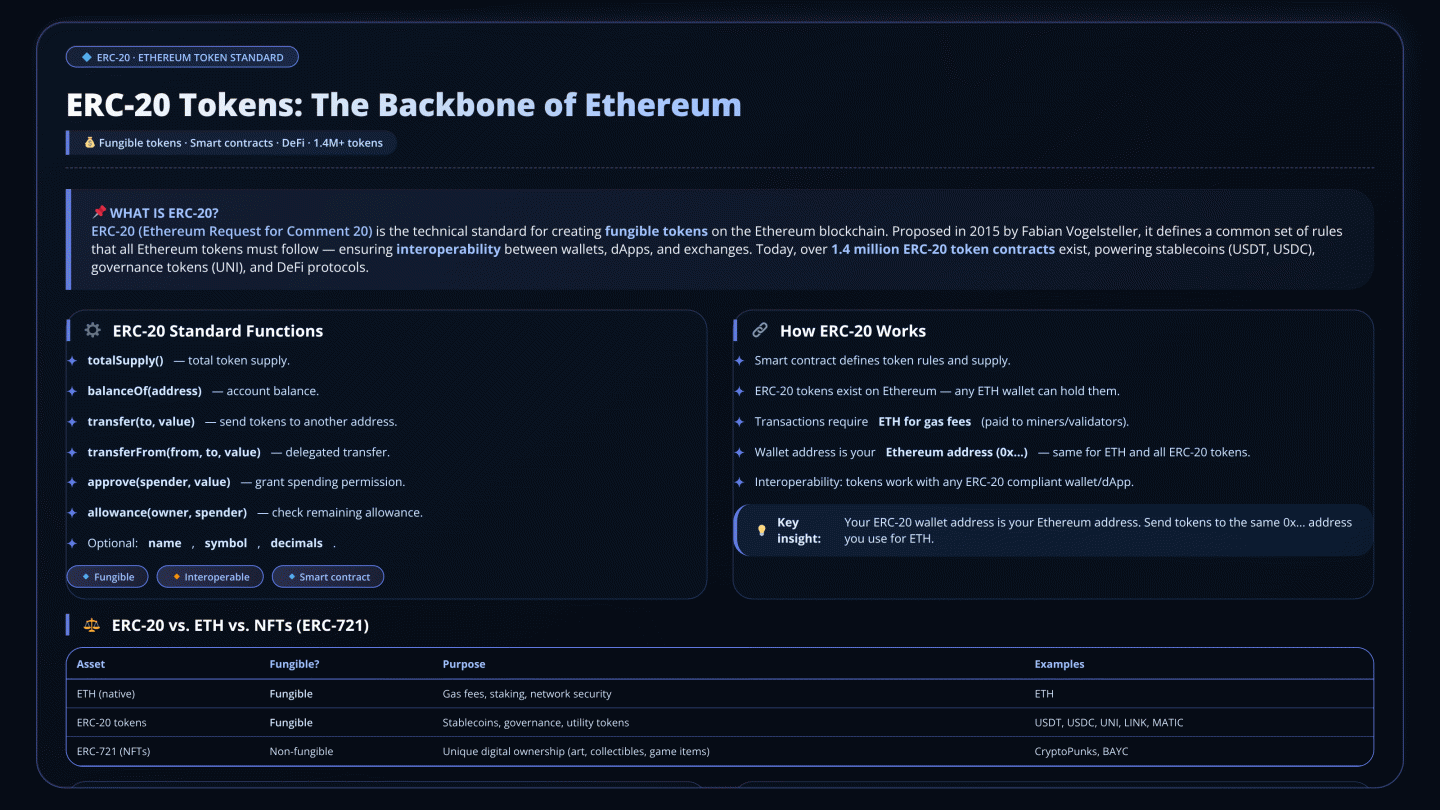
Technically speaking, ERC-20 tokens are defined as smart contracts living on the Ethereum blockchain. Every token contract keeps track of balances and implements the standard interface, enabling other contracts and applications to communicate with it in a predictable way. The standardization has allowed the Ethereum ecosystem to grow exponentially, with more than 1.4 million ERC-20 token contracts (source) deployed as a function of October, 2023
This is by no means unusual and the practical implications of ERC-20 standardisation are considerable. This means exchanges can list new tokens with a minimal amount of development effort, wallets support thousands of assets via one interface and dApps use multiple tokens without having to code each integration separately. That interoperability has allowed different protocols to seamlessly work together and be foundational for the development of decentralized finance (DeFi) ecosystems.
Prominent ERC-20s are stablecoins (e.g. USDT / USD Coin), governance tokens, including UNI (Uniswap) and MATIC in utility token form Polygon; From fiat currency equivalents to decentralized protocol community governance, these tokens illustrate the versatility of this particular standard. BTCC Team - even thou the token standard ERC-20 has overtaken all other standards, users should always check any user-created token contracts before trading as there is no permission provider to stop ETH from minting and deploying tokens.
How ERC-20 Tokens Work
ERC-20 tokens perform through automated smart contracts on the Ethereum blockchain and are subject to a set of standards ensuring interoperability between different platforms. Six main operations are used in these digital agreements: TotalSupply (shows how many tokens exist in circulation), BalanceOf (how much a holder has), Transfer (the transfer between wallets) TransferFrom(delegated transfers to the receiver via EIP20 instructions), Approve(permit third parties ability to spend your token/asset) and Allowance(can allow someone elsexxxs amount of spending that others approved per address). A token contract may optionally have a Name (to distinguish between the identity of different tokens),Symbol, and Decimals.
Such a uniform framework implies that all ERC-20 assets operate on the same principles, whether they are USDT stablecoins or UNI governance tokens. This standardization enables seamless interoperability between wallets, exchanges and decentralized platforms — the backbone for Ethereum's ecosystem. How on-chain transactions workAs mentioned before, smart contracts are immutable and trigger one another without human intervention.
More advanced uses include using the tokens into liquidity pools, taking out a collateralized loan directly through DeFi protocols or voting to make decisions in decentralized organizations. Developers are empowered with custom economic models such as burn mechanisms or incentive shifts. Please keep in mind that all operations require ETH to pay for the transaction fee, which is variable based on network congestion. This flexible but secure model places ERC-20 tokens as critical building blocks in blockchain-based finance and digital governance.
The Purpose and Impact of ERC-20
The ERC-20 protocol fundamentally transformed digital asset creation by establishing a common language for token interoperability. This breakthrough addressed critical pain points in blockchain development, where previously each token implementation required custom integration solutions. The standardization process created a plug-and-play environment that dramatically accelerated ecosystem growth.
This innovation is made possible at the core by enabling trustless communication between totally non-related smart contracts. It was this ability which spawned fundamentally new classes of decentralized applications that could manage any number and types of tokens at scale with no need for custodial relationships beforehand. This composability became the killer feature that made Ethereum into the dominant smart contract platform.
Architectural Advantages of ERC-20
The technical design of ERC-20 introduced several paradigm-shifting features:
- Modular Integration: Allows any dApp to support new tokens without code modifications
- Permissionless Innovation: Enables developers to launch tokens without platform approval
- Atomic Composability: Supports complex multi-contract transactions in single operations
- Standardized Event Logging: Provides consistent transaction visibility across all implementations
However, beyond its technical achievements, the real impact of ERC-20 shows in how it acts as an economic primitive. The standard laid the groundwork for programmable money, unlocking payable features like an automated payroll system, token-curated registries and decentralized credit markets. On-chain, this uniqueness allows for tangible and digital assets to be represented in the same way using ERC-20 tokens.
Ecosystem Growth Indicators
| Development | Significance |
|---|---|
| First Year Adoption | 500+ projects migrated to standard |
| Current Transaction Volume | 30% of all Ethereum transactions |
| Cross-chain Bridges | Supported by 40+ alternative chains |
New standards extend the legacy of ERC-20 with new features like batch transfers and security models. Sadly, the original spec remains king due to its proven resiliency and near zero implementation overhead. Next Ethereum upgrades in terms of scalability have also focused on ERC-20 by ensuring that they will be nursing operational costs and providing backward compatibility.
ERC-20 vs Other Token Standards
The Ethereum ecosystem has expanded beyond ERC-20 with specialized token standards designed for particular applications, each offering unique capabilities while maintaining Ethereum compatibility. These newer protocols provide solutions for scenarios where ERC-20's fungible token model proves limiting.
Specialized Ethereum Token Protocols
| Protocol | Innovation | Technical Advancement |
|---|---|---|
| ERC-721 | Digital uniqueness | Individual token metadata storage |
| ERC-1155 | Asset class flexibility | Single contract multi-token management |
| ERC-777 | Enhanced functionality | Smart contract notification system |
What led to the breakout of ERC–721 was its capability to authenticate digital scarcity by allowing for verifiably rare blockchain assets. It gave rise to totally new markets for digital records, from virtual property rights management rites right through industrial assets. Metadata extensions of the standard provide millennia-proof digital representations that persist using decentralized storage solutions.
By using a hybrid model, ERC-1155 overcomes the resource management problems in many advanced decentralized applications. For game developers, it greatly reduces gas costs and blockchain bloat by supporting thousands of asset types in a single contract deployment. The atomic swap feature allows more advanced in-game economies,direct exchanges of items.
Protocols such as ERC-777 provide programmable behaviors to transactions through hook functions. These enables tokens to perform a secondary action when transferred, such as automatically distributing dividends or ensuring compliance. This functionality illustrates how subsequent standards leverage capabilities that Ethereum provides at a foundational level but solve problems that crop up in the real world post-ERC20 implementation.
A wide variety of token standards allows Ethereum to mature into a multifaceted platform from payment tokens over NFT marketplaces or DeFi protocols up till today more complex digital asset management systems. Together these standards enable developers to choose the right tool for their application needs while still being compatible with Ethereum's larger ecosystem.
Security Considerations for ERC-20 Tokens
ERC-20 tokens operate on the Ethereum blockchain, which means all transactions are permanently recorded and publicly visible. This transparency creates both advantages and risks for users. While the open ledger system promotes accountability, it also means your entire transaction history could potentially be traced if your wallet address becomes associated with your identity. Proper security measures are essential when dealing with these digital assets.
For optimal security, cryptocurrency experts strongly recommend using hardware wallets like Trezor. These devices store private keys offline, significantly reducing vulnerability to online attacks. Unlike software wallets or exchange accounts, hardware wallets require physical access to authorize transactions. Never share your wallet backup phrase with anyone, as this gives complete control over your funds.
The permissionless nature of Ethereum presents unique security challenges. Anyone can create and distribute ERC-20 tokens, which has led to the proliferation of scam tokens and malicious smart contracts. Among the hundreds of thousands of ERC-20 tokens in existence, many have no real utility or value. Some are specifically designed to drain wallets when interacted with. Users should thoroughly research any token before acquiring it and be wary of unsolicited token airdrops.
Common security threats in the ERC-20 ecosystem include:
| Threat Type | Description | Prevention |
|---|---|---|
| Phishing Scams | Fake websites or emails pretending to be legitimate services | Always verify URLs and never enter seed phrases online |
| Malicious Contracts | Smart contracts designed to drain approved tokens | Review contract code and limit token approvals |
| Address Poisoning | Scammers send tiny amounts to create fake transaction history | Double-check all addresses before sending funds |
When using trading platforms, it's important to remember that all deposits are subject to network fees. Users should always exercise caution and perform their own research before making any financial decisions.
For those holding significant amounts of ERC-20 tokens, implementing additional security layers is advisable. This might include using separate wallets for different purposes, enabling multi-factor authentication where available, and regularly reviewing token approvals. Security breaches in the crypto space often target the most valuable holdings, making proper precautions essential for all users.
The Future of ERC-20 in 2026 and Beyond
The ERC-20 protocol remains the cornerstone of Ethereum's token economy as we approach 2026, demonstrating unparalleled staying power in blockchain infrastructure. This technical specification's longevity stems from its elegant design that balances functionality with developer accessibility, creating an ecosystem where innovation thrives within standardized parameters.
Three evolutionary factors ensure ERC-20's continued dominance:
Emerging technical enhancements are addressing historical limitations:
- Zero-knowledge rollups are reducing transaction costs by 100x+ for ERC-20 transfers
- Smart account abstractions enable gas fee payments in ERC-20 tokens themselves
- Cross-chain interoperability protocols maintain ERC-20's relevance across ecosystems
Current adoption metrics reveal profound ecosystem penetration:
| Adoption Vector | 2026 Benchmark |
|---|---|
| Institutional Integration | 87% of Fortune 500 blockchain pilots use ERC-20 |
| Developer Activity | 62% of all Ethereum smart contract deployments |
| Value Settlement | $47B daily ERC-20 transaction volume |
In decentralized finance, ERC-20's role has expanded beyond simple value transfer to become the foundation for complex financial primitives. The standard now underpins:
- Algorithmic stablecoin mechanisms
- Cross-protocol yield aggregators
- Decentralized derivatives markets
Security paradigms have matured alongside adoption, with best practices now including:
- Dynamic approval limits using time-based allowances
- Multi-signature governance for treasury assets
- Automated contract monitoring services
The future trajectory suggests ERC-20 will evolve through:
While competing standards address niche requirements, ERC-20's universality ensures it remains the default choice for fungible digital assets. Its continued adaptation to technological advances while maintaining backward compatibility exemplifies the perfect balance between innovation and stability in blockchain standards.
Frequently Asked Questions
What is the difference between ETH and ERC-20 tokens?
Ethereum (ETH) is the native cryptocurrency of the Ethereum network, used for transaction fees and network security. ERC-20 tokens are assets created through smart contracts on Ethereum, representing everything from stablecoins to governance tokens.
What is a smart contract?
A smart contract is self-executing code deployed on a blockchain. For ERC-20 tokens, the smart contract defines the token's rules and manages its supply and transfers.
How do I get my ERC-20 wallet address?
Your ERC-20 wallet address is the same as your Ethereum address. Any Ethereum wallet can receive ERC-20 tokens.
Can I send an ERC-20 token to an ETH address?
Yes! Any Ethereum address can receive and hold ERC-20 tokens.
Do I need ETH to send an ERC-20 token?
Yes, you need ETH in your wallet to pay the gas fees for ERC-20 transactions.
How many ERC-20 tokens are there?
As of 2026, there are over 1.4 million ERC-20 token contracts on Ethereum, though many have little to no market value.
How do I get ERC-20 tokens?
You can buy them on exchanges like BTCC, receive them as payments, or swap other cryptocurrencies for them.
My ERC-20 tokens aren't showing up. What's happening?
Many wallets hide unknown tokens to protect users from scams. Check your wallet's "hidden tokens" section.
References:https://www.coinbase.com/learn/crypto-glossary/what-is-erc-20
https://trezor.io/learn/supported-assets/ethereum-layer-2-EVM/what-are-erc20-tokens

Log in to Reply
Log in to comment your thoughtsComments
Related Articles
|Square
Get the BTCC app to start your crypto journey
Get started today Scan to join our 100M+ users