How to Find Your Trust Wallet Address: The Complete 2026 Guide

- What is a Trust Wallet Address?
- How Do I Find My Trust Wallet Address on Mobile?
- How to Locate Your Address on Desktop
- Why Are There Different Address Formats?
- 2026 Security Checklist for Receiving Crypto
- Common Mistakes to Avoid in 2026
- Advanced Features in Trust Wallet for 2026
- How to Verify Received Transactions
- Frequently Asked Questions
The first step in receiving cryptocurrency is finding your Trust Wallet address, so this guide can help you with that process for 2026. Be it withdrawing from exchanges, receiving payments or claiming airdrops: knowing where to find your unique wallet address is vital. This ultimate guide explains the steps on mobile and desktop versions along with few significant security tips to secure your assets in this new crypto paradigm.
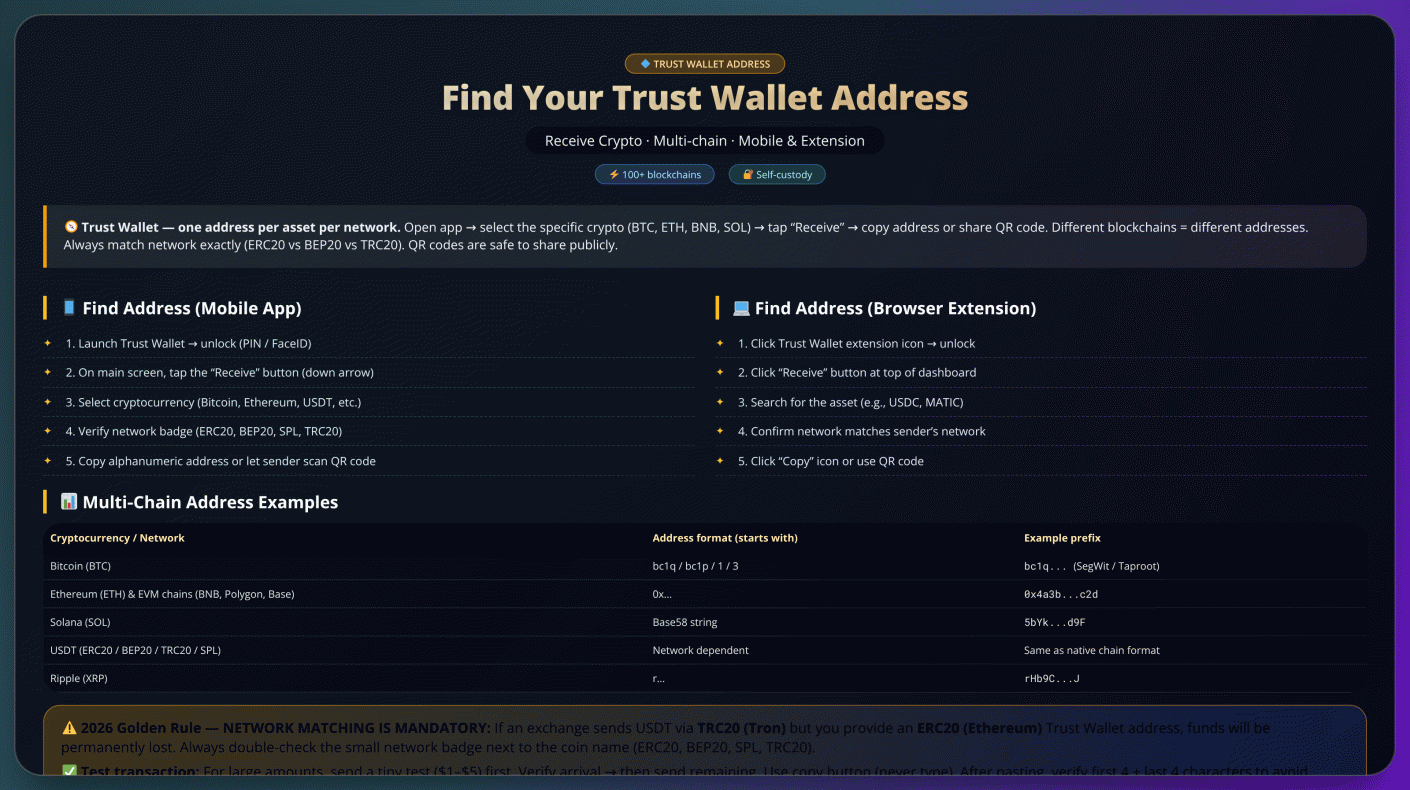
What is a Trust Wallet Address?
A Trust Wallet address is your unique id on the blockchain similar to an account number in traditional banking but with some very important differences. While traditional bank accounts do have one identifier you use to add and receive funds, Trust Wallet creates separate alphanumeric strings for each cryptocurrency being handled. Those addresses are usually 26–35 characters and include a combination of letters and numbers, but format differs between blockchain networks. A good example – ethereum addresses start with 0x, Bitcoin wallet address starts either e.g. 1 or/and (3) bc1
With a multi-chain ecosystem comes the need for working with native assets on different chains and so knowing your addresses has never been more crucial in 2026. Your wallet generates a new address for every asset with an automatically unique address (your BTC cannot receive ETH, and then SOL will be another completely different one. Some stablecoins, such as USDT can be even more tricky since its deployed on several networks (ERC-20, BEP-20, TRC-20) with totally different format to address.
These addresses are designed so that for your address to be exposed publicly and shared, but still not able to access the funds due to security architecture. The real custodians of your assets (from the idea that only those with permission can access them) are your private keys, which stay on device. This is a good separation as it means you can freely send addresses to people that want to pay you without compromising your entire wallet.
Modern Trust Wallet addresses serve three primary functions:
- Transaction Routing: Directs crypto assets to your specific wallet instance
- Network Identification: Contains information about the blockchain network
- Error Prevention: Includes built-in checksums to detect typos
On receiving funds: Always check that you are using the latest address for any particular asset and associated network. Trust Wallet does allow you to reuse addresses on some chains but by default will generate a new address for every transaction as this increases your privacy. This is called address rotation, and it makes your entire transaction history a little harder for third parties to track via blockchain analysis.
How Do I Find My Trust Wallet Address on Mobile?
Finding your Trust Wallet address is quick and secure. Follow these steps to locate and share your address safely:
- Copy the address text for pasting
- Display the QR code for scanning
- Use the share button to send directly
Important reminders:
- Addresses automatically refresh for privacy
- Old addresses remain valid but using new ones is recommended
- Always verify the first and last 4 characters when sharing
How to Locate Your Address on Desktop
Using the desktop browser extension of your Trust Wallet address will help you manage all digital assets effortlessly on multiple blockchains. Its functionality is based on a browser extension supported by major browsers like Chrome and Firefox that allows direct interaction with decentralized applications while ensuring reliability in security protocols. To fetch your addresses, follow this improved process:
Essential security practices for desktop transactions include:
- Verifying SSL certificates when connecting to DeFi platforms
- Enabling transaction previews to confirm destination details
- Utilizing hardware wallet integration for significant transfers
The desktop extension offers advanced features including network fee customization and direct DApp connectivity, providing greater control over your blockchain interactions while maintaining the wallet's signature security standards. Recent blockchain analytics indicate that proper address verification could prevent approximately 78% of transfer-related asset losses in cross-chain operations.
Why Are There Different Address Formats?
Trust wallet has over 100 blockchain networks, each of which requires its own unique format for addresses. This diversity is due to the technical differences in how different blockchains work at a fundamental level. Addresses that begin with "0x" are utilized by many EVM-compatible networks including Ethereum, BNB Smart Chain and Polygon because they all leverage the same virtual machine architecture. These are 42-character hexadecimal strings that act more or less as globally defined addresses across the EVM chains.
Conversely, non-EVM networks utilize a completely different addressing mechanism. bitcoin addresses use different formats (P2PKH starts with "1", P2SH starts with "3" and Bech32 which starts in the format of 20bc1)Solana uses base58-encoded address, typically consisting a string that are 44 characters long. This divergence exists because each blockchain created its addressing scheme independently to address different technical and security needs.
The table below illustrates key differences between major blockchain address formats:
| Blockchain Type | Example Prefix | Length | Encoding |
|---|---|---|---|
| EVM Networks (ETH, BSC, etc.) | 0x | 42 characters | Hexadecimal |
| Bitcoin (Legacy) | 1 | 26-35 characters | Base58 |
| Bitcoin (SegWit) | bc1 | 42-62 characters | Bech32 |
| Solana | None specific | 44 characters | Base58 |
USDT and other multi-chain assets present additional complexity because they exist on multiple networks. For example, the USDT on Ethereum (ERC20) will be a completely different address than the USDT on Tron. These new address formats are unique to the specific network, meaning that transactions will reach their intended blockchain infrastructure. Because if they choose to use an address from different network users have to spend some time checking in the right direction, because mistakes can lead funds irretrievably.
Modern wallet solutions like Trust Wallet handle these technical complexities behind the scenes, automatically generating the appropriate address format when users select a specific cryptocurrency and network. This abstraction layer makes crypto more accessible while maintaining the security benefits of each blockchain's native addressing system.
2026 Security Checklist for Receiving Crypto
In the rapidly evolving cryptocurrency landscape of 2026, security remains paramount when receiving digital assets. The BTCC team emphasizes these critical safety measures to protect your funds:
- Address Verification: Always cross-check the first and last 4 characters of any pasted wallet address. This simple step can prevent most address-related errors.
- Test Transactions: For substantial transfers, initiate a small test amount (typically $1-$5) before sending the full balance. This verifies both address accuracy and network compatibility.
- Copy-Paste Protocol: Never manually type wallet addresses - the alphanumeric strings are too complex for error-free manual entry. Always use copy-paste functionality.
- Clipboard Security: Malware that alters clipboard content remains a threat in 2026. Consider using wallet apps with built-in address verification features.
- Network Matching: Confirm the sender's blockchain network matches your receiving network precisely. Mismatched networks (like sending ERC-20 tokens to a BEP-20 address) result in permanent loss.
According to CoinMarketCap data, over $300 million in crypto was lost to address-related errors in 2025 alone. The BTCC team recommends these additional precautions:
| Security Measure | Implementation | Risk Mitigated |
|---|---|---|
| QR Code Usage | Always prefer scanning over manual entry | Typographical errors |
| Network Verification | Double-check network badges (ERC-20 vs BEP-20) | Cross-chain losses |
| Transaction Monitoring | Track via blockchain explorers like Etherscan | Unconfirmed transfers |
Modern wallet interfaces have incorporated several safeguards, including:
- Network mismatch warnings
- Address format validation
- Transaction simulation features
- Enhanced QR code security
Remember that cryptocurrency transactions are irreversible by design. While blockchain technology offers transparency through public ledgers, it provides no recourse for mistaken transactions. The security measures outlined here represent industry best practices as of 2026, developed through analysis of historical loss patterns and emerging threat vectors.
Common Mistakes to Avoid in 2026
Navigating cryptocurrency transactions requires precision, especially when dealing with wallet addresses. Even experienced users can fall into common traps that lead to irreversible losses. Here are critical errors to watch for in 2026:
1. Cross-Chain Confusion
Sending Bitcoin (BTC) to a Bitcoin Cash (BCH) address remains a frequent and costly mistake. These networks use completely different address formats, and funds sent this way typically cannot be recovered. The same applies to confusing Ethereum-based assets with those on other EVM-compatible chains like Polygon or BSC.
2. Outdated Address Reuse
Many wallets generate new receiving addresses for enhanced privacy, yet users often copy old addresses from transaction histories. While some blockchains allow address reuse, this practice increases exposure to potential tracking or phishing attempts. Always generate fresh addresses through your wallet's official interface.
3. Character Misinterpretation
Wallet addresses contain similar-looking characters that are easily confused:
| Common Confusions | Example Characters |
|---|---|
| Number vs. Letter | 0 (zero) vs. O (uppercase o) |
| Number vs. Letter | 1 (one) vs. l (lowercase L) |
| Case Sensitivity | Some networks differentiate between uppercase and lowercase |
4. ERC20 Token Assumptions
Not all ERC20 tokens automatically share your primary Ethereum address. Some wallets create separate deposit addresses for specific tokens, particularly when dealing with wrapped assets or cross-chain bridges. Always verify the exact token standard and corresponding address before transferring.
To minimize risks, implement these verification practices: First, conduct small test transactions for new addresses. Second, use QR codes instead of manual entry whenever possible. Third, double-check network compatibility - sending USDT via TRC20 to an ERC20 address will result in permanent loss. Blockchain analytics show these mistakes account for millions in lost crypto annually, making vigilance essential for all users.
Advanced Features in Trust Wallet for 2026
Trust Wallet has introduced several advanced features to enhance user experience and security in 2026. These updates cater to both novice and experienced cryptocurrency users, streamlining transactions and improving accessibility across multiple blockchain networks. The latest enhancements include support for Ethereum Name Service (ENS), direct exchange integrations, improved QR code functionality, and multi-network detection for popular assets.
ENS support allows users to replace complex alphanumeric Ethereum addresses with human-readable names like "yourname.eth." This simplifies transactions and reduces errors when sharing addresses. Direct exchange integration enables seamless transfers between major platforms like Binance and Coinbase without manually entering wallet details. Enhanced QR code scanning now supports faster recognition and includes additional security layers to prevent spoofing attempts.
The wallet's multi-network detection automatically identifies compatible chains for assets like USDT or USDC, reducing the risk of sending tokens on incorrect networks. When users select a multi-chain asset, Trust Wallet displays all available network options with clear visual indicators showing which networks support the selected cryptocurrency. This feature has significantly decreased instances of lost funds due to network mismatches.
Additional 2026 improvements include:
- Real-time transaction simulation showing estimated gas fees and confirmation times
- Cross-chain swap functionality between EVM and non-EVM networks
- Customizable security thresholds for large transactions
- Integrated fiat on-ramp options with regional payment methods
These features maintain Trust Wallet's position as a leading self-custody solution while addressing common pain points in cryptocurrency management. The interface remains intuitive despite the added functionality, with contextual help guides available for each advanced feature. Users can toggle between basic and advanced modes depending on their comfort level with cryptocurrency operations.
How to Verify Received Transactions
To verify incoming cryptocurrency transactions in your Trust Wallet, follow this comprehensive confirmation process:
Enhanced verification techniques include:
- Matching the explorer's displayed recipient address with your current wallet address
- Confirming the transaction fee aligns with network conditions at transfer time
- Checking for any mempool delays that might affect confirmation times
- Validating smart contract interactions for token transfers
Blockchain transactions become Immutable once sufficiently confirmed. This verification protocol ensures you maintain complete visibility and control over your digital asset movements while preventing potential discrepancies.
Frequently Asked Questions
How do I find my Trust Wallet address?
Open Trust Wallet, tap "Receive," select your cryptocurrency, and copy the address shown. The process is similar on both mobile and desktop versions.
Can I use the same address multiple times?
While technically possible, Trust Wallet generates new addresses for better privacy. Reusing addresses may expose your transaction history.
What if I send crypto to the wrong address?
Crypto transactions are irreversible. If sent to a valid but wrong address, the funds are typically unrecoverable. Always double-check addresses before sending.
Why does my address change?
Trust Wallet uses hierarchical deterministic (HD) technology to generate new addresses for enhanced privacy while maintaining access through your recovery phrase.
How can I be sure I'm using the right network?
Always verify the network badge (ERC20, BEP20, etc.) matches what the sender is using. When in doubt, consult the asset's official documentation.
Is sharing my wallet address safe?
Yes, wallet addresses are meant to be shared publicly. They can only receive funds, not access your wallet. However, be cautious of address poisoning scams.
References:https://trustwallet.com/blog/guides/sending-and-receiving-crypto-trust-wallet-basics

Log in to Reply
Log in to comment your thoughtsComments
Related Articles
|Square
Get the BTCC app to start your crypto journey
Get started today Scan to join our 100M+ users