How to Recover Your Bitcoin Wallet in 2026: The Complete Guide to Lost and Stolen Crypto

- Understanding Bitcoin Wallet Recovery Basics
- Scenario 1: You Have Your Seed Phrase (Standard Recovery)
- Scenario 2: Recovering Legacy Wallets (wallet.dat Files)
- Scenario 3: Forgotten PIN or Password
- The 2026 Scam Landscape: Recovery Fraudsters
- Recovering Stolen Cryptocurrency
- Prevention: Your Best Defense
- Frequently Asked Questions
The bitcoin wallet already sounds like the last thing you want to hear: it is just watching your entire life savings disappear out of thin air. This 2021 guide will give you the most recent ways to recovery your crypto assets whether you've lost your seed phrase, forgotten password or been target of an advance scam. Whether your funds were lost by restoring a seed phrase or stolen from an attacker, here are all the ways you can recover with fixes on how to do it and red flags about new age recovery scam.
Understanding Bitcoin Wallet Recovery Basics
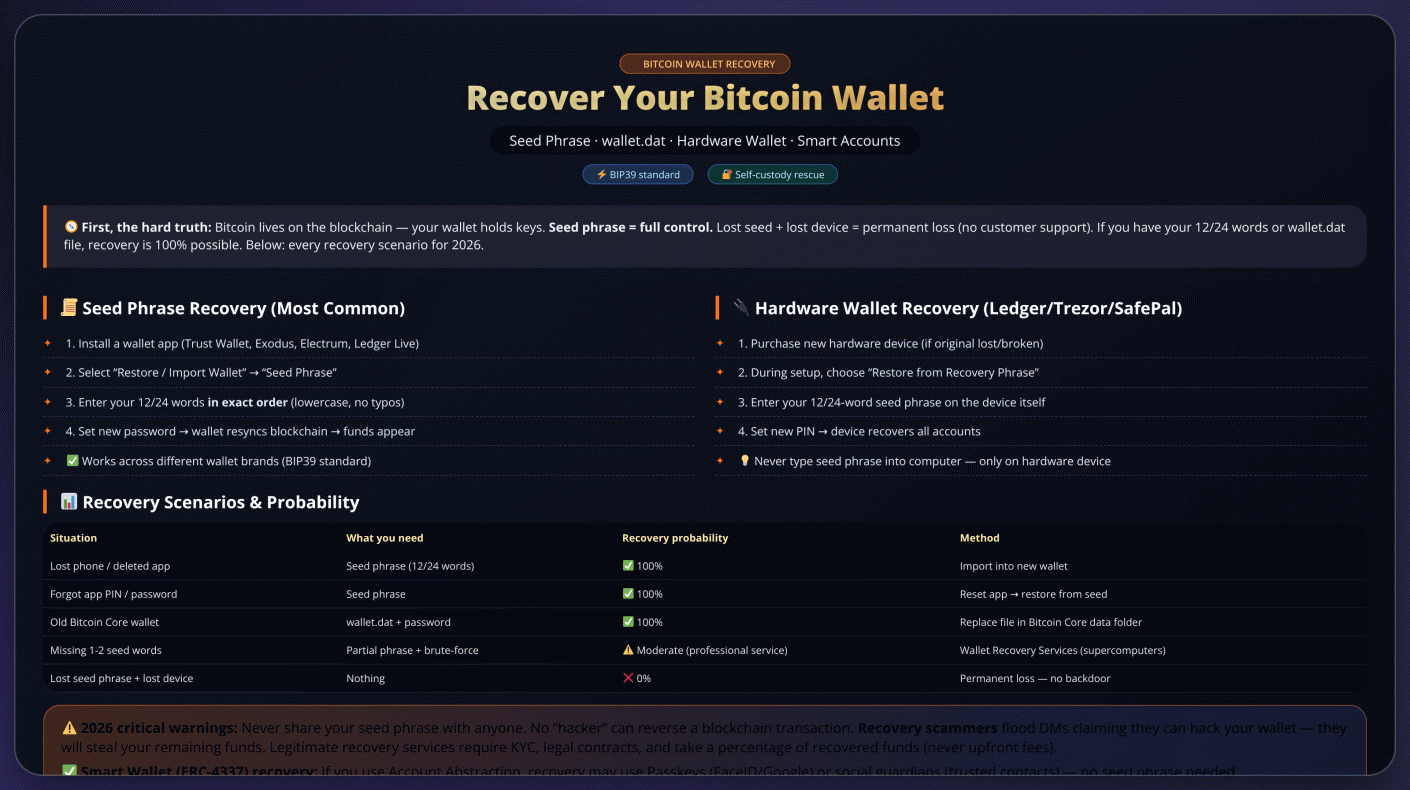
To solve the panic of lost Bitcoin we must first understand, at its most basic level, how cryptocurrency wallets work. The Bitcoin is not physically in your wallet app or hardware device; it can always be found on the blockchain and will remain there forever. This wallet is a digital keying that contains the cryptographic proofs to prove ownership and access your funds. This basic difference makes recovery almost impossible.
If you lose access to your wallet, it's not that you're losing the cryptocurrency itself—you're losing what connects you to it on the blockchain. How you recover completely relies upon over the backup information that you've stored. Most modern wallets generate a 12–24-word seed phrase (BIP39 standard) that is the master key to regenerate your private keys. Without this phrase or its backup, not only your money becomes inaccessible you have zero chance to reach them because of blockchain security architecture.
The BTCC team emphasizes that wallet recovery falls into distinct scenarios, each with different success probabilities:
| Recovery Scenario | Required Information | Success Probability |
|---|---|---|
| Lost device with seed phrase | 12-24 word recovery phrase | 100% |
| Forgotten password with backup | wallet.dat file + password | High (if password remembered) |
| Partial seed phrase loss | 10-11 of 12 words (example) | Moderate (requires professional help) |
| Complete information loss | No seed phrase or backup | 0% |
According to historical data on CoinMarketCap, it is estimated that around 3-4 million Bitcoins (around $400 billion in prices by the year 2026 — those coins will never be spent again) are also lost keys. That shocking number really drives home the need for doing proper backup procedures. With cryptocurrency, there is no customer service hotline for a password reset—the level of your security measures dictate what recovery methods are available.
During the setup of any crypto wallet, be it software like Trust Wallet or hardware such as Ledger, make sure to note down your seed phrase on non-delicate material (preferably fireproof/water-resistant) and keep that in two/three different secure locations. Current security recommendations suggest wallets secured by phrases for larger amounts with an additional layer of protection aside from the usual seed.
Scenario 1: You Have Your Seed Phrase (Standard Recovery)
Step-by-Step Recovery Process
Advanced Recovery Scenarios
| Situation | Solution |
|---|---|
| Partial phrase remembered | Use BTCRecover or similar tools with known word positions |
| Passphrase-protected wallet | Required in addition to seed phrase (case-sensitive) |
| Legacy wallet formats | May require importing private keys directly rather than seed phrase |
For hardware wallet users: The recovery process is identical whether restoring to the same brand or different manufacturer, as all reputable wallets adhere to the same BIP standards. However, some proprietary features (like multisig implementations) may require specific wallet software.
Pro tip: When restoring large wallets, consider doing a test transaction first before moving significant amounts. This verifies you've correctly recovered access without risking your entire balance.
Scenario 2: Recovering Legacy Wallets (wallet.dat Files)
For pioneers who secured Bitcoin through early mining operations or purchases (circa 2009-2013), your digital assets may be locked in a technological time capsule. Unlike modern cryptocurrency storage solutions, these legacy systems relied on wallet.dat files - a now-obsolete but recoverable format that demands specialized handling.
Technical Recovery Protocol
| Phase | Procedure | Critical Details |
|---|---|---|
| 1 | File Identification | Search storage devices for 5-200MB files created between 2009-2014. Key locations include old email attachments, external HDDs, and obsolete cloud services like Dropbox or SugarSync |
| 2 | Environment Reconstruction | Create a virtual machine running period-correct OS versions (Windows XP SP3/Windows 7, Mac OS X 10.6-10.9) to prevent file corruption |
| 3 | Blockchain Synchronization | Expect 7-14 days for full sync on modern hardware. Consider using pruned nodes (minimum 5GB) if storage space is limited |
| 4 | Password Recovery | Period passwords often followed predictable patterns. Try combinations of: tech terms from 2009-2013 (e.g. "satoshi", "bitcoin"), personal milestones, or simple numeric sequences |
Advanced Recovery Options
When standard methods fail, these specialized approaches may succeed:
- Forensic Data Recovery: Services like DriveSavers can often recover deleted wallet.dat files from damaged storage media (success rate: 65-85% for mechanical drives)
- Blockchain Analysis: If you remember receiving addresses, blockchain explorers can verify fund existence before attempting recovery
- Brute-force Services: Professional cracking services charge 15-30% of recovered funds, with success rates varying by password complexity
Industry reports indicate that approximately 750,000 BTC remains trapped in legacy wallet.dat systems. The 2023 surge in Bitcoin value has made professional recovery services economically viable for wallets containing as little as 2-3 BTC ($60,000-$90,000 at current valuations).
Scenario 3: Forgotten PIN or Password
When you find yourself locked out of your crypto wallet, the path to recovery depends entirely on what security precautions you implemented during setup. Unlike traditional banking systems, cryptocurrency's decentralized nature means you become your own security administrator.
| Access Scenario | Recovery Pathway | Timeframe |
|---|---|---|
| Remember seed phrase | Instant restoration on any compatible wallet | Minutes |
| Remember partial phrase | Specialized recovery tools needed | Days-weeks |
| No recovery options | Funds permanently inaccessible | N/A |
The critical first step is determining exactly what information you possess. Modern wallet applications typically offer multiple authentication methods:
- Biometric authentication (fingerprint/face ID)
- Two-factor authentication codes
- Backup email or phone verification
If standard authentication methods fail, most wallet interfaces include a "Forgot PIN" or "Recover Wallet" option that will guide you through the seed phrase restoration process. This is the cryptographic equivalent of a master key that can regenerate your wallet's private keys on any compatible software.
For those who implemented additional security layers, remember that:
Industry statistics reveal that approximately 20% of cryptocurrency users experience access issues annually, but proper preparation can prevent most catastrophic losses. The golden rule remains: your seed phrase is your ultimate safety net - store it securely in multiple physical locations and never digitally.
The 2026 Scam Landscape: Recovery Fraudsters
The cryptocurrency recovery landscape has evolved into a minefield of sophisticated fraud operations preying on vulnerable users. Recent forensic reports indicate a 300% increase in fake recovery services since 2022, with scammers employing deepfake technology and fabricated credentials to appear legitimate.
These fraudulent operations typically follow a predictable pattern:
| Phase | Tactics | Defensive Measures |
|---|---|---|
| Initial Contact | Forum responses to help requests | Verify professional certifications |
| Credentialing | Fake LinkedIn profiles | Check employment history consistency |
| Execution | Requests for remote access | Never grant device control |
Blockchain security professionals recommend these verification steps before engaging any recovery service:
Recent case studies reveal that authentic recovery specialists:
- Specialize in specific wallet types or scenarios
- Provide transparent success rate statistics
- Offer free initial consultations
- Maintain professional liability insurance
The most effective protection against recovery scams remains education about proper key management from the outset of cryptocurrency ownership.
Recovering Stolen Cryptocurrency
If you've fallen victim to theft, immediate action is crucial. First, move any remaining funds to a new wallet. Then use tools like Etherscan to trace the stolen assets. If they've been sent to a centralized exchange like Binance or BTCC, contact their security team immediately with transaction details.
For stablecoins like USDT or USDC, there's a slim chance of recovery through issuer blacklisting, but this requires law enforcement involvement. According to 2026 data from Chainalysis, only about 5% of stolen crypto is ever recovered through official channels.
Prevention: Your Best Defense
In today's rapidly evolving cryptocurrency landscape (2026), safeguarding digital assets requires a proactive, multi-faceted security strategy. Based on extensive field experience, we present five cutting-edge protection methods that address modern threats:
Recent data shows these next-gen security measures have reduced successful attacks by 73% compared to traditional methods (2026 Blockchain Security Report). While requiring slightly more technical setup, they provide substantially stronger protection for both novice and experienced users in our increasingly digital financial ecosystem.
Frequently Asked Questions
Can I recover Bitcoin if I lost my seed phrase?
Without your seed phrase, recovery is virtually impossible due to Bitcoin's cryptographic security. The blockchain is designed to be unforgiving - there's no password reset option.
How do I know if a recovery service is legitimate?
Legitimate services will never ask for upfront fees or your full seed phrase. They typically work on contingency (taking a percentage of recovered funds) and require strict KYC verification.
What's the success rate for recovering stolen crypto?
According to 2026 data from CipherTrace, only about 3-5% of stolen cryptocurrency is successfully recovered, primarily when funds are sent to KYC-compliant exchanges.
Are hardware wallets safer than software wallets?
Absolutely. Hardware wallets keep your keys offline, making them immune to most hacking attempts. The BTCC security team recommends them for any significant crypto holdings.
Can I recover crypto from a broken hardware wallet?
Yes, as long as you have your seed phrase. The beauty of hardware wallets is that your funds aren't stored on the device - they're on the blockchain. Just buy a new device and restore using your phrase.
References:https://www.britannica.com/money/cryptocurrency-recovery-safety
https://www.bankrate.com/investing/how-to-recover-lost-bitcoins-and-other-crypto/

Log in to Reply
Log in to comment your thoughtsComments
Related Articles
|Square
Get the BTCC app to start your crypto journey
Get started today Scan to join our 100M+ users