World Liberty Financial’s USD1 Makes Bold Move Onto Solana Blockchain

Stablecoin expansion hits warp speed as institutional player bridges traditional finance with DeFi's fastest network.
The Solana Migration
World Liberty Financial deploys its USD1 stablecoin onto Solana's high-throughput blockchain—bypassing Ethereum's congestion and gas fees that have plagued institutional adoption. The move positions USD1 to capture market share in the rapidly growing real-world asset tokenization space.
Speed Versus Tradition
Solana's architecture processes transactions at fraction of the cost and time compared to legacy financial networks—cutting settlement times from days to seconds while maintaining regulatory compliance. Because nothing says 'financial innovation' like recreating traditional banking products on a blockchain that occasionally takes naps.
The expansion signals growing institutional confidence in Solana's infrastructure despite crypto's volatile reputation—proving that even traditional finance can't resist the siren call of sub-second finality.
World Liberty Financial’s native token launch
USD1’s integration into Solana goes live on the same day as World Liberty Financial’s WLFI token debut on major crypto exchanges like Binance, Bybit, OKX, KuCoin and more. At press time, the trading data for the token is not available yet.
However, data for perpetual contracts that was launched one month is available. According to data from TradingView, future products or perpetual contracts based on WLFI/USDT are now trading at around $0.318.
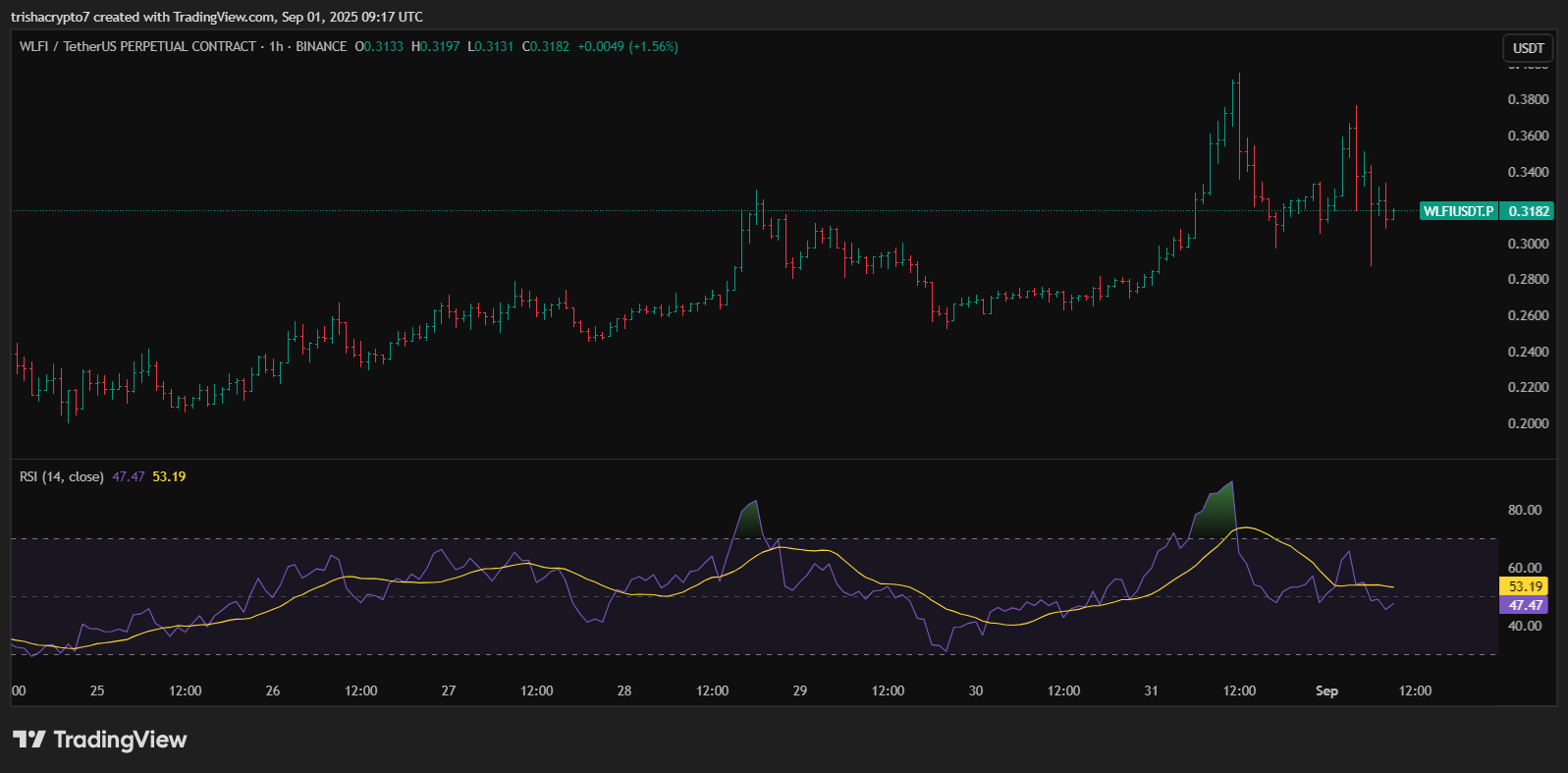
Aside from the token launch of World Liberty Financial’s token, the surge is likely driven by momentum surrounding the expansion of WLFI’s USD1 stablecoin to Solana, which boosted speculative interest. However, the token experienced a slight correction which highlights profit-taking and hesitancy.
The Relative Strength Index reflects this cooling momentum: after spiking into overbought territory above 70 during the rally, it has since returned to a neutral zone around 47 until 53. This indicates that buying pressure has eased, and WLFI is consolidating rather than continuing its parabolic move.
