Bitcoin & Ethereum Hold Strong Amid Market Calm – Stablecoin Reserves Hit Record Highs

Crypto markets shrug off volatility as giants BTC and ETH enter steady accumulation phase.
Stablecoins balloon to $180B – Traders park cash waiting for the next big move.
The calm before the storm? While risk assets stabilize, smart money's building war chests.
Wall Street analysts mutter about 'irrational stability' between sips of $8 oat milk lattes.
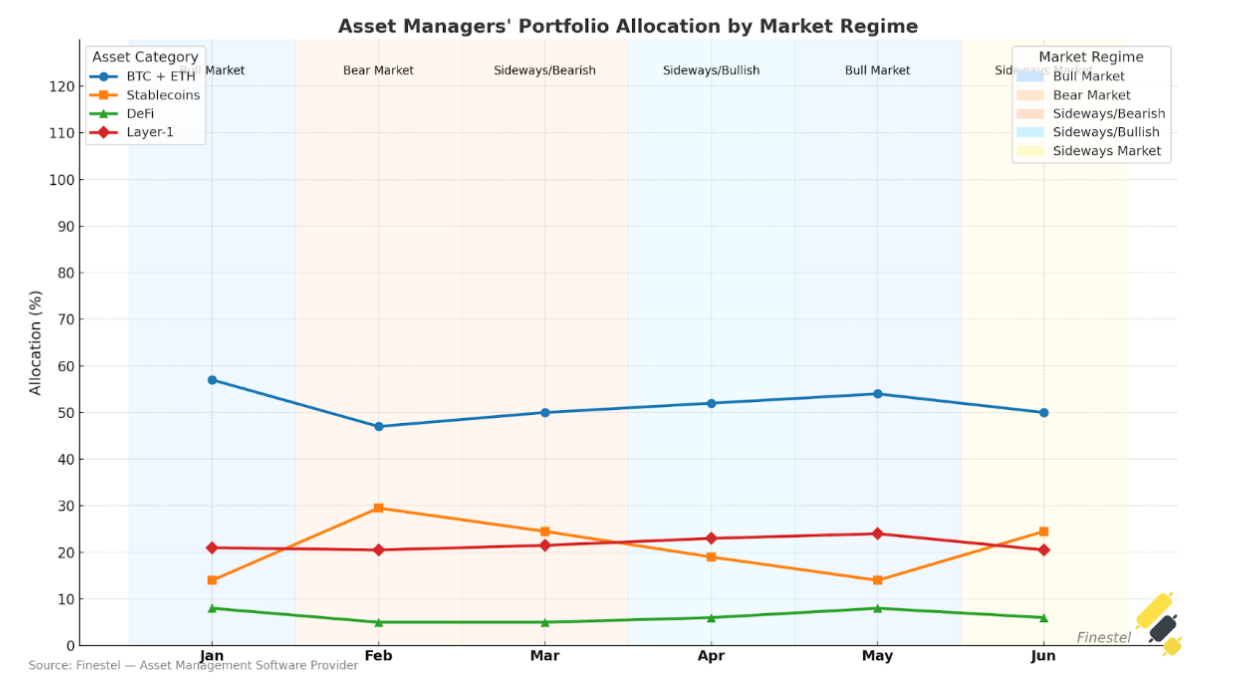 Asset managers’ portfolio allocation by market regime | Source: Finestel
By May, that setup hardly budged. BTC and ETH together accounted for 54%, with layer-1s at 24%, DeFi at 8%, and stablecoins at 14%. That might suggest that, in strong up-markets, managers keep a steady overweight in Core tokens and key smart-contract chains.
The mood appeared quite different in February, when BTC and ETH allocations fell to about 47%, down 10% from January. At the same time, stablecoin holdings nearly doubled to almost 30%. During that pullback, managers appear to have relied on Tether (USDT) and USD Coin (USDC) for liquidity and downside protection. Exposure to high-beta DeFi assets reportedly dropped from 8% to 5%, while layer-1s eased to around 20.5%, preserving what the report calls “dry powder” for when markets calm.
Risk-managed baseline
When markets moved sideways — in March, April, and June — allocations appeared to be relatively balanced. In March, for instance, BTC and ETH held steady at 50%, stablecoins sat at 24.5%, and DeFi and layer-1 hovered around 5% and 21.5%, respectively. That mix seems to reflect a cautious reentry into yield strategies as volatility cooled.
April brought another mild shift toward risk. As price action teased new highs, BTC and ETH ROSE to 52%, DeFi inched up to 6%, and layer-1 tokens climbed to 23%. Stablecoins fell to 19%, blending momentum plays with income generation.
By June, after a mild sell-off, portfolios had reverted to a structure resembling that of March. Bitcoin and Ethereum were back at 50%, stablecoins at 24.5%, DeFi at 6%, and layer-1 at 20.5%. That return to a more defensive posture suggests managers remained cautious about upside after the earlier rally.
Finestel’s report emphasizes three themes that appear consistent across all regimes:
- Core Consistency. Bitcoin and Ethereum appear to be anchoring roughly half of most portfolios, serving as what the report refers to as a “risk-managed baseline.”
- Dynamic Dry Powder. Stablecoins fluctuate between 14% and 30%, offering tactical liquidity to buy dips or hedge against market downturns.
- Selective Growth. Allocations to DeFi and layer-1 expand in bullish or cooling phases, aimed at harvesting yield or tactical alpha, but get trimmed when markets turn risk-off.
Of course, these figures aren’t one-size-fits-all. The report doesn’t identify specific firms or their performance targets, and it’s unclear how rebalancing frequency or fee structures might affect the results. For everyday investors, it obviously isn’t a plug-and-play playbook.
And yet, Bybit‘s numbers from a recent research report tell a similar story, with a twist though. They show that Bitcoin’s slice of everyone’s wallets has been climbing, now almost 31%, up from about 25% back in November. Even with all the ups and downs this year, people continue to come back to BTC as their go-to.
At the same time, XRP has quietly moved into third place among non-stablecoins, nudging out Solana, whose share has dropped by about a third since last fall. And it’s not just regular traders doing this. Institutions have nearly 40% of their holdings in Bitcoin, compared with about 12% for retail investors, showing how BTC is both a crowd-pleaser for everyday buyers and a macro hedge for the big players.
