VanEck Warns: Crypto Treasury Firms Face Revenue Squeeze as Market Volatility Plummets

Crypto's calm is becoming corporate treasury's nightmare.
The Great Stabilization Hits Revenue Streams
VanEck's latest analysis reveals an ironic twist—the very market stability everyone claimed to want now threatens the business models of crypto treasury firms. As wild price swings become increasingly rare, the traditional profit engines of these companies are sputtering.
Volatility Drops, Margins Shrink
Remember when 20% daily moves were normal? Those days are fading faster than a meme coin's relevance. Treasury operations that built their strategies around capturing volatility premiums now face the harsh reality of compressed yields and diminishing arbitrage opportunities.
Adapt or Become Digital Dinosaurs
The warning couldn't come at a worse time—just when traditional finance was finally warming up to crypto treasury management. Firms now face the ultimate test: innovate beyond simple volatility plays or risk becoming another footnote in crypto's evolutionary history.
Because nothing says 'mature asset class' like watching your revenue streams evaporate while Wall Street bankers nod knowingly about 'market efficiency.'
How BNMR shows game in action
Bitmine’s BNMR share provides a clear example of how this works in action. VanEck analysts highlight that BNMR is “the most widely traded DAT by nearly a factor of two,” yet it still has to underprice volatility to attract buyers.
Bitmine Immersion, the largest ETH-focused DAT with more than $11 billion in ethereum (ETH) holdings, recently sold shares at $70 while the stock was trading at $61.39. These shares came with two warrants to buy more stock at a higher price. Using options math, each warrant is worth roughly $20, meaning the total package was worth about $104.61, but investors paid only $70.
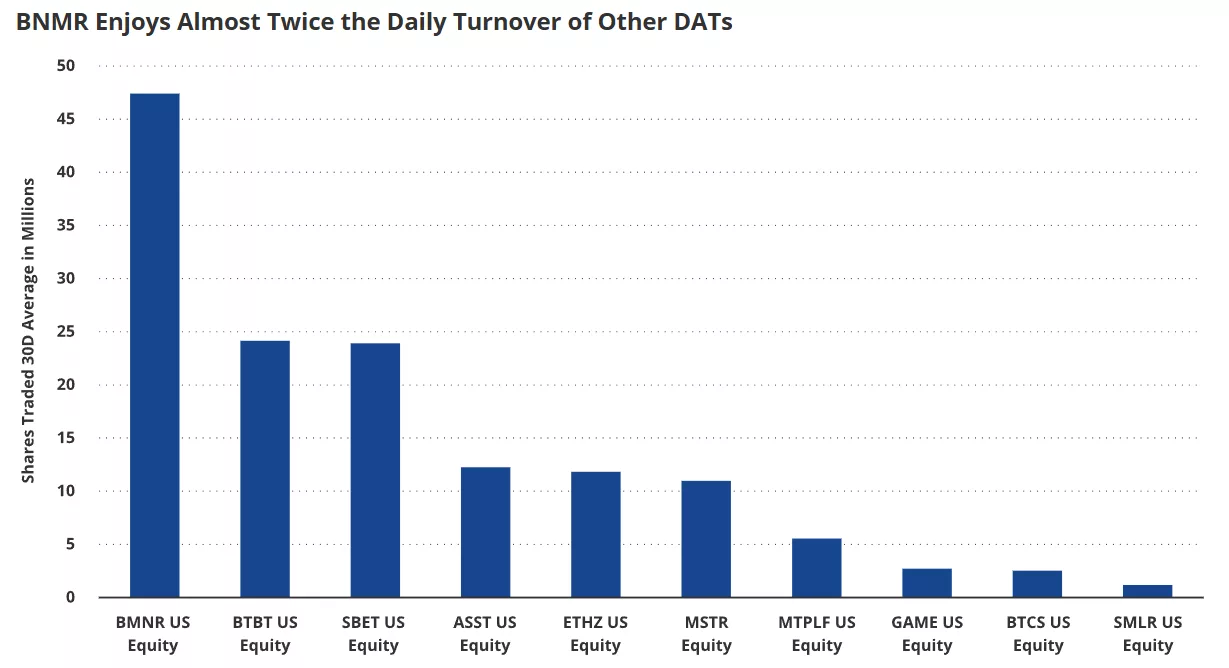
VanEck analysts describe this as BNMR “underpricing volatility by selling warrants at a steep discount,” giving speculators an extra opportunity if they can handle the options risk. The analysts also point out that DATs are essentially “volatility reactors,” borrowing Michael Saylor’s term. They need consistent market swings to fund more crypto purchases. However, cryptocurrency volatility has been trending down for nearly a decade, and the analysts now warn that if this trend continues, DATs may find it harder to finance further crypto acquisitions.
They suggest that as investor excitement fades and more digital asset products become available, mNAVs, which is also known as market-adjusted net asset values, should therefore “fade because investors can no longer count on most DATs to expand their treasuries consistently.”
Risks and limits
Another trend VanEck analysts highlight is that DATs may actively compress implied volatility by selling options or warrants to generate cash. Saylor confirmed that Strategy WOULD do this “under circumstances where he could not issue shares due to MSTR mNAV
But the analysts warn that if Bitcoin experiences a prolonged drop, other DATs could also see declining mNAVs. While they might sell options to raise cash, this would reduce implied volatility across the sector, and over time, this could deplete the “volatility well” that DATs rely on to keep buying crypto.
Liquidity, or the lack of it, is another key concern. VanEck analysts note that many new DATs “are encountering […] the lack of DEEP and liquid markets for the secondary trading of their securities (particularly options).” Without established options markets, DATs must offer large discounts to attract investors, which means their ability to expand treasuries is closely tied to active trading and volatility.
For investors, VanEck analysts suggest the space offers both opportunity and caution. DATs provide a way to gain exposure to digital assets while still participating in traditional markets, using mechanics like discounted warrants and underpriced volatility. But the same structures that make them interesting also make them sensitive to market trends. Falling volatility could limit their growth, reduce mNAVs, and curb opportunities for speculative gains.
