Stanford MBA Reveals Why Bitcoin Can Hit $10 Million - The Math Behind the Madness

Forget everything you thought you knew about Bitcoin's ceiling.
The $10 Million Thesis
A Stanford MBA graduate just dropped the financial equivalent of a nuclear bomb—detailing exactly how Bitcoin could reach an unprecedented $10 million per coin. The analysis isn't based on hopium or wild speculation, but on cold, hard mathematical models that track Bitcoin's historical adoption curves against global asset classes.
Adoption Meets Scarcity
When you combine Bitcoin's fixed supply with accelerating institutional adoption, the numbers start looking radically different from traditional valuation metrics. The graduate's model shows how Bitcoin could absorb just a fraction of global wealth—while making gold's market cap look like pocket change.
Why Wall Street Hates This Math
Traditional finance types are sweating—because this projection essentially suggests Bitcoin could outperform every asset class in human history. Of course, the same people who dismissed Bitcoin at $100 are now calling this prediction insane. Funny how that works.
Whether you're a crypto believer or skeptic, one thing's clear: the rules of money are being rewritten right before our eyes—and the old guard is desperately trying to grade the test while someone else is building the new school.
TLDR
- Q3 2025 earnings per share were $1.06, beating analyst estimates of $0.95.
- Profit rose 23% year-over-year to $8.5 billion.
- Revenue increased 10.8% to $28.24 billion, exceeding forecasts.
- Investment banking revenue surged 43% to $2 billion.
- Net interest income hit a record $15.39 billion, up 9% from last year.
Bank of America Corporation (NYSE: BAC) stock closed at $50.09, up 2.52%, and traded higher at $52.29 in pre-market hours on October 14, 2025, after reporting third-quarter results that surpassed Wall Street expectations.
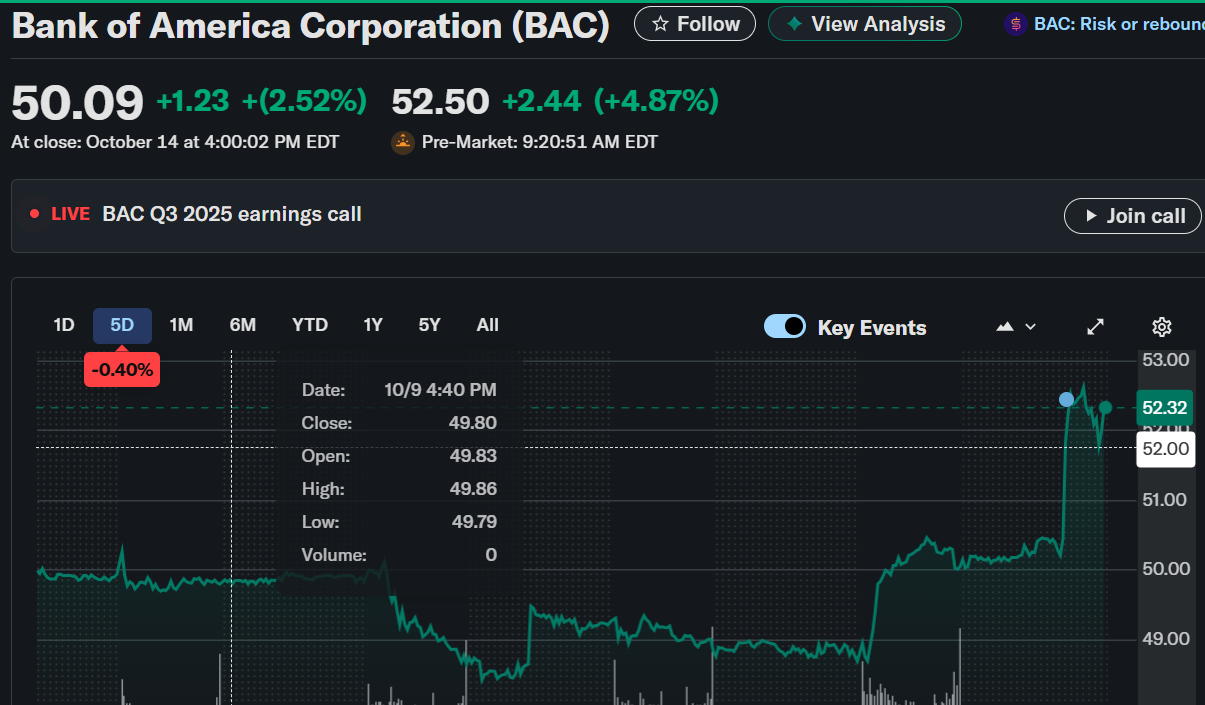
Bank of America Corporation (BAC)
The strong performance was fueled by a sharp increase in investment banking revenue, improved trading results, and record-high net interest income.
Profit and Revenue Beat
The second-largest U.S. bank by assets reported a 23% rise in profit to $8.5 billion, or $1.06 per share, above analyst estimates of $0.95. Total revenue grew 10.8% year-over-year to $28.24 billion, exceeding projections of $27.5 billion. The results reflected solid contributions across all business segments, signaling sustained momentum in the U.S. banking sector.
Bank of America, $BAC, Q3-25. Results:
📊 Adj. EPS: $1.06 🟢
💰 Revenue: $28.1B 🟢
📈 Net Income: $8.5B
🔎 Strong performance across Consumer Banking and Global Markets drove earnings higher, with total revenue reaching $28.1B. pic.twitter.com/GHHd0VBrdU
— EarningsTime (@Earnings_Time) October 15, 2025
CEO Brian Moynihan credited the results to continued organic growth across all divisions. “Strong loan and deposit growth, coupled with effective balance sheet positioning, resulted in record net interest income,” Moynihan stated in the earnings release.
Investment Banking and Trading Surge
Bank of America’s investment banking division was a major driver of the quarter’s success, with fees surging 43% year-over-year to $2 billion, about $380 million above analyst expectations. The bank benefited from heightened merger, acquisition, and capital-raising activity among corporations.
Trading also performed well, as equities trading revenue ROSE 14% to $2.3 billion, while fixed income trading increased 5% to $3.1 billion, meeting forecasts. The improvement reflected strong client activity amid volatile market conditions.
Credit Losses Decline and Net Interest Income Grows
The bank’s provision for credit losses fell 13% to $1.3 billion, coming in well below the expected $1.58 billion, indicating improved loan quality and lower default risk. Net interest income, which represents profits from lending, rose 9% to $15.39 billion, about $150 million higher than estimates.
Despite recent Federal Reserve rate cuts, Bank of America maintained healthy margins between deposit costs and loan yields. The management forecast further net interest income growth through year-end, reflecting confidence in continued lending demand and consumer resilience.
Consumer Banking Strength
The bank’s consumer operations remained robust, generating steady profits supported by increased borrowing and spending activity. Despite broader economic uncertainty and elevated tariffs, consumers showed resilience, helping drive credit and deposit growth.
With the U.S. economy continuing to demonstrate strength, Bank of America’s diversified business model, spanning consumer banking, wealth management, and trading, positioned it to benefit from stable financial activity.
Market Performance and Outlook
Shares of BAC have gained 16.01% year-to-date, outperforming the S&P 500’s 12.97% return. Over the past year, the stock has advanced 22.33%, reflecting investor Optimism in the bank’s earnings power and strategic execution.
Analysts expect solid growth ahead as Bank of America capitalizes on improving credit conditions, strong investment banking demand, and expanding interest income. The company’s performance underscores its resilience and operational strength amid shifting macroeconomic conditions.
