Visa Unleashes AI-Powered VCS Hub: Payment Industry Braces for Revolution

Visa just dropped a blockchain bomb on traditional finance—their new AI-driven VCS Hub is rewriting the rules of digital payments.
The Architecture Shift
Forget clunky legacy systems. Visa's neural-network-powered platform processes transactions at speeds that make SWIFT look like snail mail. It's not just faster—it's smarter, predicting fraud patterns before they even form.
Market Impact
Traditional payment processors are scrambling as Visa's move validates what crypto maximalists knew all along: decentralized infrastructure is inevitable. The timing couldn't be more brutal—right as central banks struggle with their digital currency rollouts.
Investor Takeaway
While Wall Street analysts debate whether this will boost Visa's stock price, the real story is how traditional finance keeps co-opting crypto innovations while maintaining their centralized cut. Some things never change—even in revolution.
TLDR
- Visa stock closed at $337.37 and gained 0.33% pre-market ahead of VCS Hub launch.
- The VCS Hub introduces AI-driven automation and embedded payments for issuers and fintechs.
- Core features include GenAI payables, reporting, and tailored user experiences.
- Visa’s profit margin stands at 52.16%, with strong long-term returns versus the S&P 500.
- Market cap is $654.82B, supported by $20.06B in net income and $18.05B free cash flow.
Visa Inc. (NYSE: V) closed at $337.37 on September 26, 2025, rising 0.73% in regular trading and adding 0.33% pre-market to $338.50.
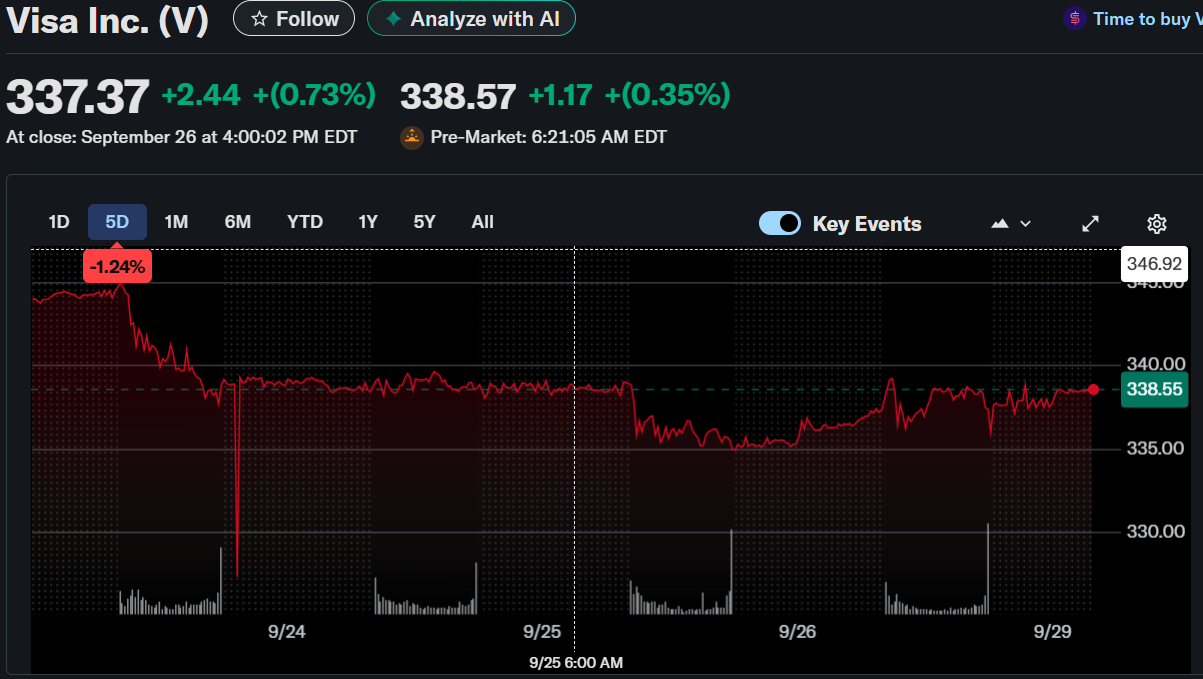
Visa Inc. (V)
The company’s financial strength remains robust with a trailing twelve-month revenue of $38.89 billion and net income of $20.06 billion. Visa will integrate these results into its next earnings report, where investors will focus on the impact of its latest AI-powered platform launch.
Launch of the VCS Hub
Visa has announced the general availability of the Visa Commercial Solutions (VCS) Hub, a breakthrough platform designed for issuers and fintechs. The system represents a transformative step for commercial payments, bringing AI-driven automation and seamless integration into business processes.
Following a successful pilot, the VCS Hub now offers end-to-end payables support, enabling invoice and supplier payments, along with ad hoc transactions. Embedded finance is central to the rollout, with smooth integration into accounting and ERP systems.
AI-Powered Capabilities
The platform incorporates generative AI to optimize workflows and improve efficiency. Key features include:
- AI-Powered Payables: Automating accounts payable, anticipating needs, and improving cash flow management.
- Embedded Payments: Enabling integration into business applications via Visa’s open APIs.
- Reporting and Insights: Providing predictive analytics and real-time intelligence to guide decisions.
- Personalized Experiences: Using AI to tailor user recommendations and alerts for growth and efficiency.
These enhancements underscore Visa’s focus on building a unified ecosystem that reduces complexity and boosts productivity for its partners.
Financial Strength and Market Performance
Visa maintains a market capitalization of $654.82 billion and trades at a trailing P/E ratio of 32.95 with a forward P/E of 26.25. Profitability metrics remain strong, with a 52.16% profit margin, a return on equity of 51.75%, and a diluted EPS of 10.26.
Performance returns have been solid across multiple time horizons. As of September 26, 2025, Visa recorded a 1-year return of 25.05%, outperforming the S&P 500’s 15.64%. Over three years, Visa returned 91.13%, compared to the benchmark’s 81.77%.
Balance Sheet and Cash Flow
Visa reported total cash of $19.18 billion and a debt-to-equity ratio of 65.02%. Levered free cash FLOW stood at $18.05 billion, underscoring the company’s capacity to invest in innovation while maintaining strong shareholder returns.
