Tesla Q1 Earnings Surpass Forecasts as Strong Tailwinds Propel Auto Growth

Tesla's Q1 earnings delivered a stark warning to investors Wednesday, with shares reversing sharply after-hours as the company's aggressive capital expenditure plans triggered immediate concern. The electric vehicle maker reported adjusted EPS of $0.41, beating the $0.36 consensus, and revenue of $22.39 billion also cleared estimates, while gross margin surged to 21.1% from 16.3% a year ago—marking its strongest Q1 figure in years. However, the initial stock spike on the print evaporated once management outlined its spending roadmap, overshadowing positive operational metrics and the ongoing Robotaxi expansion into Dallas and Houston.
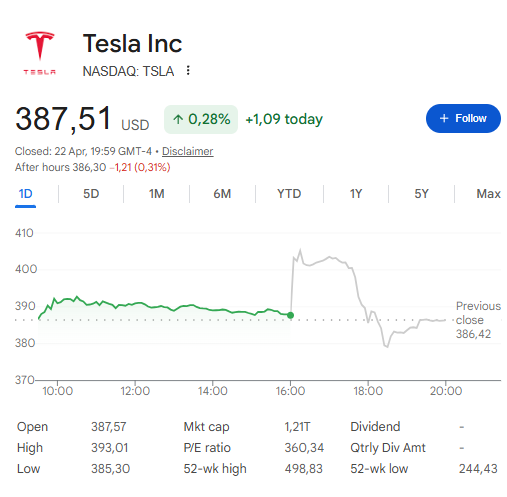 TSLA closed at $387.51 on April 22, up 0.28% on the day, then dropped 2.13% in after-hours trade after the Tesla Q1 earnings call flagged a $25B+ capex plan
Source: Yahoo Finance
Tesla Q1 Earnings and TSLA Earnings Beat on Robotaxi and Capex
The Robotaxi rollout moves into new territory
The Tesla Robotaxi rollout is, at the time of writing, the part of the story investors follow most closely — and Tesla did have real progress to report here. The company pushed the service into Dallas and Houston, running it unsupervised, with no safety driver present in the vehicle. Robotaxi miles nearly doubled sequentially in Q1, and Cybercabs — the dedicated two-seat autonomous product — stay on schedule for volume production in 2026. Those will eventually take over from the Model Y SUVs currently running the fleet. Tesla still does not share how many vehicles operate in each city or how many run without a driver at any given time, so sizing the business with much confidence stays difficult.
Capital expenditure sends Tesla stock after hours lower
The capital expenditure number really drove Tesla stock after hours into the red. CFO Vaibhav Taneja told analysts on the call that Tesla now targets capex above $25 billion for 2026 — up from $20 billion just last quarter, and a steep jump from $8.6 billion in 2025. The company also guided negative free cash flow for the rest of the year, a significant turn for a business that keeps pushing the “” pivot.
CFO Vaibhav Taneja said on the call:
“Our current expectation for 2026 is over $25 billion of CapEx … we’re further increasing our investment in AI-related initiatives, including the AI infrastructure to support Robotaxi and the launch of Optimus.”
Taneja also added:
“We are in a very big capital investment phase, which is going to start now and would last a couple of years.”
That spending covers six factories — some already running, others coming online later this year — along with AI compute, battery materials, Cybercab, Tesla Semi, Megapack 3, Optimus, and the Terafab chip manufacturing facility Tesla plans to build in Austin. On the demand side, Tesla ended Q1 with its highest Q1 order backlog in over two years, recording growth in EMEA, APAC, and also North America.
Musk on Optimus, chips, and production timing
CEO Elon Musk used part of the Tesla Q1 earnings call to walk through what the Optimus production ramp actually looks like. The company targets an Optimus V3 reveal in July or August, close to start of production, and preparations for a large-scale Optimus factory — targeting one million units per year — kick off in Q2.
Musk said on the earnings call:
“So you should expect that initial production of Cybercab and Semi will be very slow, but then ramping up and going kind of exponential towards the end of the year, and certainly next year.”
On holding back the Optimus V3 reveal, Musk said:
“We’re also a little hesitant to show V3 off, because we find our competitors do a frame by frame analysis whenever we release something and copy everything they possibly can. So I think there’s some value to, you know, not showing new technology until it’s close to production.”
Not everything on the call landed well. Musk confirmed that older Tesla vehicles running Hardware 3 computers will not support unsupervised FSD, saying the hardware “” for full autonomy. Future Fund managing partner Gary Black noted that while the Tesla Q1 earnings beat forecasts cleanly, the valuation multiple could face downward pressure over what he described as “.”
Heading into Q2, the Tesla Q1 earnings results hand investors a decent floor — stronger margins, a broader Tesla Robotaxi rollout, and a clean beat on both EPS and revenue. Tesla’s capital expenditure surge and the FSD delay, though, will likely shape how the market prices TSLA from here. Tesla stock after hours said it plainly: up first, then right back down.

Log in to Reply
Log in to comment your thoughtsComments
|Square
Get the BTCC app to start your crypto journey
Get started today Scan to join our 100M+ users