US Economic Growth to Average Only 1.7% for 30 Years, Lowest in History - A Stark Warning for Traditional Finance

A historic economic slowdown is officially projected: the Congressional Budget Office warns US growth will average just 1.7% annually over the next three decades—the weakest sustained stretch in American history—as ballooning federal debt, mandatory spending, and rising interest costs create a perfect storm of stagnation. This dramatic decline from the post-WWII average of 3.1% signals profound structural weakness in the traditional financial system, creating a powerful macro backdrop for decentralized digital asset adoption.
How Federal Debt, Mandatory Spending, And Interest Spending Threaten Growth

Gross Debt On Track for a Historic High
The long-term budget outlook puts gross federal debt at $182 trillion by 2056 — roughly $2 million per American family of four. Debt climbs from 123% of GDP in 2025 to 190% of GDP in 2056, the highest level in American history. That federal debt projection crowds out private investment and pushes borrowing costs higher across the economy, dragging directly on US economic growth.
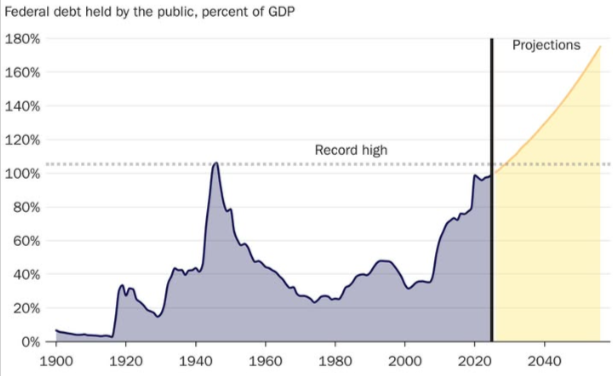
Source: The Cato Institute
House Budget Committee Chairman Jodey Arrington stated:
“This CBO report confirms what we already know: America’s fiscal trajectory is unsustainable. Our long-term budget outlook goes from bad to far worse, with gross federal debt projected to reach $182 trillion by 2056 — that’s roughly $2 million per American family. I have warned time and time again that runaway mandatory spending and our crushing national debt represent the single greatest danger to our nation’s prosperity and our children’s future.”
Entitlement Programs And Interest Costs Eat Deeper Into the Budget
Mandatory spending growth pushes outlays from 75% of the federal budget today to 83% by 2056, leaving Congress with less room to fund the kind of investment that supports US economic growth over time. The interest spending rise compounds this: net interest outlays climb from 3.3% of GDP in 2026 to 6.9% by 2056, consuming 37% of all federal revenues by then, up from 19% today. Interest payments will also surpass all discretionary spending combined by 2038.
Arrington also had this to say:
“The structural imbalance in our federal budget — driven primarily by autopilot spending in our largest entitlement programs — cannot be ignored any longer.”
Shrinking Population Growth Seals the Outlook
By 2030, deaths will outnumber births in the US, and population growth through 2056 will be the slowest the country has ever recorded. Mandatory spending growth keeps rising automatically, the interest spending rise keeps widening the deficit, and the federal debt projection keeps climbing — and at 1.7% for 30 consecutive years, US economic growth reflects a break from everything that came before it.
