CBO’s $64 Trillion US Debt Warning Sparks BRICS Dollar Exodus Frenzy

The Congressional Budget Office has issued a stark warning: U.S. national debt is projected to surge to $64 trillion within a decade, with annual deficits ballooning to $3.1 trillion by 2036. This alarming trajectory, pushing the debt-to-GDP ratio past 120%, coincides with BRICS nations accelerating their move away from the dollar, creating a perfect storm of fiscal uncertainty that highlights the structural vulnerabilities of traditional fiat systems.
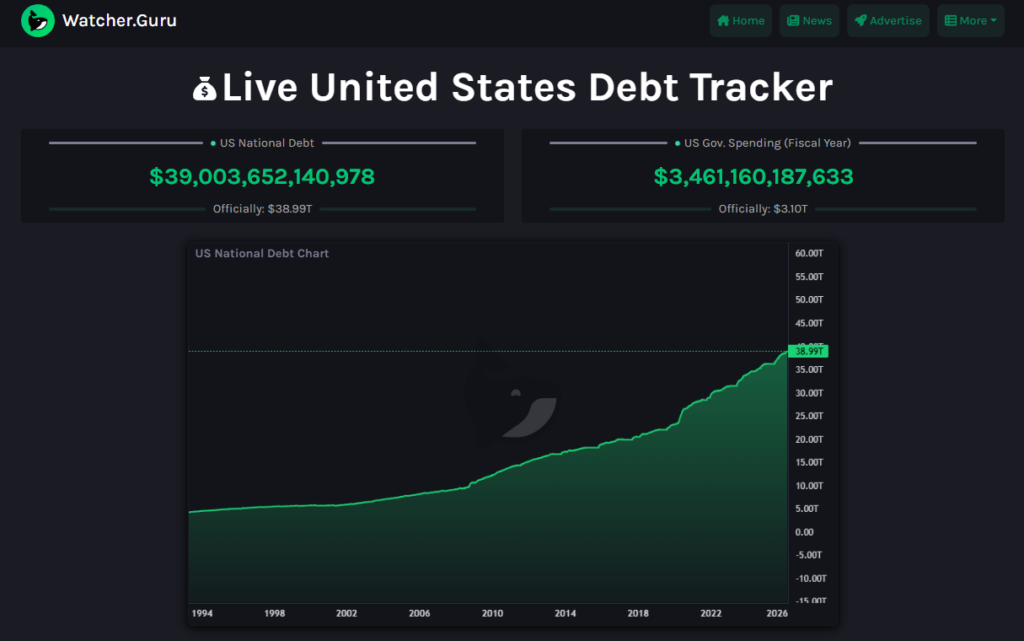 Watcher.Guru Live US Debt Tracker,
showing $39.003T current national debt and exponential growth post-2010
US Debt Prediction Soars With Trillion-Dollar Deficit and BRICS Dollar Exit

What the US Debt Prediction Actually Shows
The CBO US debt projection puts cumulative deficits at $24.4 trillion over the next ten years — averaging 6.1% of GDP per year, more than double the 50-year historical average of 3.8%. Interest payments alone will cross $1 trillion in 2026 and climb to $2.1 trillion by 2036. At that point, the federal government will spend more on debt service than it currently allocates to national defense, also a first in US history.
CBO Director Phillip Swagel stated:
“Our budget projections continue to indicate that the fiscal trajectory is not sustainable.”
On what drives the trillion-dollar deficit higher, Swagel also had this to say:
“Tax provisions including the permanent extension of provisions of the 2017 Tax Act increase deficits, as does increased spending on defense and homeland security. Other provisions of the 2025 reconciliation act, such as changes to Medicaid and the Supplemental Nutrition Assistance Program (SNAP), reduce deficits.”
The Republican-backed reconciliation act adds $4.7 trillion to the ten-year US debt prediction through 2035. New tariffs will offset roughly $3 trillion, but that still leaves $1.4 trillion in additional borrowing compared to estimates from one year ago. The US debt-to-GDP ratio will also surpass the 1946 postwar record before 2030 and could reach 175% by 2056 under current law.
BRICS Sees Opportunity in the US Debt Prediction

The BRICS dollar exit has been picking up speed alongside every new CBO warning. China, India, and Brazil collectively shed $144.6 billion in US Treasuries over the past year. China alone cut its holdings by $75.5 billion — a 10% reduction — while India trimmed its exposure by 18% and Brazil by 16%.
ING, one of the world’s largest banks, warned in December 2025 that BRICS nations are:
“Quietly leaving the Treasury market.”
In October alone, those three countries cut their combined Treasury exposure by $28.8 billion in a single month. The latest US debt prediction from Washington keeps reinforcing the bloc’s central argument — a government running a trillion-dollar deficit annually and heading toward 120% debt-to-GDP makes for a less reliable anchor for global trade than it did a decade ago. Every time the CBO US debt projection gets revised, the US debt prediction gets a little harder to defend, and the BRICS dollar exit gets a little easier to justify.
