BRICS Faces Major Test as Iran Crisis Threatens Global Oil—What It Means for Digital Assets

Oil markets are shaking—and crypto markets are watching.
When geopolitical tensions spike in the Middle East, traditional finance holds its breath. But for digital asset investors, it’s a different story. Volatility in oil? That’s just another signal flashing on the trading dashboard.
The Petrodollar’s Weak Spot
For decades, oil crises propped up the old financial guard. Now, they expose its fragility. Every supply shock, every embargo, every pipeline threat—it all whispers the same thing: the system is brittle.
And what thrives in brittle environments? Decentralized alternatives.
Digital Gold vs. Black Gold
When nation-states clash over physical resources, attention shifts to digital ones. Bitcoin doesn’t need tankers or treaties. Its network hums along, borderless and sanction-resistant. It’s the ultimate hedge against logistics—and political grandstanding.
Remember, finance loves a crisis—it’s just another revenue stream for the suits in charge.
The BRICS Play and Crypto’s Open Door
A bloc like BRICS scrambling over oil stability isn’t just a commodities story. It’s a multi-trillion-dollar search for financial independence. They’re trying to build new rails while the old ones are on fire.
Crypto doesn’t need to build those rails. They’re already here, live, and processing value while diplomats are still drafting statements.
So, watch the headlines. Watch the oil prices. Then watch the blockchain. One reacts to the world. The other is building the next one.
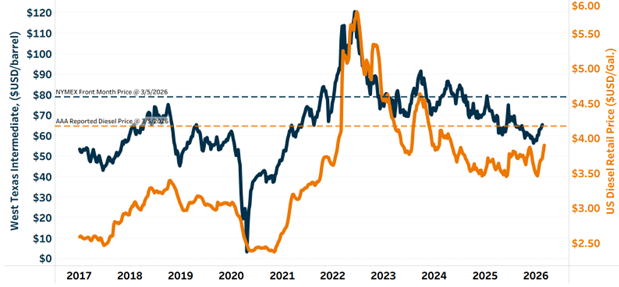 Rising oil prices chart showing WTI crude and US diesel retail prices from 2017 to 2026
Source: U.S. Energy Information Administration / ConstructConnect — WTI crude and diesel prices, March 2026.
How BRICS Oil Trade, Iran Crisis and De-Dollarization Shape Oil Prices
Hormuz Closure Cuts Off BRICS Oil Flows
The strait closure left Gulf oil with basically nowhere to go. Iraq and Saudi Arabia started cutting production as storage at key terminals filled up faster than expected — Kayrros reported Wednesday that four of Saudi Arabia’s Ras Tanura refinery tanks were already full, and the Ju’aymah terminal on the country’s east coast is also running out of spare capacity. The Iran crisis is, right now, directly blocking BRICS oil flows out of some of the most critical export routes in the world.
Iran’s Islamic Revolutionary Guard Corps warned ships that vessels were
“could be at risk from missiles or rogue drones.”
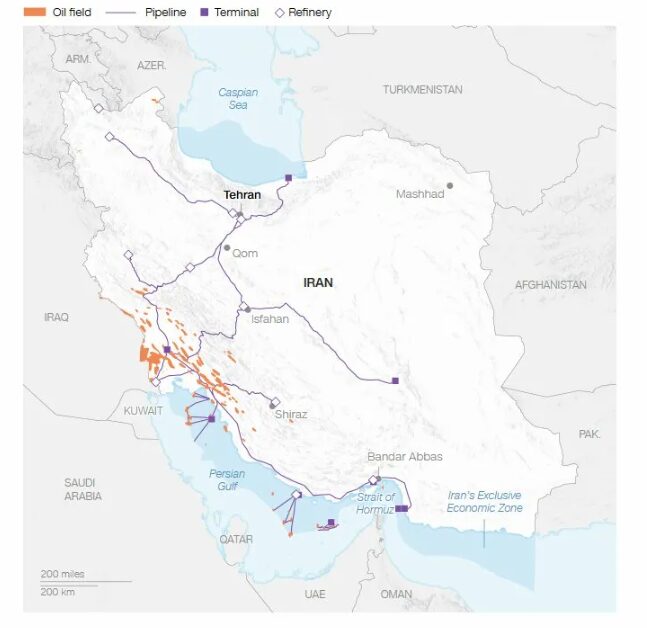
Source: S&P Global Energy / CNN
Goldman Sachs put the real-time risk premium for crude at $18 per barrel — its estimate of what a six-week full halt to tanker traffic through the strait actually costs the market. An Iranian drone also caused a major fire at the UAE’s Fujairah oil hub on Tuesday, and separate drone attacks forced Saudi Arabia to shut down its Ras Tanura refinery, which processes 550,000 barrels per day.
China Moves as Global Oil Prices Keep Climbing
Beijing told its largest refiner on Thursday to suspend exports of diesel and gasoline, citing the Persian Gulf conflict. That move is pushing global oil prices even higher, and at the time of writing there is no signal from China that it is getting reversed. US Defense Secretary Pete Hegseth had this to say about the ongoing offensive:
“Death and destruction from the sky all day long.”
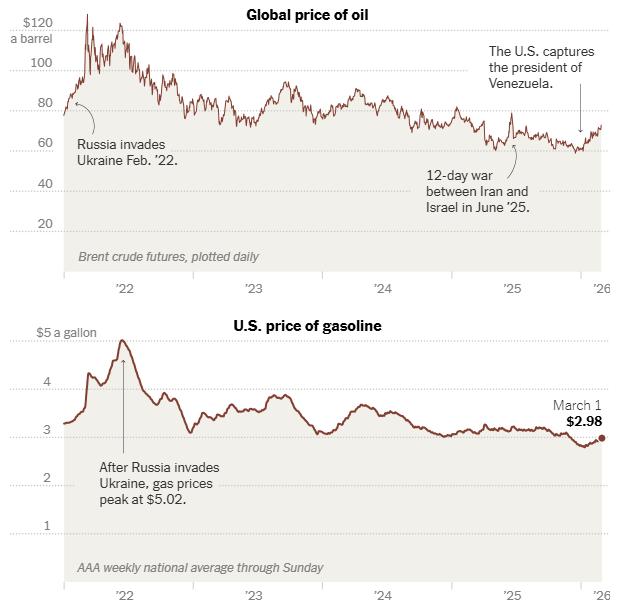
Source: FactSet / AAA / The New York Times
Israel has also indicated weeks more of conflict ahead. The Guardian reports that the US-Israeli offensive has killed over 1,000 civilians since it started, including scores of children. Iran is retaliating — hitting US military bases and civilian infrastructure across the region, including in Oman. The BRICS oil sector, which depends on stable Persian Gulf transit, has no immediate buffer for a conflict of this scale.
BRICS De-Dollarization Plans Hit a Wall
The Iran crisis has also landed directly on BRICS de-dollarization efforts, and the timing is bad. BRICS oil producers were already navigating US sanctions on Russian and Iranian crude, and this escalation adds another layer of risk. Wang Tao, former VP of ZTE and a regular voice on China’s strategic direction, had this to say in a recent Think BRICS interview:
“The BRICS countries possess the greatest economic development potential in the world. The future demand for energy is immense. It’s necessary to decouple all of these areas of infrastructure from those former hegemonic ones established by predatory nations.”
On the 2026 BRICS Pay rollout and cutting ties with SWIFT, Wang also stated:
“The BRICS payment system, or BRICS Pay, which originates from Russia, is a very important example of testing to such a crucial wealth-creating infrastructure. It is equally important to quickly decouple from the SWIFT system.”
OPEC+ said Sunday it will add 206,000 bpd in April — well above the 137,000 bpd analysts had expected. Even so, that extra supply is being absorbed by the disruption. Vortexa data shows around 290 million barrels of Russian and Iranian crude sitting in floating storage, over 50% more than a year ago. BRICS oil trade through these corridors has no clear path out right now, and the bloc’s wider BRICS de-dollarization push is also under strain as long as BRICS oil stays trapped in conflict zones and sanctioned shipping routes.
