South Korea Stocks Plunge in Biggest Crash Since 2008 – The Traditional Market Bloodbath That Has Crypto Smiling

While Seoul's traditional markets hemorrhage value in their worst collapse since the global financial crisis, a quiet revolution accelerates in the digital shadows.
The Old Guard Stumbles
Talk about a bad day at the office. The KOSPI isn't just dipping—it's in freefall, echoing the terrifying plunge of 2008. It's a stark, numbers-driven reminder of the fragility baked into legacy financial systems. One domino tips, and the whole creaky table threatens to collapse. Meanwhile, the 24/7 decentralized networks just keep on humming, completely indifferent to a single nation's trading floor panic.
Decentralization's Stress Test
This isn't just a stock crash; it's a live-fire demonstration. It showcases the systemic risk of centralized choke points—the exchanges, the regulators, the opening bells. Crypto's core proposition—a borderless, permissionless, and continuously operational asset class—suddenly looks less like a speculative bet and more like a rational hedge. When traditional gates slam shut, digital assets flow through different channels entirely.
A Tale of Two Systems
Contrast the scene: frantic traders in Seoul watching red numbers scroll, versus a global network of nodes validating transactions around the clock. One system is geographically trapped and emotionally charged; the other is distributed and dispassionately algorithmic. The irony? The very volatility crypto is often criticized for is now mirrored tenfold in the 'stable' old world, proving that risk never disappears—it just changes costumes.
So, as the Financial Services Commission scrambles for answers and analysts dust off their 2008 playbooks, a parallel financial universe operates on its own rules. The crash of 2026 will be studied for years, but perhaps its most enduring lesson won't be about stopping the next crash, but about building systems that don't care when one happens. After all, in traditional finance, a crash is a crisis. In crypto, a 20% drop is just Tuesday—and another buying opportunity for those who see the bigger picture.
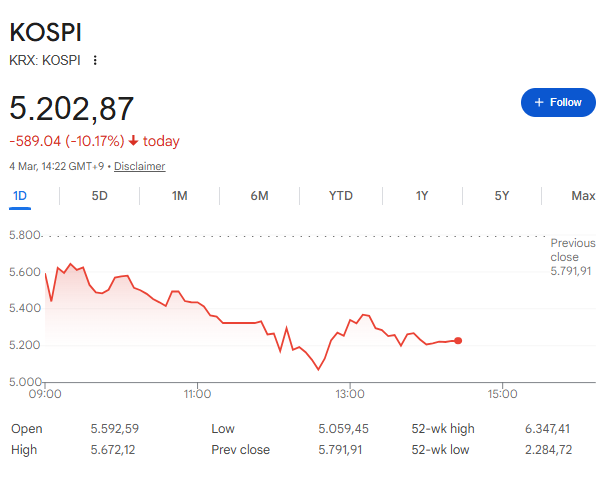 Source: Google Finance
South Korea Stock Market Today Faces KOSPI Crash
What’s Driving South Korea Stocks Lower
South Korea stocks had been on a remarkable run — the stock market soared more than 75% over the past year, fueled by insatiable demand for memory chips. Samsung Electronics and SK Hynix led that rally, and right now those two names are also leading the selloff. Samsung fell over 9% Wednesday, and SK Hynix dropped more than 6%. Together, they make up almost 50% of the KOSPI stock index, according to Morningstar data, so when those names MOVE sharply, the whole market moves with them.
Lorraine Tan, Asia director of equity research at Morningstar, stated:
“The decline in the KOSPI can broadly be attributable to the single-name concentration that we see in the Korean markets. We believe that the drop in share prices is partly driven by profit taking after a strong runup amidst a risk-off environment but also implies growing concern that the AI datacenter adoption pace might slow due to its significantly higher energy costs than regular data centers.”
Oil prices are also making things harder. South Korea ranks as the world’s eighth-largest crude consumer, and the escalating Iran conflict — including moves to close the Strait of Hormuz — hit the country’s manufacturing-heavy economy hard. South Korea stocks have always been sensitive to energy price swings, and right now those swings are unusually sharp. Japan’s Nikkei also fell nearly 4% and Hong Kong’s Hang Seng dropped over 2.9%, adding extra regional pressure on the South Korea stock market today.
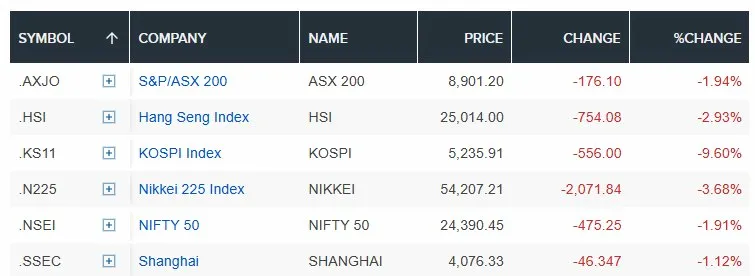
Source: CNBC
Margin Calls Are Making the South Korea Crash Worse
A big chunk of the South Korea crash traces back to forced selling. Retail investors borrowed heavily to ride the rally, many putting down just 30–40% as a margin deposit. As the market turned, those positions started unwinding fast, and local brokers began pulling margin services during Wednesday’s session.
Kim Dojoon, chief executive and investment officer at Seoul-based Zian Investment Management, said:
“There’s been a lot of buying on credit, especially those heavyweight stocks, with investors putting down only 30%-40% in margin deposit. If there’s another drop tomorrow, nobody will catch a falling knife.”
Foreign funds also sold more than 1 trillion won worth of South Korea stocks in Wednesday’s morning session alone. Retail buying — which had kept the stock market from sliding even harder early in the day — faded through the afternoon, and the KOSPI stock index’s volatility gauge hit its highest reading since March 2020.
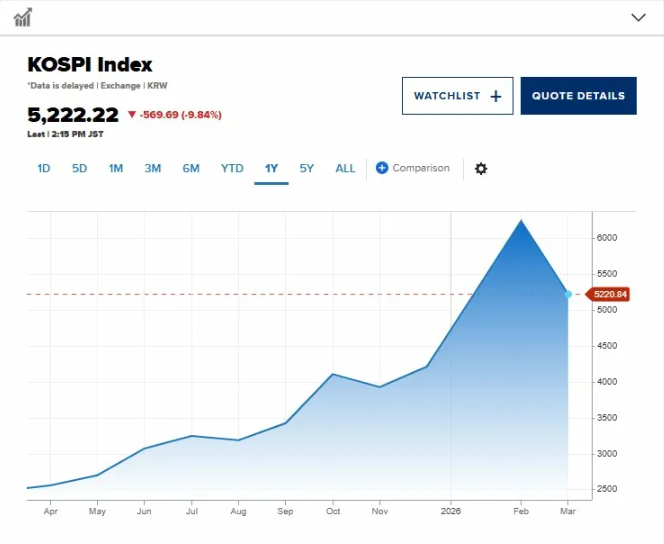
Source: CNBC
Shawn Oh, an equity trader at NH Investment & Securities in Seoul, said:
“Local brokers started halting providing margin and we’re seeing retail buy-the-dip much weaker today. We might see further weakness during the last hour of trading due to fears of margin call.”
Dave Mazza, chief executive officer at Roundhill Investments, had this to say:
“This reads like a positioning unwind more than a Korea-specific fundamental break. When global risk appetite turns and energy and foreign exchange volatility jump, you get fast de-risking in the biggest, most liquid index names.”
What Comes Next for the South Korea Stock Market
South Korean authorities activated contingency plans, including a market stabilization fund of over 100 trillion won ($68 billion). South Korea stocks in defense and energy bucked the broader selloff — LIG Nex1 gained ground, and refinery S-Oil Corp. ROSE as much as 25%. Those pockets of strength do little to offset the scale of the South Korea crash, though, and the stock market today still looks fragile heading into the next session.
An Hyungjin, CEO at Billionfold Asset Management, summed up the mood on trading floors across Seoul:
