Bitcoin’s 2022 Low of $15,000: What Are the Odds We See It Again?

Bitcoin's 2022 low of $15,000 stands as a stark reminder of crypto winter's chill. Could the digital asset revisit that painful price point? The odds hinge on a volatile cocktail of macroeconomic pressure, regulatory shifts, and pure market sentiment.
The Macroeconomic Gauntlet
High interest rates and quantitative tightening form the primary headwind. Traditional finance's attempt to curb inflation—a process often as precise as a sledgehammer—siphons liquidity from risk assets. Bitcoin, still viewed by many institutions as a speculative bet, often gets sold first when portfolios need trimming. A severe recession could amplify this flight to safety, pushing capital toward bonds and away from digital volatility.
The Regulatory Wild Card
Clarity breeds confidence; confusion breeds sell-offs. A major, hostile regulatory crackdown in a key jurisdiction could trigger panic. Conversely, the establishment of clear, supportive frameworks—the kind that move at a glacial pace compared to blockchain time—could provide the structural floor needed to prevent such a deep retrace. It's a waiting game where the rules are written in slow motion.
On-Chain Sentiment & The Miner Squeeze
Watch the miners. A sustained drop below key production costs could force capitulation—miners selling their coin reserves to cover operational expenses, creating a vicious cycle of selling pressure. On-chain data showing mass movement of coins from long-term 'hodler' wallets to exchanges often signals distribution and impending downside. These are the cold, hard metrics that often whisper before the market screams.
The Bull Case Buffer
Don't discount the institutional infrastructure built since 2022. Spot ETFs, growing corporate treasury adoption, and the evolving narrative of Bitcoin as a digital gold analogue create a fundamentally different demand profile. Each cycle low has historically been higher than the last. The $15,000 level represents a total unwind of this progress—a scenario requiring a perfect storm of negative catalysts.
So, what are the odds? Lower than in 2022, but never zero. In a market where 'black swan' is a regular guest, only the over-leveraged and under-prepared should truly fear that number. For everyone else, it remains a distant benchmark of stress, not a probable destination—unless, of course, the traditional finance giants decide to teach the crypto upstarts another expensive lesson in market gravity.
 Source: CoinGecko
Will Bitcoin fall To Its 2022 Low Of $15000?

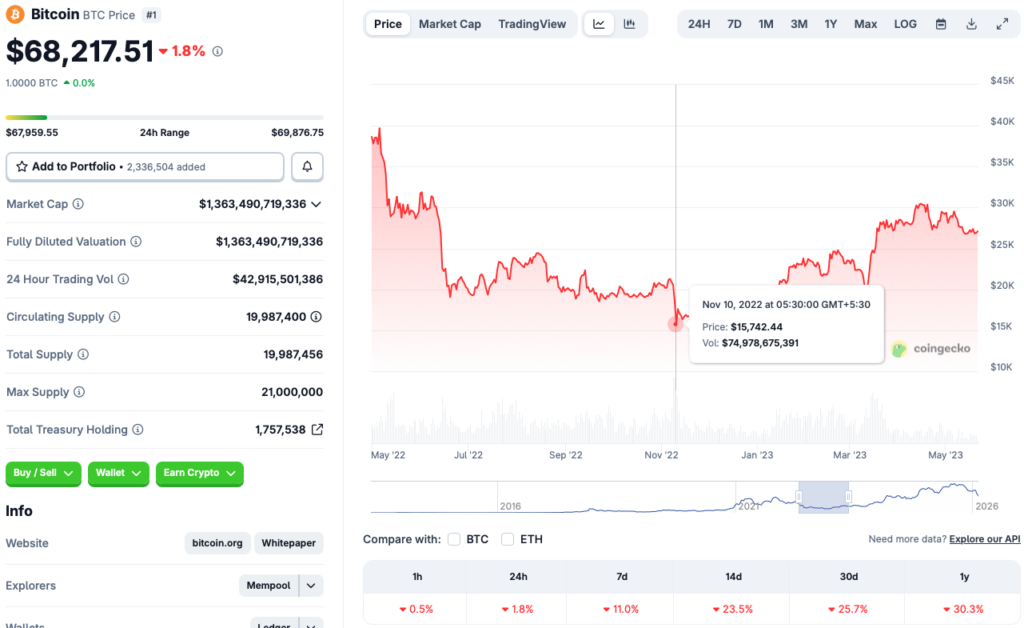
The crypto market faced a massive price crash in November 2022, right after the collapse of FTX. Bitcoin (BTC) fell to the $15000 price level soon after the exchange had a bank run. Most other assets followed BTC’s trajectory, with Solana (SOL) falling to the $9 price level.
The 2022 crash was triggered by the whole FTX debacle. This time around, the crash is due to macroeconomic uncertainties, geopolitical tensions, and a liquidity crunch. While the factors are concerning, it may not be as bad as a major exchange defaulting. Hence, the chances are low that Bitcoin (BTC) will fall to the $15000 mark this cycle.
However, some experts anticipate Bitcoin (BTC) to fall below the $40,000 price level this cycle. According to Stifel, the original cryptocurrency could dip to the $38,000 mark this year.
Despite the bearish short-term outlook, Bitcoin (BTC) is expected to reclaim its glory when the market is back on its feet. Some financial institutions, such as Grayscale and Bernstein, expect BTC to hit a new all-time high in 2026. Both firms claim that BTC could be following a 5-year pattern and not the previously believed 4-year trajectory. This means that Bitcoin (BTC) will climb to a new all-time high in 2026, five years after its 2021 peak.
