Microsoft Earnings Were Strong: So Why Did MSFT Stock Fall?

Microsoft posts a blowout quarter—and Wall Street responds by selling the stock. Welcome to the logic of modern markets.
The Numbers Game
Revenue smashed expectations. Profit margins expanded. Cloud growth accelerated. Every key performance indicator flashed green. The company executed its playbook flawlessly.
The Street's Cold Shoulder
Yet the share price dropped. Analysts pointed to 'forward guidance' that merely met, rather than wildly exceeded, already lofty forecasts. One whisper of 'deceleration' in a minor segment drowned out a chorus of strong results elsewhere. The market priced in perfection—and punished anything less.
Buy the Rumor, Sell the News
It's the oldest play in the book. The stock ran up for weeks on anticipation. When the actual report landed, even if stellar, it became a catalyst for profit-taking. Short-term traders cashed out, creating immediate downward pressure that often has little to do with the company's fundamental health.
The Guidance Gambit
Management offers a cautious outlook, citing macro uncertainties or investment cycles. The Street, addicted to hyper-growth narratives, interprets prudence as weakness. It's a classic disconnect between operators building for the next decade and traders focused on the next quarter.
A Lesson in Market Mechanics
Strong earnings don't guarantee a rising stock price—not in a market driven by algorithms, options flows, and sentiment that often borders on the superstitious. Sometimes, beating expectations just resets the bar higher for next time. It's a treadmill, not a staircase.
So, why did MSFT fall on good news? Because in today's markets, 'good' is frequently the new 'disappointing.' The real cynic's take? Wall Street would rather a company consistently under-promise and over-deliver than honestly report strength that's already been priced in—a system that rewards sandbagging, not transparency.
MSFT Stock Down: Details

Microsoft stock fell 7% Wednesday as the company reported fresh earnings, with a slight disarray in its cloud storage business. The firm stated that 39% of revenue was generated from Azure and associated cloud business, which is lower than the earlier reported stats of nearly 40%. In simpler terms, investors expected Microsoft’s rapid cloud growth, considering the firm’s expanding AI narrative and spending on the domain, leaving its stock to take a sharp direct hit
Despite the aforementioned hiccup, the collective team of analysts has ended up issuing a buy call for MSFT stock, stating that the company is set to surpass constrained cloud elements to produce better results.
The firm is also betting big on AI, allocating its spending and attention to bolster the budding amplified MSFT artificial intelligence domain.
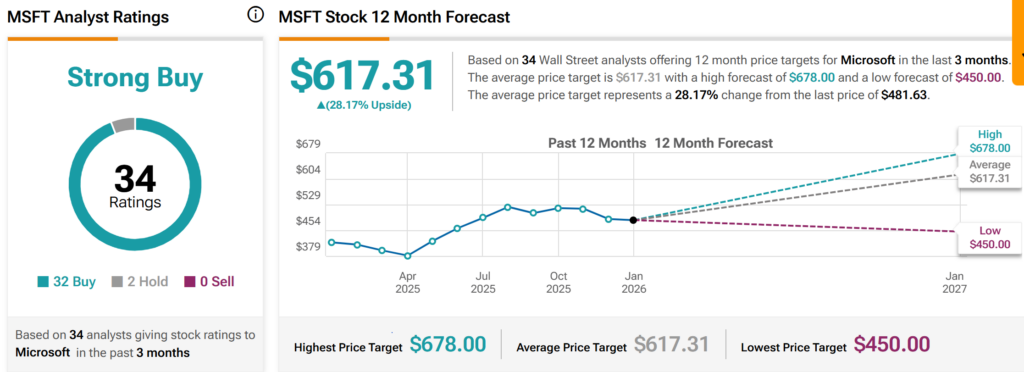
MSFT Stock Price Outlook for 2026
According to TipRanks MSFT stock stats, the firm may end up hitting its ambitious price target of $678 in the next 12 months.