BRICS Currency Major Update Puts Pressure on Dollar Dominance

The dollar's long-held throne just got a serious challenger. A major update to the BRICS currency framework is live, and it's designed to bypass traditional financial gatekeepers entirely.
A New Settlement Architecture
Forget SWIFT delays and correspondent banking fees. The upgraded system facilitates direct, cross-border settlements between member nations using a basket of local currencies and commodities. It cuts out the middleman, aiming to reduce transaction costs and shield trade from geopolitical leverage. Think of it as a dedicated financial highway where the toll booths don't accept greenbacks.
The Ripple Effect for Global Finance
This isn't just about cheaper transactions for Brazil and India. It's a structural shift. By creating a viable alternative to dollar-denominated trade, the bloc chips away at the foundation of dollar dominance. It offers nations a tangible exit ramp from dollar dependency—a move that could accelerate de-dollarization trends already simmering in the global south.
Of course, Wall Street veterans will scoff, calling it another bureaucratic pipe dream destined to collapse under its own weight. They said the same thing about digital assets a decade ago. The update may not topple the dollar overnight, but it pours concrete for a parallel financial system. And in finance, as in crypto, the most powerful force isn't always the incumbent—it's the viable alternative that finally works.
How BRICS Currency Update, CBDC Payments, and Gold-Backed Settlements Threaten Dollar
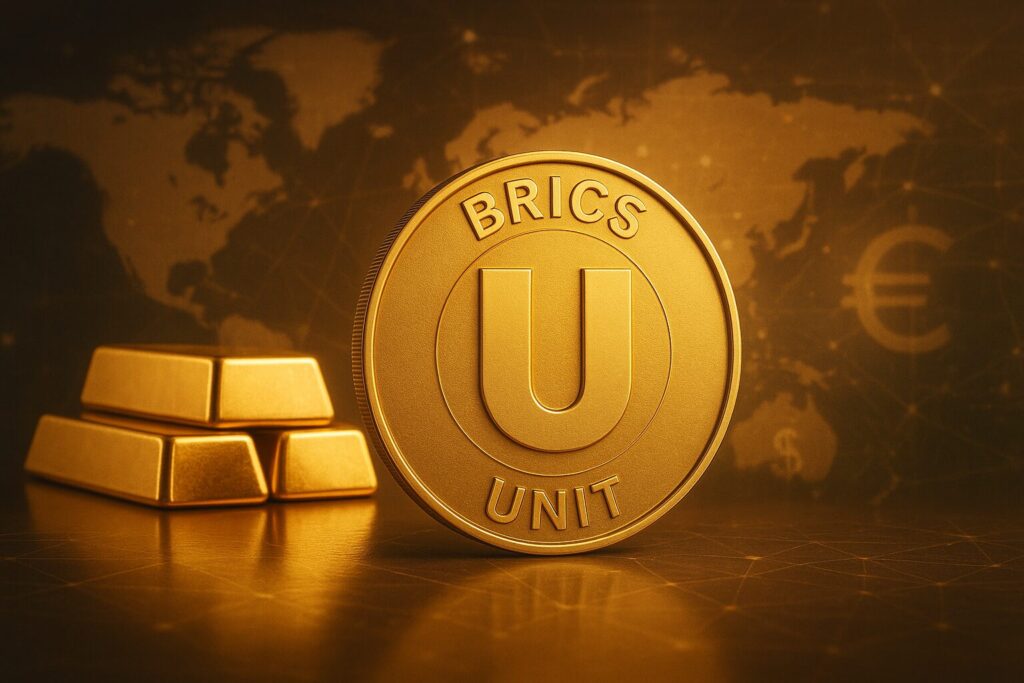
The Unit Launches as Gold-Backed Settlement Tool
The BRICS currency update centers on the Unit, which is a digital trade currency pilot. Researchers launched the pilot on October 31, 2025, and also introduced a prototype on December 8, 2025. Through several key monetary strategies, the architects engineered various major settlement components at the time of writing. The basket combines 40 grams of physical gold and 60% of member currencies that split equally at 12% each, including the Brazilian real, Chinese yuan, Indian rupee, Russian ruble, and also the South African rand.
The initiative came from IRIAS, the International Research Institute for Advanced Systems, and it’s designed specifically for cross-border settlement between BRICS economies. Russian economist Yevgeny Biryukov stated:
“For BRICS countries, gold is a tool to protect against sanction risks, a response to the unreliability of traditional partners, and a tangible asset recognised for thousands of years.”
Members face sanctions, high dollar borrowing costs, and volatility tied to US monetary policy. The Unit WOULD allow them to settle trade without using US banks, store value using gold instead of foreign currency reserves, and reduce exposure to dollar liquidity shocks.
India Advances CBDC Cross-Border Payments
The Reserve Bank of India has recommended that a proposal connecting Central Bank Digital Currencies be included on the agenda for the 2026 BRICS summit, which India will host later this year. This marks the first formal attempt to LINK these digital currencies for trade finance and tourism payments, and it represents a significant BRICS currency update in the payment infrastructure space.
The RBI’s proposal builds on a 2025 BRICS summit declaration in Rio de Janeiro, which encouraged interoperability among members’ payment systems to improve efficiency in CBDC cross-border payments. The e-rupee has attracted around 7 million retail users since December 2022, and the RBI has enabled offline payments and also programmability for government subsidy distribution to support adoption.
RBI Deputy Governor T Rabi Sankar had this to say:
“Beyond the facilitation of illicit payments and circumvention of control measures, stablecoins raise significant concerns for monetary stability, fiscal policy, banking intermediation and systemic resilience.”
India is positioning its e-rupee as a safer and more regulated alternative to stablecoins for CBDC cross-border payments, which helps address concerns about security risks and regulatory uncertainty that worry many investors.
De-Dollarization Through Gold Accumulation

BRICS member states now hold combined gold reserves exceeding 6,000 tonnes, with Russia leading at 2,336 tonnes, China following with 2,298 tonnes, and India holding 880 tonnes. Between 2020 and 2024, central banks of BRICS member states purchased more than 50% of global gold, and this systematically reduced their reliance on dollar-denominated assets.
Brazil added 16 tonnes in September 2025, which was its first purchase since 2021, bringing total reserves to 145.1 tonnes. This dual strategy positions BRICS as both a key supplier and also a major influence in the physical gold market. According to the World Gold Council, central banks bought more than 1,000 tonnes of gold per year from 2022-24, making it the longest sustained gold-buying period in modern history.
The gold-backed currency framework addresses dollar debasement concerns. Public interest in dollar debasement reached unprecedented peaks during the final quarter of 2025, with Google Trends showing record search volumes according to Bloomberg data.
At the 2023 BRICS Summit, Brazilian President Luiz Inacio Lula da Silva stated:
“Why can’t an institution like the BRICS bank have a currency to finance trade relations between Brazil and China, between Brazil and all the other BRICS countries? Who decided that the dollar was the (trade) currency after the end of gold parity?”
Russia and China now settle almost all of their bilateral trade using the yuan and the rouble, and local currencies dominate transactions across the Eurasian Economic Union. This process accelerated following Western sanctions on Russia after its invasion of Ukraine in February 2022.
According to IMF data, the dollar accounted for 58% of global foreign exchange reserves at the end of 2024, which is down from 65% ten years earlier. The share of the US Treasury market owned by foreigners has also fallen sharply, from 50% in 2014 to around a third today.
What This Means for Global Trade
The BRICS currency update through the Unit and the push for CBDC cross-border payments represent a significant challenge to dollar dominance. The Unit makes gold part of daily settlement, not just storage, which shifts the role of the metal from a passive reserve to an active trade asset.
It’s important to clarify that at this stage the Unit is only a prototype and has not yet been adopted by BRICS central banks. The next phase depends on whether BRICS members treat it as a research exercise or a blueprint for a shared settlement system.
For the Unit to function as a shared settlement layer, members would need to agree on how to manage volatility, contribute reserves, and also respond to stress events. Success of the gold-backed currency linkage will depend heavily on agreements regarding interoperable technology, governance frameworks, and mechanisms for settling trade imbalances.
Dollar Dominance Faces Growing Challenges

The Financial Times published an analysis from the global head of FX research at Deutsche Bank, who warned:
“We are witnessing a simultaneous collapse in the price of all US assets including equities, the dollar versus alternative reserve FX and the bond market. We are entering unchartered territory in the global financial system.”
At present, Watcher.Guru’s De-Dollarization Tracker identifies 55 countries using non-dollar currencies for international transactions. Oil trading, which used to be nearly 100% conducted in US dollars, has also shifted as a fifth of oil trades were made in non-USD currencies in 2023.
BRICS Controls Half of Global Gold Production
The alliance now controls about 50% of global gold production through a combination of output from member states and strategic partners. China produced 380 tonnes in 2025 and Russia produced 340 tonnes, which ensures that BRICS holds significant control over the world’s physical gold supply.
The Unit is neither a Central Bank Digital Currency nor a cryptocurrency stablecoin. Rather, the Unit most closely resembles the bancor, which economist John Maynard Keynes invented as a non-redeemable, basket-oriented settlement unit for international clearing.
