BRICS Currency Launch Sparks Accelerated De-Dollarization - Greenback Under Siege

The dollar's dominance faces its most serious challenge yet as BRICS nations roll out their alternative currency.
The De-Dollarization Acceleration
Global financial markets are witnessing what analysts call the fastest shift away from dollar dependency in modern history. BRICS member states are actively bypassing traditional USD settlements, cutting transaction costs while reducing exposure to Federal Reserve policy fluctuations.
Digital Infrastructure Takes Center Stage
The new settlement system operates on blockchain technology that processes cross-border payments in minutes rather than days. Traditional banking corridors are being disrupted as emerging economies embrace the efficiency of digital currency networks.
Geopolitical Realignment in Real-Time
Nations long constrained by dollar-based financial systems are rapidly adopting the BRICS currency for international trade. The move represents the most significant challenge to Western financial hegemony since the Bretton Woods system collapsed.
As central bankers scramble to respond, one thing becomes clear: the era of unquestioned dollar supremacy is over—proving once again that when nations get tired of playing by someone else's rules, they simply change the game. And Wall Street? They're still trying to figure out how to charge a 2% spread on it.
BRICS Currency Progress Drives Rapid De-Dollarization And Market Shifts
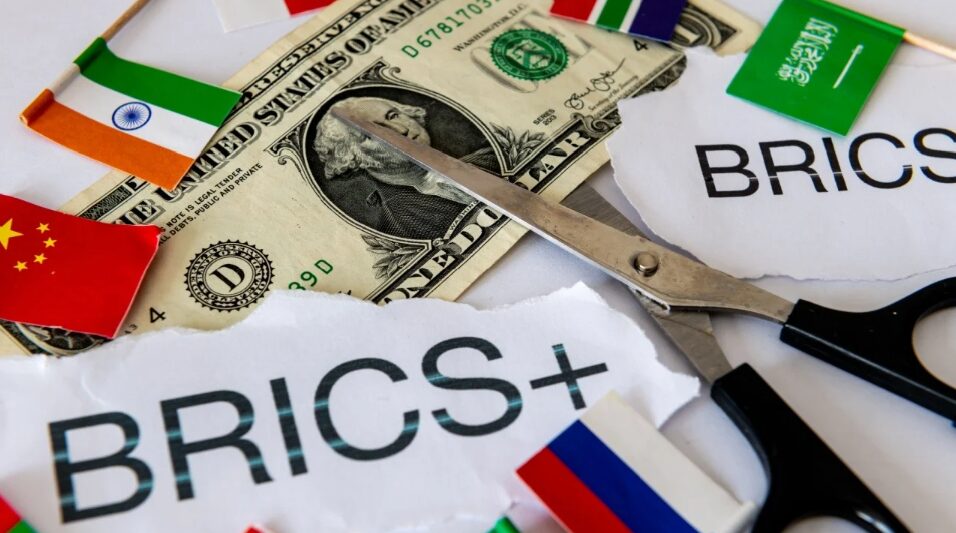
Three Systems Are Changing How Trade Works
While BRICS members aren’t officially considering a single currency in 2025, member countries are pursuing three separate initiatives to reduce their reliance on the dollar. The first one involves expanding bilateral trade in national currencies—something that really picked up momentum after Western nations imposed economic sanctions on Russia following the Ukraine crisis. Member nations are upgrading banking infrastructure across these countries to make these transactions smoother and more efficient.
The BRICS Cross-border Payments Initiative represents the second major effort, and member countries designed it to create an alternative to SWIFT that Western government sanctions can’t disrupt. The third initiative is the BRICS Grain Exchange, which will allow commodity trading in local currencies instead of dollars—a pretty significant shift considering that US and Western exchanges have dominated agriculture commodity trading for decades now.
Kelly Bogdanova, Vice President at RBC Wealth Management, had this to say:
Tariffs Speed Up The De-Dollarization BRICS Process
The rapid de-dollarization trend has intensified quite a bit as US tariff policies triggered what analysts describe as unprecedented coordination among BRICS members. When the US imposed tariffs on Brazil over domestic political disputes and on India for maintaining trade relations with Russia, BRICS nations viewed these actions as economic sanctions—and they sparked the most intense level of cooperation the bloc has seen in its history
China has cut its US Treasury holdings by more than 27% since 2022, and central banks around the world have been purchasing over 1,000 tonnes of Gold annually since 2022 as part of their reserve diversification strategies. The rapid de-dollarization process is being driven partly by these policy responses.
Deutsche Bank’s George Saravelos observed:
Digital Infrastructure Powers BRICS Currency Progress
Technology is making it easier and faster to MOVE away from dollar-based systems than traditional channels could. China’s digital yuan is already operational, and BRICS Pay pilot programs are being tested right now alongside the Bridge platform for cross-border settlements. These technological advances are enabling rapid de-dollarization across multiple fronts.
The New Development Bank recently launched something called the BRICS Multilateral Guarantee Mechanism, which aims to mobilize private capital for infrastructure projects and also climate resilience initiatives using local currency arrangements rather than dollar financing. This represents significant BRICS currency progress in practical terms.
India’s External Affairs Minister S. Jaishankar clarified the country’s position:
This measured approach reflects India’s concerns about Chinese monetary dominance within BRICS—India has refused to settle Russian oil payments in yuan, even though the Chinese currency now accounts for 90% of Russia-China bilateral trade.
Summit Expansion Shows Growing Momentum
The 17th BRICS Summit took place in Rio de Janeiro in July 2025, and it marked a real turning point for the organization. Indonesia officially joined as a member, and 11 new partner countries were welcomed—Belarus, Bolivia, Kazakhstan, Cuba, Nigeria, Malaysia, Thailand, Vietnam, Uganda, and Uzbekistan. This expansion means BRICS groups now represent 47.9% of the global population, which gives the de-dollarization BRICS movement considerable weight.
India will assume the BRICS currency 2026 presidency with priorities focused on global financial reforms, climate finance frameworks, and digital governance. The summit’s Rio de Janeiro Declaration emphasized south-south cooperation and the need for a more inclusive multilateral order—themes that support ongoing rapid de-dollarization efforts.
Retired General Mark Milley, who served as Joint Chiefs of Staff Chairman, acknowledged back in 2023:
This recognition is something that many Western policy circles have been reluctant to accept, but the evidence of rapid de-dollarization continues to mount.
What The Timeline Looks Like
Analysts are making various predictions on how this is going to take place in the coming years. With a gradual transition, the reserve share in the dollar may reduce to between 40-45% by 2040 with adjustable changes on the US borrowing costs. But political shocks, such as enforced debt restructuring or loss of Federal Reserve independence, may shorten this timeline quite significantly, possibly by the year 2030 the dollar shares had fallen to less than 30 per cent.
The trend towards the rapid de-dollarization can be considered as established though the pace is not quite clear. The foreign buying of the US. Treasuries is declining, the yields are climbing and, more importantly, the dollar is not only losing the aura of safe haven, but it is losing it in a generation. The BRICS currency development and the BRICS de-dollarization approach is redefining the way the world markets are operating, and whether the transition WOULD be smooth or messy, will hinge significantly on the US policy reactions and the speed with which substitute systems can reach operational scale in the international trade.
