Trump’s 401(k) Crypto Surge: $1.25 Trillion Tsunami Looms for Digital Assets

Brace for impact—Washington just lit the fuse on the biggest wealth transfer in crypto history.
Retirement accounts go rogue
The old guard never saw this coming. With Trump-era policy shifts greenlighting 401(k) exposure to digital assets, pension funds and retail investors are about to collide in a $1.25 trillion stampede. Wall Street's compliance officers are already reaching for the antacids.
Liquidity meets legacy
Forget 'wait-and-see'—institutional custody solutions are scaling faster than a DeFi exploit. Coinbase's retirement product waitlist ballooned 400% overnight. Meanwhile, BlackRock quietly backtests Bitcoin futures in their target-date funds. The irony? Boomers might accidentally pump your bags.
The fine print tsunami
Yes, the SEC will still find ways to disapprove your grandma's Shiba Inu allocation. But when 401(k) providers start competing on crypto options? That's when the real FOMO begins—and the suits finally learn what 'wen moon' means.
*Bonus jab: Nothing unites political rivals faster than watching hedge funds miss out on 1000x memecoin gains.*
Is A Trillion-Dollar Crypto Flood About To Hit?
The news marks a sharp reversal from the US Department of Labor’s (DOL) aggressive stance just three years ago, when the agency issued an unprecedented warning urging retirement plan providers to “exercise extreme caution” before offering crypto in 401(k) plans. As Ryan Rasmussen, Head of Research at Bitwise Asset Management, noted, “It was the first — and only — time the DOL singled out an asset class like this. Not even junk bonds or ESG funds.”
In 2022, the DOL went further, stating that adding crypto to a 401(k) could be interpreted as a failure to meet the required fiduciary standard of professional care. The message was unambiguous: providers who failed to meet that standard could be held personally liable for any losses. This effectively froze the market before it began. “401(k) providers had to decide if adding crypto to plans was worth the risk of DOL scrutiny. Most didn’t,” Rasmussen explained. The chilling effect was immediate — sponsors backed off, firms paused crypto-linked retirement products, and investors “missed out on life-changing returns.”
By mid-2025, however, the tide had turned. Mounting legal pressure, pushback from 401(k) providers, and Congressional criticism of regulatory overreach led the DOL to rescind its “extreme caution” guidance in full. More strikingly, the agency admitted that its 2022 approach was a deviation from its historically neutral treatment of investment strategies. As Rasmussen put it, “Once again, the US government admitted it had singled out crypto.”
Now, the executive order will not merely remove the roadblocks but actively open the gates. According to Bloomberg data cited by Rasmussen, the US 401(k) market is valued at approximately $12.5 trillion. Even a 1% allocation to crypto WOULD translate to $125 billion in inflows; a 10% allocation could reach $1.25 trillion. Rasmussen believes the earliest beneficiaries will be assets with existing exchange-traded fund (ETF) structures, naming Bitcoin, Ethereum, and Solana, while adding that “a rising tide lifts all boats.”
More Implications
For industry observers, the implications extend beyond a one-time capital injection. Tom Dunleavy, Head of Venture at Varys Capital, stressed that the mechanics of 401(k) investing create a powerful and persistent demand driver. “In the US, roughly 100 million Americans have a retirement investment vehicle known as a 401(k),” Dunleavy explained.
“Every 2 weeks, a portion of their paychecks are routed directly into purchasing a mixture of stocks and bonds… This is a HUGE driver of the equity market run and resilience over the past 20 years. A constant background bid for assets.” With around $50 billion entering these funds biweekly, even a modest portfolio allocation to crypto — 1%, 3%, or 5% — could create recurring inflows of $120 billion to $600 billion annually. “And these aren’t one-time flows. THEY KEEP BUYING ONCE ALLOCATIONS ARE SET,” Dunleavy emphasized.
Jan Happel and Yann Allemann, the founders of Glassnode and Swissblock, are already calling the MOVE a watershed for mainstream adoption. They remarked via X, “People don’t realize yet how big today’s news has been for crypto… this will be seen as the watershed moment for mainstream adoption, much more than the ETF.”
Scott Melker, known as “The Wolf of All Streets,” highlighted the transformational nature of the change: “Until now, the average American couldn’t touch Bitcoin or Altcoins in a 401(k). Soon, they might be able to DCA and trade like a degen tax-free for decades. This isn’t just policy — it’s a paradigm shift.”
As Dunleavy summed it up, with 401(k)s and direct asset trusts in place, the policy “put[s] a ridiculous floor under crypto going forward and move[s] the limit from the moon to Jupiter.”
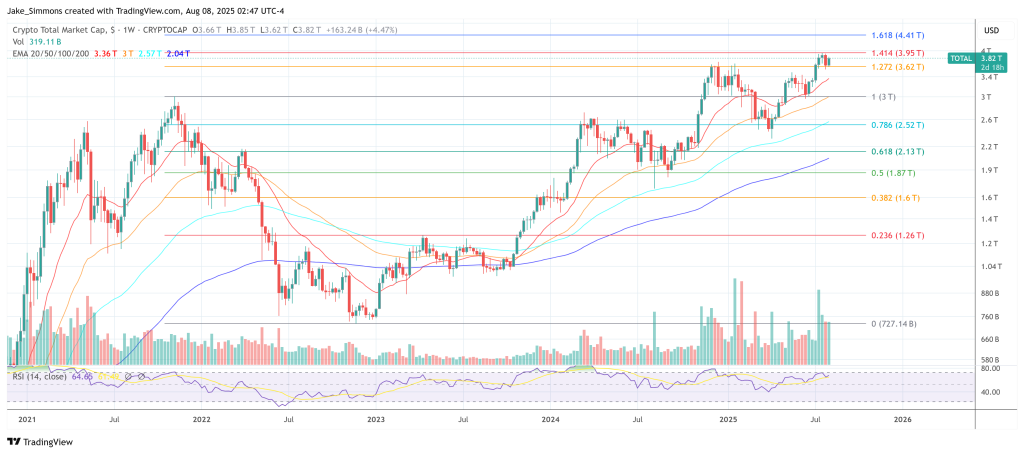
At press time, the total crypto market cap stood at $3.82 trillion.