Bitcoin ETF Flows Expose the Split Inside Crypto’s $1 Billion Selloff—Institutional Risk Appetite on the Brink

WARNING: Bitcoin ETF flows have just absorbed their first serious macro shock in seven weeks, and last week's $1 billion outflow could signal the opening move of a broader institutional de-risking cycle—with traders now bracing for a potential 10% correction. CoinShares reported the first negative week in seven for digital asset investment products, the third-largest weekly outflow of 2026, totaling over $1 billion. Bitcoin products accounted for $982 million of that total, Ethereum products $249 million, and total crypto ETP assets under management slipped to $157 billion from $159 billion. CoinShares explicitly tied the reversal to Iran-related risk-off sentiment, framing it as the end of a six-week positive streak that had fueled record inflows.
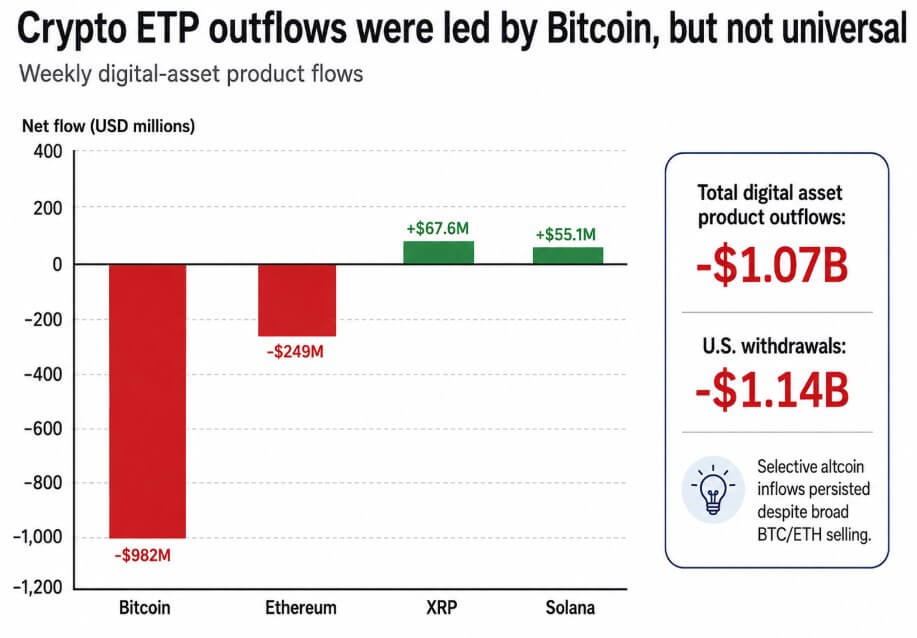 Bitcoin lost $982 million and Ethereum $249 million in weekly ETP outflows while XRP and Solana attracted a combined $122.7 million in inflows.
The macro chain that turned Bitcoin ETF flows
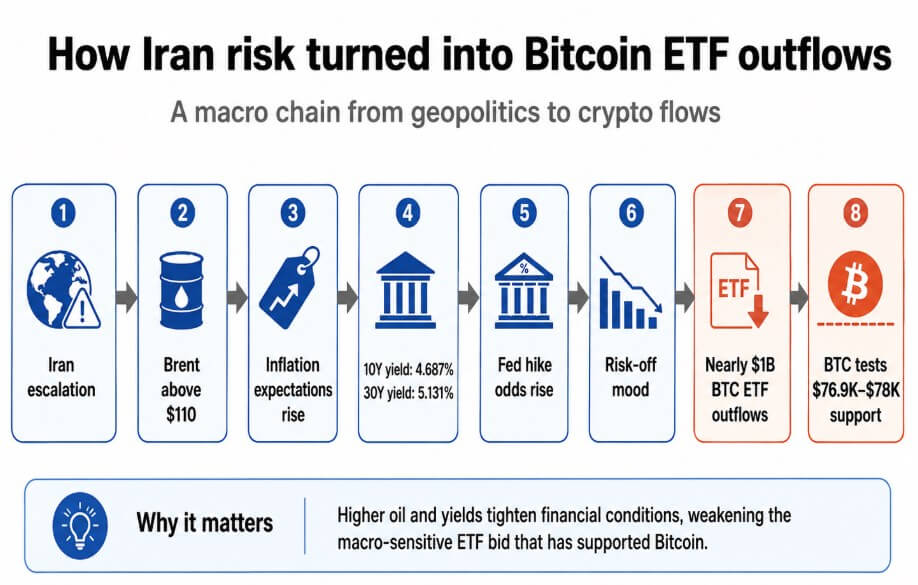
Iranian escalation pushed Brent crude above $110 as traders monitored disruption risk around the Strait of Hormuz, and oil at those levels reset inflation expectations upward, as the 10-year climbed to 4.687% before settling near 4.65%, while the 30-year reached 5.131%.
As yields moved higher, market-implied odds of Fed rate hikes climbed, with December pricing near 40% for a 25-basis-point hike and 14% for a 50-basis-point hike. That combination turned risk appetite negative across liquid assets, and Bitcoin absorbed the selling first.
Bitfinex noted the $80,000-$83,000 as a resistance zone turned sellers back, Bitcoin closed the week 4.6% lower, and US spot Bitcoin ETF weekly net outflows reached nearly $1 billion.
Institutional conviction fell short of absorbing macro shocks and rate volatility at current flow levels. An ETF bid that retreats when yields spike and oil surges is treated by allocators as a discretionary risk allocation.
Glassnode identified immediate Bitcoin support near $76,900 on a 30-day cost basis and near-term resistance near $86,900 based on the November-to-February accumulation range.
Its Realized Cap 30-Day Net Position Change had recovered to $2.8 billion per month as BTC climbed above $80,000, but that figure sat well below the $10 billion-plus levels associated with stronger bull market expansions.
Bitcoin was trading near $77,000 on May 19, inside that stress zone, with Bitfinex's shorter-term framework putting BTC in a $72,000-$80,000 corridor until it reclaims the Short-Term Holder Realized Price and True Market Mean area around the prior rejection zone at $80,000-$83,000.
Köymen noted that selected altcoin perpetual funding rates turned positive during the sell-off, even as Bitcoin and Ethereum funding rates stayed negative, though both showed signs of recovery.
Bitcoin responded to geopolitical risk, dollar strength, and higher yields while selected altcoins and crypto sectors ran on distinct catalysts, insulating them from the BTC-specific macro forces that drove US Bitcoin ETF redemptions.
Where oil and yields decide
If Iranian tensions ease, oil retreats from above $110, and Fed-hike pricing fades, the same allocators who trimmed last week can rebuild exposure quickly, as six weeks of inflow momentum have built a baseline strong enough to withstand a single shock.
ETF inflows would restart within one to two weeks, BTC would reclaim the $80,000-$83,000 repair zone, and the over $1 billion outflow would become a one-week macro air pocket.
Glassnode's $86,900 resistance zone becomes the next target once the repair zone clears, and Köymen's profit-taking framing reinforces the view that outflows were partly driven by rational position management, which carries its own ceiling.
| Macro air pocket | Iran tensions ease; Brent retreats from $110+; 10Y yield moves away from 4.687% peak; Fed-hike pricing fades | Outflows slow or flip back to inflows within 1–2 weeks | BTC holds $76,900–$78,000 support and reclaims $80,000–$83,000 | The $1B+ outflow was tactical profit-taking and macro shock absorption, not structural institutional retreat | Next CoinShares report shows stabilized flows; U.S. spot BTC ETF daily data stop bleeding; BTC targets $86,900 resistance |
| Institutional de-risking cycle | Oil stays above $110; 10Y yield pushes back toward 4.687%; real-rate pressure persists; risk appetite remains weak | Another week of large ETF / ETP redemptions, especially in U.S. Bitcoin products | BTC loses $76,900–$78,000 and trades deeper inside Bitfinex’s $72,000–$80,000 corridor | Institutions are not abandoning crypto, but they are extending a Bitcoin risk-budget cut beyond one shock week | CoinShares shows continued BTC-led outflows; U.S. ETF redemptions persist; Glassnode’s $2.8B/month capital inflow rate deteriorates |
If oil holds above $110 and the 10-year yield pushes back toward its 4.687% peak, real-rate drag on Bitcoin persists without a macro catalyst for reversal.
Allocators who trimmed last week have no reason to rebuild, and weakness in BTC below $76,900 would trigger additional ETF redemptions from investors managing mark-to-market exposure.
Another week of large ETF outflows would confirm that institutional de-risking extends beyond a single shock response, pushing BTC into Bitfinex's lower $72,000-$80,000 trading range.
The $2.8 billion monthly inflow rate Glassnode recorded before last week's outflow would deteriorate further under sustained weekly redemptions at the $1 billion-plus pace, stripping the structural demand narrative of its factual anchor.
BTC holding onto Glassnode's $76,900 support while outflows slow would confirm that allocators have finished trimming, while BTC losing it with redemptions continuing would confirm that the de-risking cycle has more runway.
The forward test for Bitcoin ETFs
The next week of CoinShares flow data and US spot Bitcoin ETF flows provide the cleanest read on which path is unfolding.
Outflows slowing while BTC holds $76,900-$78,000 would frame last week as a shock absorbed at support, and outflows continuing while BTC loses the high-$70,000s would frame the six-week inflow streak as the entry point into a broader institutional risk-budget cut.
Köymen said short-horizon Bitcoin ETF flows constitute a single data point within a larger allocation picture, with European flows, altcoin inflows, and recovering derivatives positioning kept intact even as US products sold off that same week.
Bitcoin's ETF bid is macro-sensitive, and the next CoinShares report will determine whether that sensitivity produced a blip or a cycle.

Log in to Reply
Log in to comment your thoughtsComments
Related Articles
|Square
Get the BTCC app to start your crypto journey
Get started today Scan to join our 100M+ users