Tokenized T-Bills Shatter Records, Surpass $14B in Total Value Locked

Tokenized U.S. Treasury bills have surged to a historic $14 billion in total value locked, demonstrating remarkable resilience amid crypto market volatility and DeFi losses. The milestone, reported by Token Terminal as of April 2026, reflects accelerating institutional adoption as a growing number of wallets accumulate these real-world assets across multiple blockchain protocols.
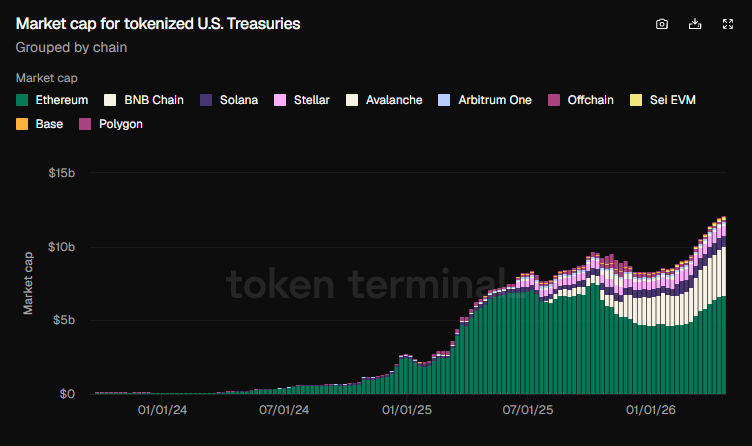 Tokenized T-bills expanded in 2026, reaching a new record above $14B in value locked. | Source: Tokenterminal
Asset tokenization has expanded despite the slowdown of DeFi. In the past month, more funds flowed into tokenized T-Bills. Funds flowed into tokenized US debt on BNB and Solana, two of the networks with robust recent growth. Ethereum is still the main tokenization venue for government debt, due to its legacy status as one of the first venues for money market funds and T-bills.
Who issued the most tokenized T-bills in the past month?
Several entities specialize in tokenizing short-term US debt on leading blockchains.
According to Token Terminal, Benji by Franklin Templeton is the leading tokenization engine. The Benji fund on Ethereum expanded its on-chain assets by over 381% in the past month.
🏦⛓️ Fastest-growing tokenized T-bill funds (30d %):
1. iBENJI on @ethereum, up +381.9%
2. TBILL on Ethereum, up +178.6%
3. USDY on @SeiNetwork, up +107.5%
4. STBT on Ethereum, up +62.0%
5. JTRSY on Ethereum, up +57.3%
Assets & issuers to follow 👇 pic.twitter.com/ThLTnhZVQ8
— Token Terminal 📊 (@tokenterminal) April 22, 2026
Tokenized US treasuries are still relatively niche compared to other on-chain assets. A total of 33.9K wallets hold those assets, also hovering near a record level.
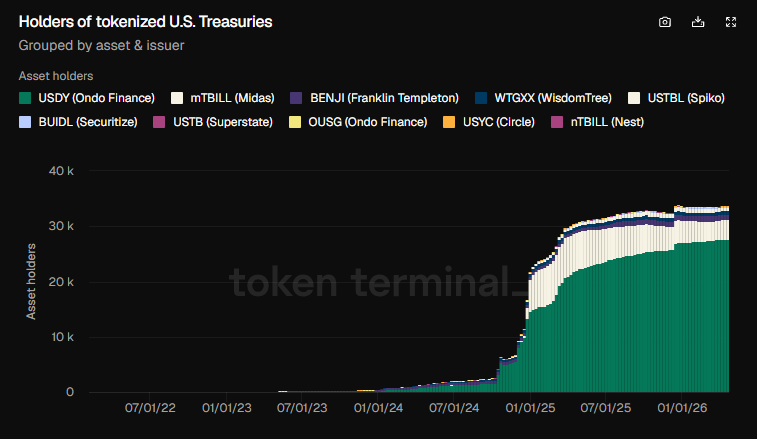
Holders are usually DeFi teams and protocols. Tokenized T-bills are held as collateral on DeFi lending protocols like Morpho, Sky, and Flux. The usage of T-bills is still more conservative. This makes the protocols using tokenized T-bills as collateral more secure.
The T-bills can be used as backing for stablecoins like USDS, in the case of Sky Protocol. The USDY stablecoin by Ondo Finance is also backed by tokenized T-bills.
Spark Protocol, a sub-DAO of Sky Protocol, uses its T-bill positions as an ‘anchor collateral’ to offset crypto market fluctuations.
Higher demand for tokenized T-bills may come from DeFi and lending protocols, seeking more conservative vaults. The rising demand followed outflows from lending protocols, which accelerated after the KelpDAO exploit.
Tokenized T-bills offer growing yield
The tokenized US treasuries represent debt directly, and are a subset of T-bills acquired by other crypto projects. Tether remains the most significant buyer and holder of US government debt.
The tokenized bills used in DeFi are a subset of the total amount. At $14B in total value locked, the issuers will receive 3.68% in annualized yield, or around $515M.
At this point, it remains uncertain if the issuers of tokenized T-bills can share their yield with holders. The rules of tokenization may vary by protocol. However, the constant expansion trend shows DeFi protocols are not capitulating, but instead seeking other tools to stabilize their financials.
Don’t just read crypto news. Understand it. Subscribe to our newsletter. It's free.

Log in to Reply
Log in to comment your thoughtsComments
Related Articles
|Square
Get the BTCC app to start your crypto journey
Get started today Scan to join our 100M+ users