Chinese Scientists Crack Immune Aging Code: Develop Revolutionary Clock to Track and Slow Human Aging Process

BREAKING: A groundbreaking study from Chinese researchers has successfully decoded the complex aging process of the human immune system—long considered the primary driver of organismal aging—and developed the first accurate 'immune aging clock' capable of measuring its decline. In a major breakthrough that overcomes decades of scientific hurdles, the team has not only identified precise biomarkers across diverse immune cell types but also discovered actionable pathways to potentially slow the aging process, marking a pivotal advancement in longevity science and preventive medicine.
Chinese scientists develop a clock that tracks immune aging
The scientists were able to create a so-called Human Immune Aging Clock (HIAC) that could precisely map immune aging.
HIAC was constructed from a single-cell multi-omics dataset of nearly 1.2 million human peripheral blood mononuclear cells collected from 230 individuals, with ages ranging from 60 years.
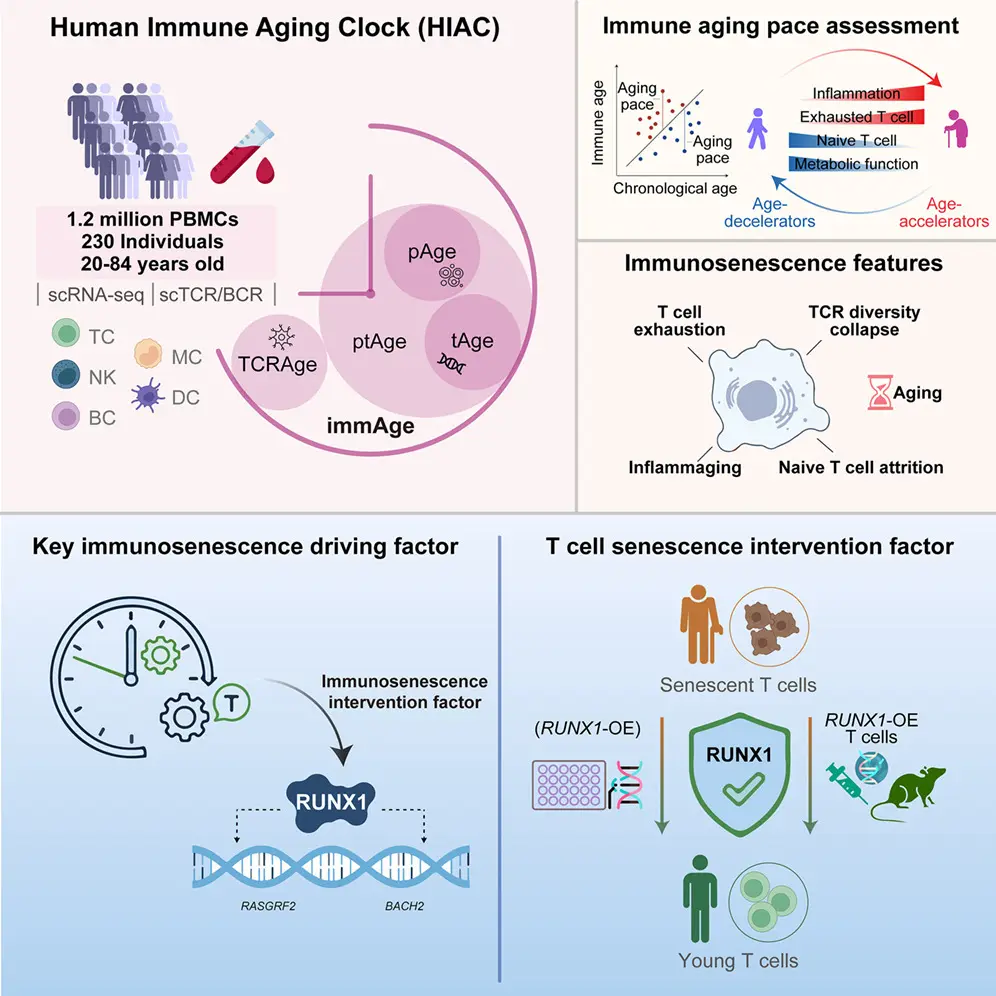
The study also led to an important discovery that the immune cells hit an inflection point around age 40, from where they quickly begin to remodel and age. It also identified T cell transcriptomes as the key indicators of immune aging. As the immune system ages, the proportion of naive T cells tends to decline as well.
The scientist found that people with decelerated immune aging had high proportions of T cells and exhibited more youthfulness.
RUNX1 spotted as a factor that can slow immune aging
The study identified RUNX1 as a central regulator, key to slowing down immune aging in humans. RUNX1 is one particular transcription factor that keeps T cells youthful. However, its expression in the T cells was found to decline with age.
The scientists discovered that when RUNX1 is removed from young T cells, they began to show signs of aging. However, it was restored in aged T cells, and those signs were alleviated, enabling the cells to maintain their youthfulness. Animal studies have already proven successful.
“Our study provides a quantitative tool for assessing immunosenescence and nominates RUNX1 as a target for rejuvenating aged immunity,” the scientists wrote in the report.
The exciting summary of the study would be that, by restoring RUNX1, aged T cells will function more like younger ones. In turn, that will help decelerate immune aging and potentially the overall body aging process.
The study marks yet another progress in longevity research. Earlier this month, Cryptopolitan reported another big event, with scientists at Life Biosciences planning to begin the first trial of partial reprogramming in humans. The trial begins later this year, treating up to 12 people with glaucoma, via a therapy based on three Yamanaka factors, excluding c-Myc.
The therapy already worked well in animal studies, with the scientists successfully restoring eye cells in mice back to a younger state.
If you want a calmer entry point into DeFi crypto without the usual hype, start with this free video.

Log in to Reply
Log in to comment your thoughtsComments
Related Articles
|Square
Get the BTCC app to start your crypto journey
Get started today Scan to join our 100M+ users