South Korea Slaps Tariffs on Japanese and Chinese Robots - Trade War Escalates

SEOUL, March 27, 2026 - South Korea has fired a major salvo in a growing trade dispute, imposing immediate antidumping duties of up to 19.85% on industrial robots from China and Japan. The Korea Trade Commission (KTC) announced the punitive tariffs Thursday, warning that a flood of low-cost imports has severely damaged the nation's domestic robotics industry and necessitated the defensive action.
Why is Korea targeting China and Japan?
The Korean trade watchdog began its probe into the matter following anti-dumping complaints filed by HD Hyundai Robotics and four others earlier last year. Therein, the South Korean firms accused Chinese and Japanese suppliers of selling vertically articulated industrial robots with four or more axes at unfairly low prices.
An HD Hyundai official said they started suffering damages in the first half of 2024, with Chinese companies selling products nearly 60% cheaper than locally-made ones.
“Chinese companies appear to be dumping their products into the Korean market to reduce their inventories amid the prolonged weakening of consumption in their own country,” the official said at the time.
South Korea happens to be the fourth largest market for industrial robots, led by China, Japan, and the United States, according to a market insight by the International Federation of Robotics.
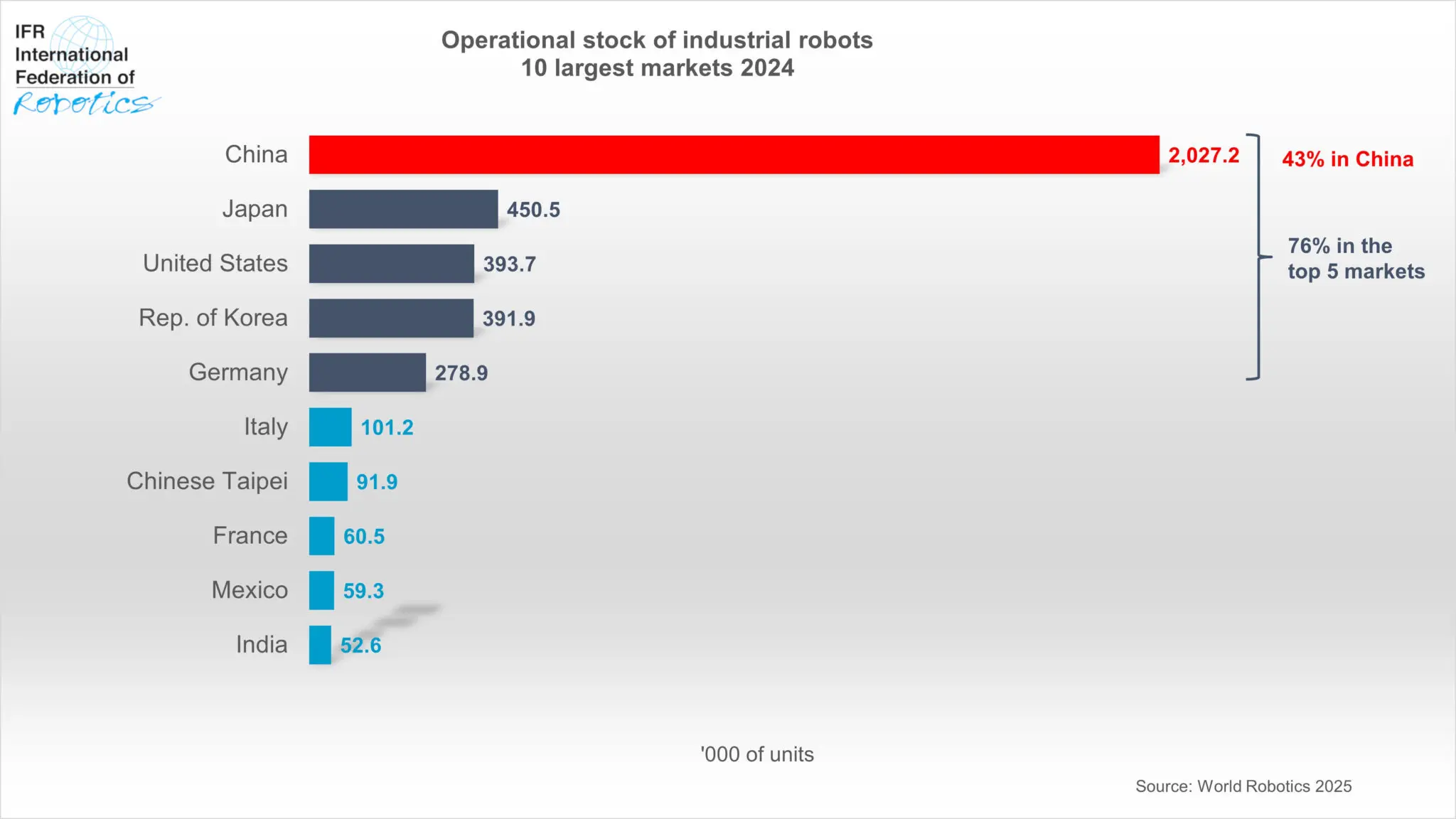
As of 2024, Korea had 391,900 operational units. China alone accounted for 43% or 2,027,200 units, followed by Japan with 450,500 units, and the U.S. with 391,900 units.
U.S. is also calling for tariffs on Chinese robots
The U.S. robotics firms are also pushing for similar measures as Korea against Chinese products.
Last year, U.S. robot makers, including Tesla, urged lawmakers to implement national strategies to bolster the domestic market and subsidize local robots, just as China does.
While testifying to Congress last December, New York-based Standard Bots CEO Evan Beard complained that U.S. quotes are ten times higher than Chinese suppliers, which makes it difficult for U.S. suppliers to compete globally.
Beard recommended the U.S. government increase funding, and also implement a ban or tariffs on industrial Chinese robots to create a “fair competitive landscape for American suppliers.”
The Trump administration is expected to issue an executive order on robotics this year, but some U.S. robotics execs say there may not be any major policy push until President Trump meets with Chinese leader Xi Jinping – a meeting that was postponed due to the escalation of the US-Iran conflict.
In other news, two U.S. lawmaker has put forward a bill to ban the government from buying or operating humanoid robots made by Chinese firms, saying they pose a national security risk, Cryptopolitan reported Thursday.
There’s a middle ground between leaving money in the bank and rolling the dice in crypto. Start with this free video on decentralized finance.
