US Lawmakers Target Chinese Robotics and AI with New Bans and Data Center Restrictions

WASHINGTON, March 26, 2026 – Bipartisan U.S. senators moved to ban federal agencies from purchasing Chinese-made humanoid robots and AI systems, escalating tech-sector tensions as Chinese firms race against Tesla and others to dominate the next generation of automation. The proposed American Security Robotics Act, sponsored by Republican Senator Tom Cotton and Democratic Senate Majority Leader Chuck Schumer, would block federal procurement and funding for unmanned ground vehicles from adversarial nations including China, citing national security risks in critical infrastructure and data centers.
Lawmakers call for a data center construction freeze
At the same time, a group of progressive lawmakers announced on Wednesday a plan to halt construction of new AI data centers. They pointed to what they described as an unprecedented energy crisis.
Senator Bernie Sanders and Representative Alexandria Ocasio-Cortez are heading up the push, arguing that the rapid growth of AI infrastructure is hurting both the environment and American workers.
“Despite the extraordinary importance of this issue and its impact on every man, woman, and child in this country, AI has received far too little serious discussion here in our nation’s capital,” Sanders told reporters Wednesday.
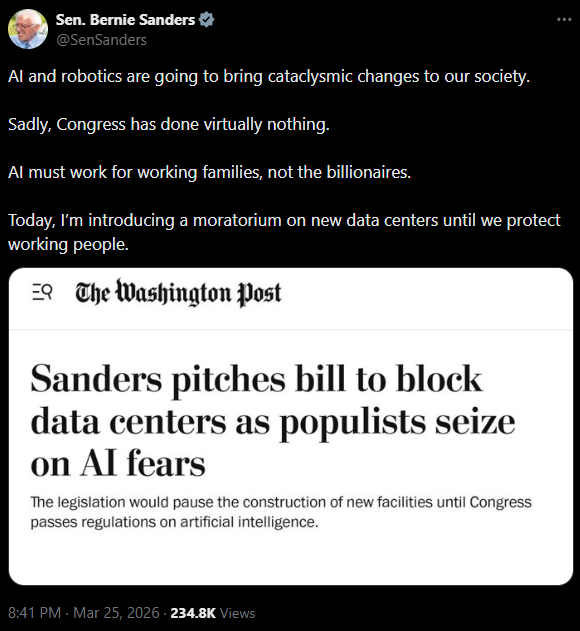
Under the proposal, construction of new AI data centers would be halted immediately once the legislation passes. The bill would also ban exports of computing hardware, including AI chips, to countries lacking similar worker and environmental protections in place.
This would limit China’s access to vital infrastructure required to continue developing AI at home.
The strategy establishes a new regulatory hurdle that might seriously impede China’s technology scaling and global supply chain integration by linking exports to certain environmental and worker protections.
Congress sharpens focus on Chinese robotics threats
Both legislative efforts are playing out against a backdrop of growing scrutiny in Congress over Chinese technology threats.
On March 17, the House Subcommittee on Cybersecurity and Infrastructure Protection held a hearing on national security risks tied to Chinese-linked robotics and AI systems, including DeepSeek and Unitree Robotics.
Industry leaders testified that robots manufactured in China might pose dangers far beyond ordinary cyberattacks.
Michael Robbins, CEO of the Association for Uncrewed Vehicle Systems International, informed lawmakers: “This coordinated national initiative seeks to undermine the U.S. robotics industrial base, resulting in a deep-seated technological and industrial dependency.”
On the trade front, U.S. robotics executives worry that the postponement of the Trump-Xi summit, which was delayed due to the conflict over Iran and rescheduled for May 14-15 in Beijing, could slow efforts to put stronger protections in place for the American industry.
According to a Cryptopolitan report, China accounted for more than 80% of all humanoid robots deployed worldwide last year, aided by government policies and its 15th Five-Year Plan, which lists embodied artificial intelligence as a national priority.
Industry leaders are pressing the administration for tariffs and direct federal support, warning of a repeat of what happened in the drone sector, where Chinese firms came to dominate the global market.
Want your project in front of crypto’s top minds? Feature it in our next industry report, where data meets impact.
