Wintermute Warns: BTC Price Now Tethered to Oil Market Volatility - Could Swing 10% on Geopolitical News

Leading crypto market maker Wintermute has issued a stark warning, directly linking Bitcoin's short-term price trajectory to oil market volatility and geopolitical risk. In a new analysis, the firm states that BTC faces a potential 10% correction to $65,000 if disruptions in the Strait of Hormuz persist, while normalization could propel it toward a $74K-$76K range. The assessment comes as Bitcoin, currently trading at $71,104.40, shows an acute sensitivity to oil risk premiums, with a recent pause in strikes against Iran helping it recover the $70,000 level. Wintermute identifies oil as the primary near-term price driver, especially as hawkish Federal Reserve policy has pushed potential rate cuts beyond 2026.
Will oil drive BTC pricing?
The connection between oil prices and BTC is chaotic, going through multiple stages. The post-pandemic oil slide coincided with a BTC bull market, but there may be more complex short-term relationships.
Wintermute advises on watching the talks between Iran and the US for signs of additional oil risk premiums and inflation. In this case, BTC may dip to a lower range.
In the case of de-escalation, BTC has a path to move into the $80,000 range if institutions and whales move in to buy the dip.
Based on Wintermute’s performance data, BTC was down by 6.8% for the week ended March 22. Gold dipped even lower, erasing 10.3%. ETH and altcoins also reacted to the news of an oil supply shock, ending the week in the red.
As of March 24, the Bitcoin fear and greed index crashed again to 11 points or ‘extreme fear’. The Ethereum fear and greed index reached 32 points, indicating fear. Altcoins as a whole remain stagnant, and oil was the only market with a strong directional move.
Crypto bear markets coincide with high oil prices
During the 2022 bear market, crypto traded under conditions with relatively high oil prices. During the previous bear market, the main factors for crypto were internal, as the market reeled from the crash of FTX.
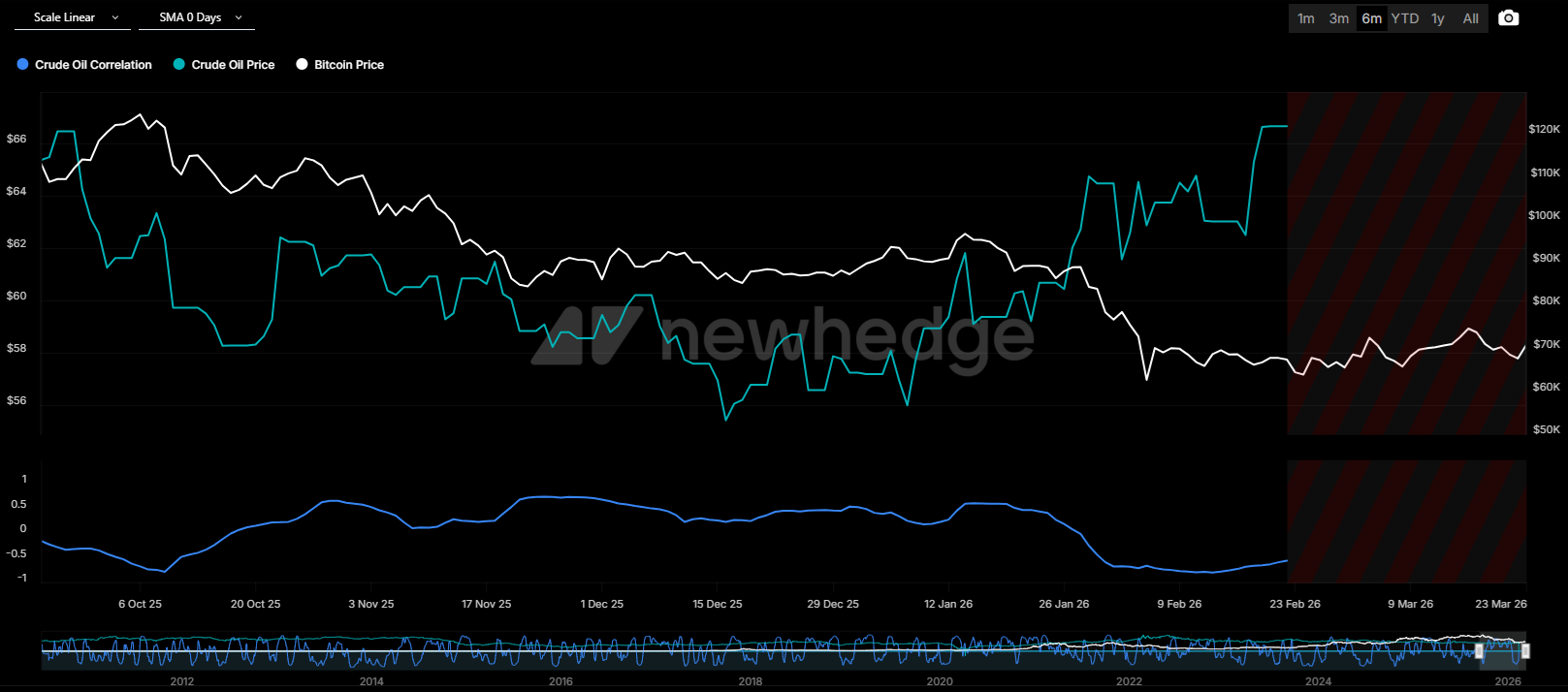
This time, the crypto space has not seen any significant internal problems, but it remains open to geopolitical risk.
BTC has also decoupled from the S&P 500 as investors turned to lower-risk assets. BTC also shifted its trading style, becoming an asset to react quickly to uncertainty, due to its trader base and active trading over the weekends.
BTC still shows it has enough support to add a net 6% to its price in March. Despite this, in Q1 to date, the leading coin is down by 18%, and has not recovered previous levels due to escalating global uncertainty.
There’s a middle ground between leaving money in the bank and rolling the dice in crypto. Start with this free video on decentralized finance.
