Beijing Marathon 2026: Over 300 Humanoid Robots Challenge Human Runners in High-Stakes Tech Showdown

BEIJING, March 24, 2026 – In a dramatic escalation of technological competition, over 300 advanced humanoid robots are poised to compete against elite human athletes in next month's Beijing Marathon, marking China's boldest public demonstration yet of its rapidly accelerating robotics sector. This high-profile event follows last year's inaugural race where 21 robots were decisively outpaced by human competitors, with the fastest android finishing in 2 hours 40 minutes—nearly 100 minutes behind the human champion's 1 hour 2 minute victory—setting the stage for what industry analysts are calling a critical benchmark for AI-driven physical performance.
Over 300 robots set to compete in Beijing marathon
More than 300 humanoid robots will be competing in the second edition of the half-marathon scheduled for April 19. The organizers said Monday the robots will be put on the same tracks as human runners in the 2026 Beijing E-Town half-marathon.
During the previous half-marathon, the robots had dedicated lanes separated by safety fences and median strips. They were mostly walked by engineers using remote controls.
Per the organizers, 38% of participating teams in the upcoming event will be competing under an autonomous navigation group, wherein the robots are expected to navigate the routes independently of the team. It highlights a shift from merely “human-led mode” to “full autonomy,” Global Times reported, citing Wang Peng, an associate research fellow at the Beijing Academy of Social Sciences.
The competition is aimed at showing off China’s advancing robotics industry, which was estimated at $47 billion in 2024 and projected to grow 23% annually through 2028.
China tops annual humanoid installations
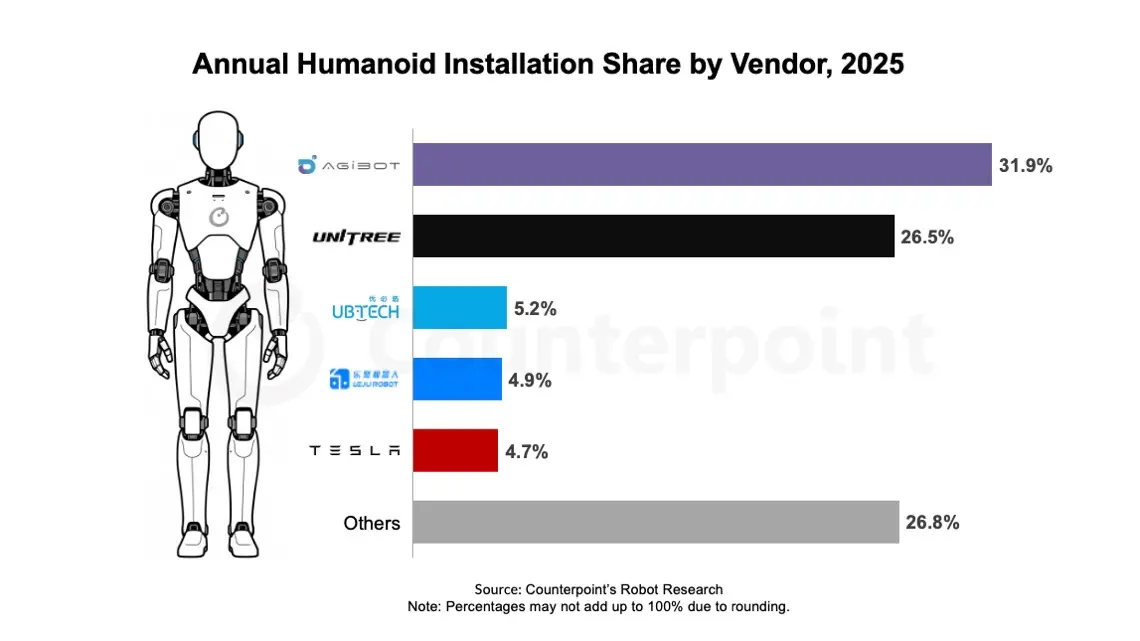
China leads the pack in global humanoid robot installations. Data from Counterpoint shows 16,000 units of humanoid robots were deployed around the world in 2025, with China accounting for more than 80%.
AGIBOT was the biggest vendor, accounting for 31.9% of the installation share, followed by Unitree, UBTECH, and Leju, which are all Chinese manufacturers. Tesla made the 5th on the list, with nearly 5% share, following the ramp-up of the Optimus Gen 2 and Gen 2.5.
In other news, Tesla is preparing to unveil the Gen 3 version of Optimus, which it says is “our first design meant for mass production.” Per the official statement, production is expected to start before the end of the year, with an eventual target volume of 1 million robots per year.
If you're reading this, you’re already ahead. Stay there with our newsletter.
