Murfreesboro Bitcoin ATM Scam: $4M Drained from Residents in Sophisticated Impersonation Scheme

Law enforcement issued an urgent warning after a sophisticated Bitcoin ATM scam drained approximately $4 million from Murfreesboro residents, primarily targeting elderly victims through fear-based impersonation tactics. The scheme, which saw a 10% correction in local cryptocurrency transaction volumes following the alert, involves scammers posing as police officers to create false arrest warrants, then directing victims to withdraw cash and deposit it into crypto wallets via Bitcoin ATMs—funds that become instantly untraceable upon transfer.
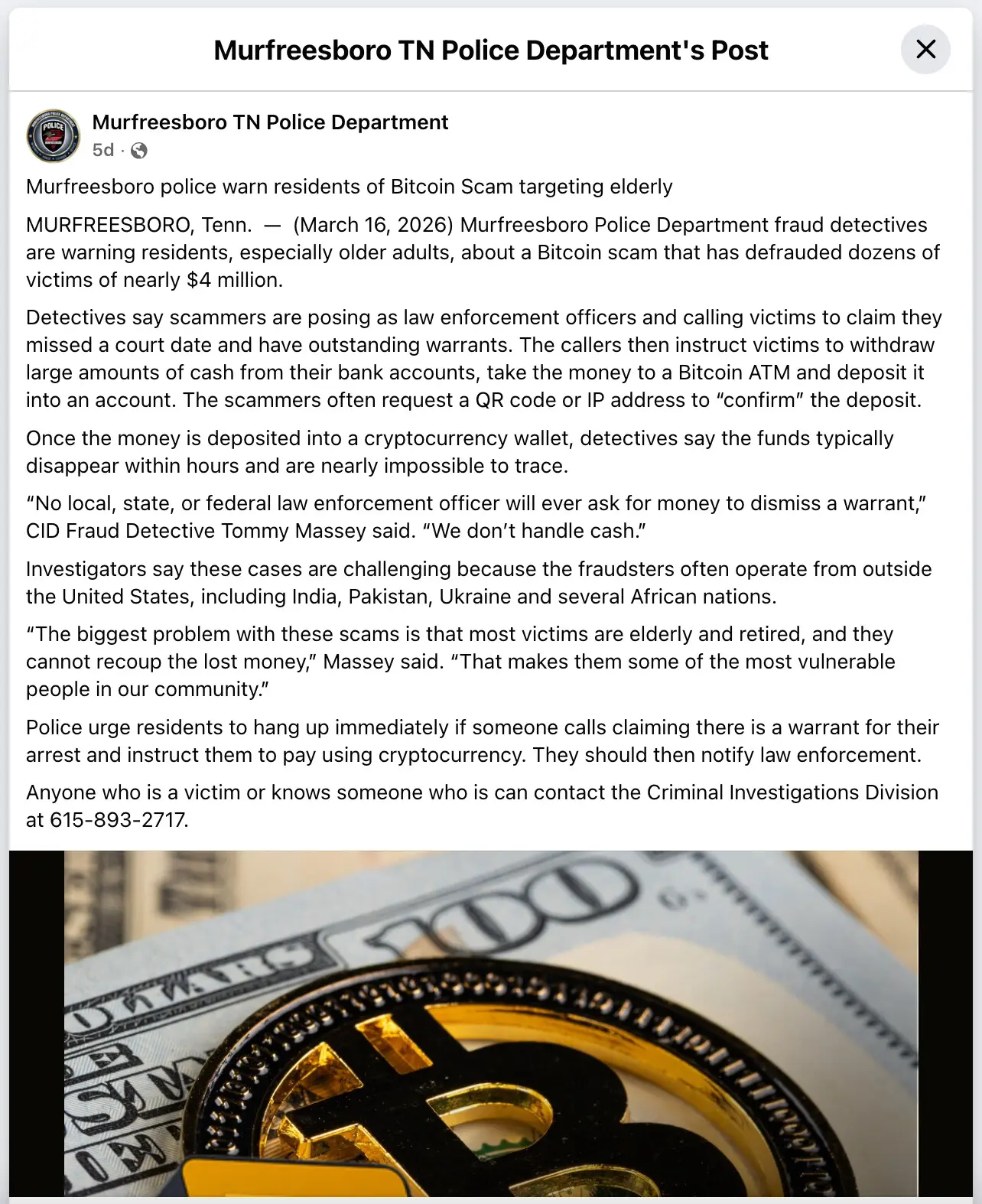 Official statement from the Murfreesboro TN Police Department. Source: Facebook.
Bitcoin scammers target Albemarle County residents
The scam repeats in Albemarle County. According to local news outlets, 30 cases were reported in the past 14 months. Victims lost an average of $26,000 per case, based on a statement from the Albemarle County Police Department.
Police said every reported victim was either over 60 years old or considered vulnerable. Many victims had worked their entire lives and were living in retirement. Some were forced to rely on family again after losing their savings.
Detective Marcus Baggett described the financial damage as devastating. He continued, “We have elderly folks who have worked their entire career to be retired. And after these types of losses, they may find themselves living with elderly parents.”
The scam follows the usual tactics. Impersonation, manipulation, and pressure on the victim to act quickly and send funds. And once the transaction is complete, tracking becomes difficult.
First Sergeant Adam Culpa said, “If you do put money into a Bitcoin ATM, it prints out a receipt with the address on there.” He added that the receipt is often the only traceable starting point. Without the receipt and wallet data, “it’s nearly impossible to follow the trace.”
Federal agents said recovery is rare once funds are moved. Heather Harris, an FBI Intelligence Analyst, explained that money is quickly transferred across different wallets.
By the time victims report the crime, the funds are often converted to other cryptocurrencies or relocated. This makes the recovery process complex and often unsuccessful.
Harris said, “There is no legitimate business, government agency, or bank, or financial institution that is going to demand our U.S. citizens to pay or send money through cryptocurrency.”
Data from the Federal Bureau of Investigation (FBI) ranks Virginia 10th based on the number of reported cases. The state is also placed 15th in total losses.
Crypto ATM scams are considered new for many law enforcement departments. The increasing scale of victims and losses requires coordination across all jurisdictions.
Authorities advise people to actively protect themselves from crypto ATM scams. If someone asks for payment via a crypto kiosk, it’s a major red flag, and the target victim should report the incident to law enforcement quickly.
There’s a middle ground between leaving money in the bank and rolling the dice in crypto. Start with this free video on decentralized finance.
