Monero Soars 7% After Massive Reorg Erases 117 Transactions—Market Shrugs Off Technical Turmoil

Monero defies logic with a bullish surge right after its largest-ever chain reorganization.
The privacy-focused cryptocurrency ripped higher despite a network event that wiped 117 transactions from existence—proof that crypto markets sometimes operate on pure vibes rather than fundamentals.
Traders clearly aren’t sweating the technical drama. Maybe they’re just used to blockchain networks occasionally hitting the undo button—after all, in traditional finance, it usually takes a government bailout to reverse transactions that decisively.
Another day, another reminder: in crypto, bad news can still mean green candles. Go figure.
 $6B Privacy Coin Monero Was Just Hijacked for $100K/Day
Monero, the $6 billion privacy coin long touted as one of crypto’s most censorship-resistant networks, has suffered a major setback.
A single mining entity, the Layer-1 blockchain Qubic, claims it seized 51% of Monero’s… — Cryptonews.com (@cryptonews) August 18, 2025
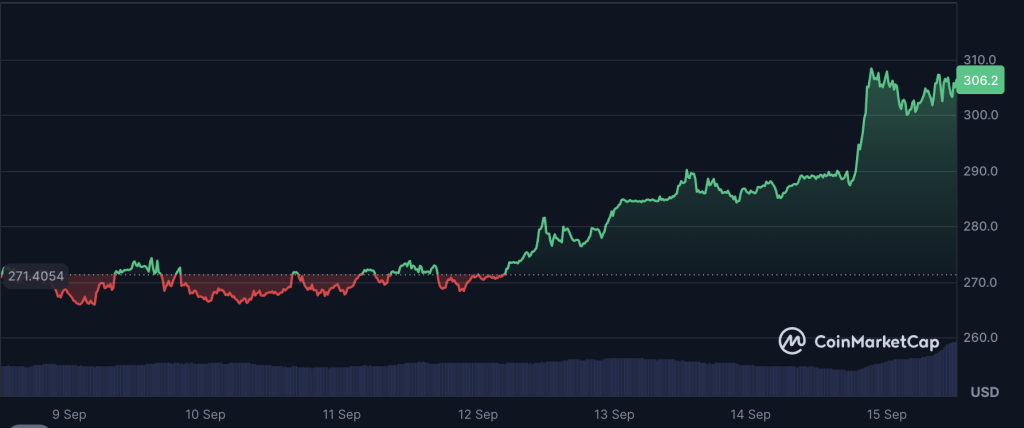
Despite the disruption, Monero’s native coin, XMR, saw a price uptick. XMR ROSE 7% in the past day before retracing to the current price. As of this press time, XMR trades at $305, extending its weekly and monthly gains to 12% and 29%, respectively.
118 Transactions Invalidated After Monero’s Deepest Chain Reorg
Monero’s largest blockchain reorganization to date wiped out 118 previously confirmed transactions, creating visible disruption for users and exchanges. Blockchain researcher Andy Fitche confirmed that the competing chain invalidated confirmed payments, noting that wallets displayed alerts showing transactions marked in red as “invalid.”
19 Blocks as alternative Blockchain. Injected into #Monero. Right now.
The consequence? The red text means that transactions, which were sent and already confirmed, are now invalid.
And trust me, it takes a long scroll to reach the end of the red lines.@MoneroTalk… pic.twitter.com/p667UprbfU
Avdiu Sazan, another community analyst, said the competing blocks were linked to the mining pool Qubic. He described the event as “a casual 18 blocks reorg.” Providing possible reasons for the recent event, crypto podcaster Xenu suggested Qubic aimed to “stop the bleeding” of XMR’s price, sparking debate on the chain’s future.
Reorganizations occur when two versions of a blockchain compete, and miners extend different ledgers. The longest valid chain ultimately becomes the accepted history, discarding blocks on shorter chains.
While one- or two-block reorgs occasionally occur on proof-of-work chains due to latency or simultaneous block discovery, Monero’s 19-block reorg is highly unusual and points to concentrated mining power or instability.
The episode has reignited discussion around Monero’s network security. The community has floated potential safeguards, including localized mining, merge mining, or Dash-style ChainLocks, to reduce the risk of DEEP reorgs and 51% attacks.
None, however, have been adopted, leaving mining pools like Qubic with disproportionate influence. Notably, the latest reorg exceeded Monero’s built-in 10-block protection, underscoring ongoing vulnerabilities in the protocol.
Monero Supporters Double Down on the Network Despite Security and Privacy Concerns
Monero supporters rallied behind the privacy-focused cryptocurrency this week despite mounting scrutiny after its deepest blockchain reorganization to date. Advocates took to X, insisting that Monero remains the only asset offering “true freedom,” contrasting its privacy guarantees with Bitcoin’s traceability under know-your-customer (KYC) regimes.
“Monero is the only SAFE haven,” one supporter posted, while another, Meta Ryuk, said the asset poses unique challenges for regulators. “Bitcoin is a haven for them. Monero is a challenge.” Ryuk dismissed claims of traceability, calling them “unfounded.”
Critics, however, questioned the network’s reliability following the 43-minute chain rewrite that invalidated 118 confirmed transactions.
Dash DAO’s Joel Valenzuela likened the disruption to “Visa going down for 40 minutes,” warning that such instability WOULD be unacceptable for mainstream systems.
When people say "crypto is still a casino," people point to solana memecoins. In reality, they should point to Monero.
If the Visa network had 40 minutes of activity disrupted on a whim, and the company wasn't taking it seriously, the company would go to zero immediately.… https://t.co/vGeTQYjEUR
A crypto analyst said he would stop accepting XMR payments until the issue is resolved, calling the network “unreliable.”
Meanwhile, Monero has been previously implicated in the criminal economy, particularly for laundering funds from CSAM sales, according to Chainalysis’s 2024 Crypto Crime Report. Vendors often convert Bitcoin into Monero via instant exchangers, taking advantage of its privacy features and lack of KYC to obscure transactions.
Similarly, Finnish authorities traced Monero in the Julius Kivimäki case, where the hacker allegedly converted bitcoin ransom payments into Monero via a non-KYC exchange to obscure the funds before transferring them to a dedicated wallet.
