US Banks Moved $312B in Chinese Drug Money, But Crypto Gets the Blame

Traditional finance moves mountains of questionable cash while pointing fingers at digital assets.
The Irony of Legacy Systems
While regulators hyper-focus on crypto's every transaction, traditional banking infrastructure processes staggering sums with minimal scrutiny. The $312 billion figure exposes a systemic hypocrisy that would be laughable if it weren't so damaging to innovation.
Selective Enforcement Patterns
Banks get fines—crypto gets existential threats. The disparity in treatment reveals more about regulatory capture than actual risk management. It's almost like legacy institutions enjoy playing both sides: profiting from opaque flows while lobbying against transparent alternatives.
The Transparency Paradox
Blockchain's traceability becomes its greatest liability in a system that prefers plausible deniability over auditable truth. No wonder traditional finance fights so hard against an innovation that actually makes laundering harder.
Of course, watching banks moralize about financial integrity while moving drug money is peak finance—nothing moves faster than wire transfers except regulatory hypocrisy.
Banks Handle Bulk of Criminal Money While Crypto Faces Heat
Banks accounted for $246 billion of the total suspicious transactions, while money service businesses handled $42 billion and securities firms processed $23 billion.
The average annual FLOW through US banking systems reached $62 billion from Chinese money laundering operations alone.
Historical cases reveal systematic banking vulnerabilities to criminal exploitation.
Wachovia Bank laundered $350 billion for Mexican drug cartels between 2007 and 2010, receiving only a $160 million penalty despite the massive scale.
Danske Bank processed $228 billion in suspicious transactions from Russia between 2007 and 2015, ignoring internal warnings throughout the period.
Similarly, HSBC paid $1.9 billion in 2012 for allowing drug cartels to transfer hundreds of millions through accounts, with criminals using specially designed cash deposit boxes that fit perfectly into bank slots.
TD Bank agreed to pay over $3 billion after prosecutors found the institution had been used to launder more than $470 million through Chinese networks in New York and New Jersey.
In fact, dating back to 2021, the 1MDB scandal involved over $1 billion stolen through global banking networks, with funds used to purchase luxury real estate, yachts, and artwork across major cities.
Bank of Credit and Commerce International laundered billions for drug cartels and corrupt governments before its 1991 closure forced stricter international banking regulations.
Criminal organizations recruit bank employees as complicit insiders and use counterfeit Chinese passports to facilitate account openings.
Money mules often report occupations as “student,” “housewife,” or “retired” during onboarding to explain large transaction volumes that are inconsistent with their stated professions.
Regulators Target Crypto Despite Minimal Illicit Activity Share
Cryptocurrency transactions represent ‘’ of total money laundering activity globally, according to TRM Labs.
In fact, Chainalysis data shows illicit crypto volumes totaled approximately $189 billion over five years, compared to over $2 trillion laundered annually through traditional financial systems worldwide.
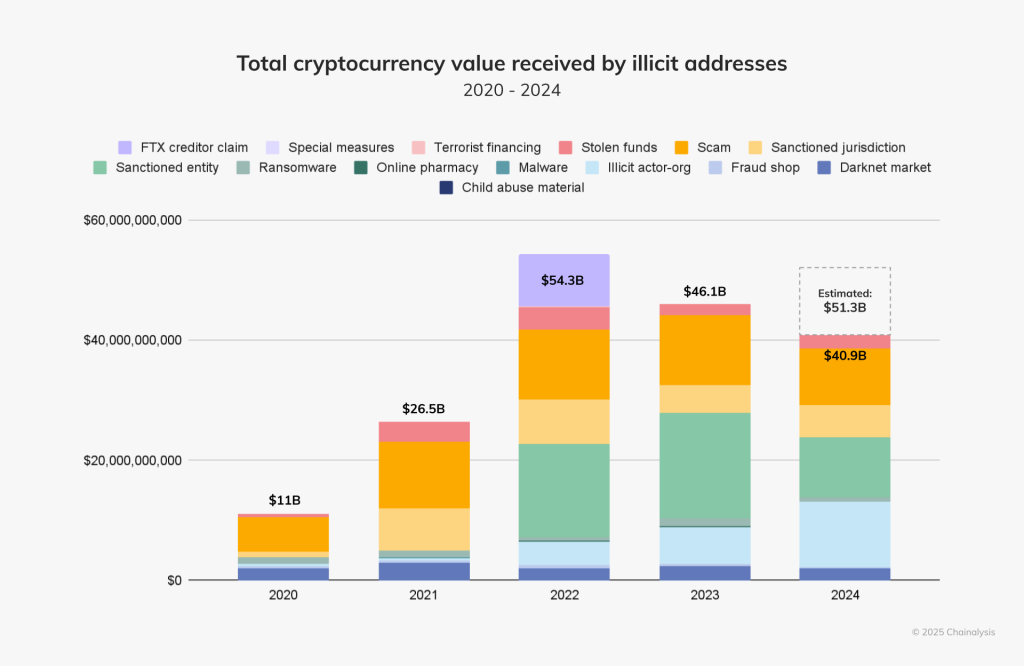
Despite this disparity, regulators are intensifying their enforcement actions against crypto.
Most recently, Binance Australia was required to appoint an external auditor within 28 days after AUSTRAC identified “serious concerns” with its anti-money laundering controls.
French authorities have also launched investigations into Binance over alleged violations, while European regulators are considering penalties against OKX following $100 million in allegedly laundered funds.
Australian enforcement expanded through systematic compliance reviews, with AUSTRAC targeting 13 remittance providers while investigating 50 additional platforms.
The agency cancelled or refused renewals for nine providers that failed to comply with their obligations, contrasting sharply with the limited penalties imposed on the banking sector despite vastly larger suspicious transaction volumes.
Senator Elizabeth Warren continues to demand tougher crypto regulations, stating, “Bad actors are increasingly turning to cryptocurrency to enable money laundering.”
However, FinCEN data reveals that Chinese money laundering networks primarily operate through traditional banking channels rather than digital assets.
Blockchain analytics firm Chainalysis reported illicit crypto transactions reached $51.3 billion in 2024, an 11.3% increase, but still representing a fraction of the $312 billion in suspicious banking transactions identified during the same period.
