Binance Proof of Reserves Sends Bitcoin News Shocking: BTC Holdings Hit 640,295 Amid Gains and Thin Stablecoin Depth

In a dramatic shift for crypto markets, Binance customer Bitcoin holdings surged to approximately 640,295 BTC in June, adding 7,715 BTC—a 1.22% gain—according to the exchange’s 44th proof of reserves report, which used a July 1 snapshot against a June 1 baseline. This marks the third consecutive monthly increase, extending a multi-month accumulation pattern in the latest consecutive PoR updates. But the real red flag is the divergence with ETH and USDT: customer ETH balance plunged 1.41% to roughly 4.086 million ETH, down 58,591 ETH over the month, after a sharp 10.17% jump in May. With thin stablecoin depth raising liquidity concerns, this could signal a 10% correction in Bitcoin as altcoins wobble—sending shockwaves through the crypto accumulation narrative. Get the full scoop on the Bitcoin news that's rocking the market.
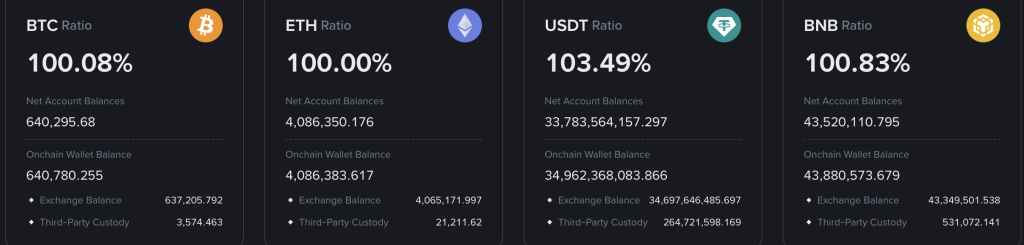 Source: Binance Report
USDT balances fell for a second consecutive month, dropping 1.51% to approximately 33.7 billion USDT, roughly 510 million tokens lower than the June 1 reading of 34.3 billion.
The prior month had already shed about 460 million USDT. Two months of consecutive stablecoin drawdown across the platform’s largest reserve asset is a meaningful data point on available buy-side liquidity, even if the direction of those funds remains unconfirmed.
Bitcoin News: What the On-Chain Data Confirms, and What It Doesn’t
The report relies on a point-in-time snapshot methodology: exchange reserves are recorded at a specific date, then compared month-over-month.
Binance uses Merkle Trees and zero-knowledge proofs to let customers verify whether their account balances are included in the total liabilities reported for each report.
What that architecture cannot do is explain the behavioral drivers behind changes in balance, whether the BTC increase came from direct purchases, deposits from external wallets, asset conversions out of ETH or USDT, or internal transfers between Binance product silos.

This ambiguity matters for interpreting the signal. Rising BTC on an exchange can read as accumulation-in-progress, but it also places more supply closer to the market. The gap between rising aggregate balances and day-to-day incremental flow signals is not directly resolvable from the PoR snapshot alone.
A similar BTC-up, USDT-down pattern appeared in the most recent reserve snapshots from Bybit and OKX. That cross-exchange alignment suggests the rotation is not Binance-specific. It more plausibly reflects a broader shift in how active traders are allocated across the major spot venues heading into the second half of 2026.
Declining USDT holdings in the platform’s proof-of-reserves report reduce the visible pool of on-exchange dry powder. Thinner stablecoin reserves do not confirm buying flows or withdrawals, but they can still matter for how liquid the on-exchange balance sheet appears at the snapshot point in time. In low-volatility conditions, that may not matter. Around key price levels or macro catalysts, it can amplify moves in both directions.
Don’t Miss Out on Our $1,000 USDT Airdrop on ByBit

Log in to Reply
Log in to comment your thoughtsComments
Related Articles