Grayscale Shakes Up Crypto ETF Landscape: Dumps Coinbase for Anchorage in Hyperliquid Filing Amendment

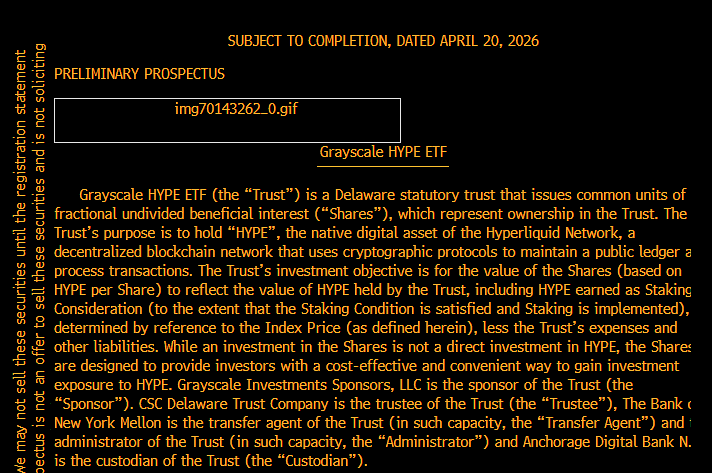
Grayscale Investments delivered a strategic shock to the crypto custody sector on April 20, 2026, by formally replacing industry giant Coinbase with Anchorage Digital Bank as the designated custodian in its amended S-1 filing for a Hyperliquid ETF. The deliberate substitution of the primary custodian for nearly all U.S. spot bitcoin ETFs signals a calculated regulatory maneuver, as Grayscale pivots to a federally chartered bank custodian while seeking SEC approval for a fund tied to an asset whose underlying perpetuals platform remains inaccessible to U.S. users.
What the Anchorage Appointment Actually Signals About Grayscale’s SEC Strategy
Anchorage Digital Bank holds a national trust charter issued by the Office of the Comptroller of the Currency, making it the only federally chartered crypto-native bank in the United States.
That designation carries qualified custodian status under federal banking law, a credential the SEC has increasingly scrutinized in digital asset custody arrangements.
Choosing Anchorage over Coinbase signals that Grayscale is prioritizing regulatory architecture over the operational convenience of using its existing ETF custody infrastructure.
Coinbase’s exchange-affiliated model, while dominant across the bitcoin ETF landscape, raises questions about conflicts of interest in its custody arrangements, a concern regulators have raised in broader crypto market structure discussions.
Anchorage operates purely as a custodian and bank, with no retail trading platform, eliminating that conflict vector entirely. Grayscale had already added Anchorage as a secondary custodian for portions of its Bitcoin and Ethereum trusts in August 2025, so this is an escalation of a relationship already in place, not a cold introduction.
Competitor filings provide a useful benchmark: 21Shares named Anchorage Digital Bank N.A. and BitGo Bank & Trust N.A. as joint custodians in its Amendment No. 2 filed April 14, 2026, for its Nasdaq-listed THYP fund. The convergence on Anchorage across multiple HYPE ETF filings suggests a shared read among issuers that the OCC charter carries weight in SEC review.
Approval Outlook: What the SEC Weighs Next Around Hyperliquid ETF
Grayscale’s initial HYPE ETF proposal was filed March 20, 2026, following earlier filings from Bitwise, which confirmed a 0.67% sponsor fee in its amended S-1, and 21Shares.
Whether Monday’s amendment resets the SEC’s review clock as a material update is a consequential procedural question; if it does, the approval timeline extends accordingly.
24h7d30d1yAll timeThe fund’s staking feature remains the largest outstanding regulatory variable; the filing explicitly conditions it on separate SEC approval, meaning the core listing decision and staking authorization are effectively two distinct regulatory events.

Log in to Reply
Log in to comment your thoughtsComments
Related Articles
|Square
Get the BTCC app to start your crypto journey
Get started today Scan to join our 100M+ users