BitMEX Proposes ’Canary Fund’ Alternative in Bitcoin Quantum-Security Debate: A Direct Counter to BIP-361’s Forced Migration

BitMEX Research has issued a stark warning with its new 'quantum canary fund' proposal, directly challenging the preemptive forced-migration approach of BIP-361. The mechanism would trigger a Bitcoin coin freeze only upon demonstrable proof of a real quantum computing threat, igniting a fierce governance battle over who decides when the protocol can act to protect user funds. The core debate is no longer about *if* quantum computers will break ECDSA signatures, but *who* gets to declare the threat actionable and *what* coercive measures the protocol is permitted to take.
How the Canary Fund Mechanism Actually Works – and What It Doesn’t Protect
The canary fund concept centers on a specially constructed Bitcoin address whose private key is provably unknown to anyone.
Using a Nothing-Up-My-Sleeve Number (NUMS) system, the address is generated on the elliptic curve in a way that no party, including its creators, can control.
A soft fork marks this address for on-chain monitoring, turning it into a live tripwire: if funds ever move from it, that movement proves a quantum computer has cracked ECDSA in practice, not just in theory.
That is not the same as quantum-proofing Bitcoin. The canary fund does not upgrade any existing wallet, does not migrate any exposed public keys, and does not protect coins that were already at risk the moment their public keys appeared on-chain.
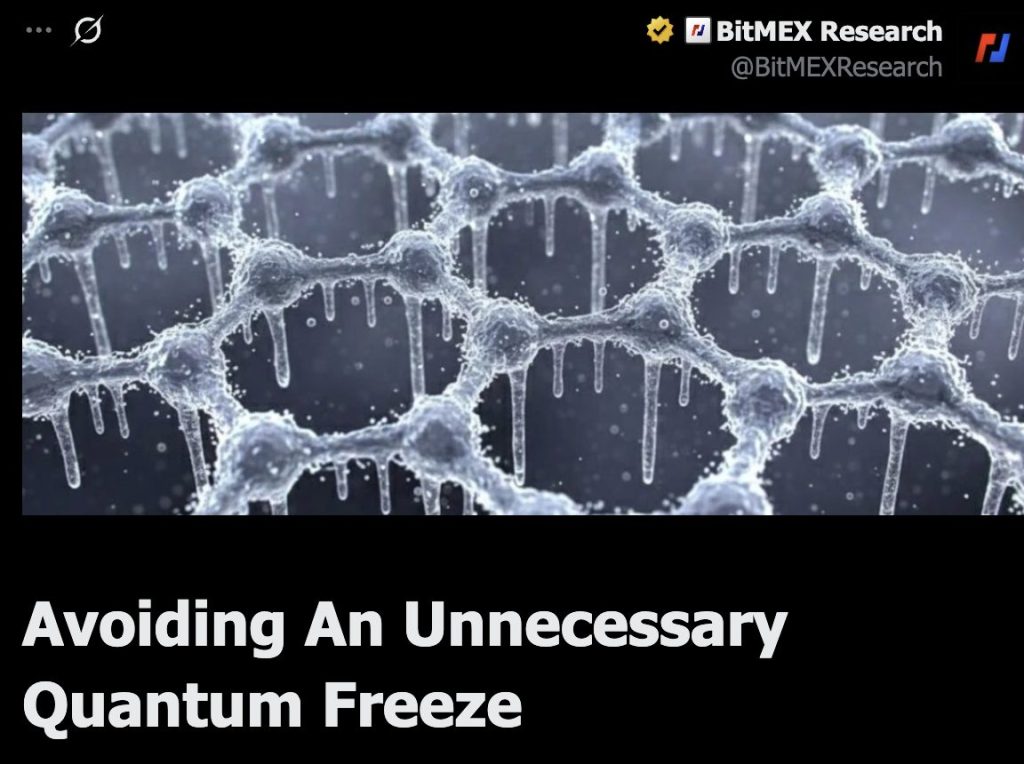
What it does is delay the most disruptive protocol intervention, a coin freeze – until there is verifiable on-chain evidence that the threat is real and active.
The 50,000-block safety window built into the proposal (approximately 345 days) is deliberately structured as an incentive, not just a grace period.
BitMEX’s reasoning: if a quantum-capable actor can crack the canary address, competitors with similar capabilities would face the same temptation across thousands of exposed addresses.
The race-to-claim dynamic theoretically surfaces the threat before it propagates silently. The complexity cost is real – the canary system requires soft fork coordination, on-chain monitoring infrastructure, and a community-wide consensus on what constitutes a valid trigger. BitMEX acknowledges this openly.
The Governance Debate the Canary Fund Sits Inside
BIP-361, authored by Jameson Lopp and merged into the Bitcoin Improvement Proposal repository on April 15, 2026, represents the most structured protocol-level response to quantum risk currently in circulation.
Its Phase A bans new sends to quantum-vulnerable addresses three years after activation. Phase B, two years later, invalidates all legacy signatures, freezing any unmigrated coins outright.
A speculative Phase C proposes zero-knowledge proofs linked to seed phrases for limited recovery, though feasibility remains unresolved.
The backlash was immediate and predictable. Critics argued BIP-361 violates Bitcoin’s core property-rights guarantees by preemptively restricting funds that have not been compromised.
There is no good incentive to solve a public canary and reveal CRQC capabilities. Canaries are disclosure events before industrial applications, not tech milestones. https://t.co/SUz8w6IEpF pic.twitter.com/8UostpBNX1
— Pierre-Luc (@dallairedemers) April 15, 2026Adam Back’s position, that Bitcoin must prepare for quantum risk through optional upgrades rather than coercive protocol changes, reflects the dominant skeptic view. The quantum security debate has been intensifying alongside broader market attention to Bitcoin’s long-term cryptographic assumptions.
BitMEX’s canary fund attempts a third path: evidence-based intervention rather than precautionary freezing.
It preserves the status quo until the threat becomes empirically demonstrable, which satisfies the ‘your keys, your coins’ objection, until the canary trips, nothing changes.
The trade-off is that it provides no protection during the window between when a quantum adversary first achieves cryptographic capability and when they choose to trigger the canary.
That gap could be exploited silently. The question isn’t whether the canary fund is philosophically cleaner than BIP-361. It’s whether ‘wait for proof’ is an acceptable risk posture given that Google and Caltech research suggests quantum breakthroughs may arrive ahead of prior estimates. Other major blockchains, including Tron, are already building out quantum roadmaps without waiting for on-chain confirmation of a threat.

Log in to Reply
Log in to comment your thoughtsComments
Related Articles
|Square
Get the BTCC app to start your crypto journey
Get started today Scan to join our 100M+ users