Trump’s Military Warning Against Iran Triggers 6% Bitcoin Plunge: Is $60,000 the Next Target?

President Trump's April 1st address warning of intensified military action against Iran sent shockwaves through financial markets, with Bitcoin plummeting 6% to near $66,500 within hours. The sharp reversal shattered recent market optimism and threatens to push the cryptocurrency toward a critical 10% correction, as Brent crude surged above $106 on fears of prolonged Strait of Hormuz disruption.
Bitcoin Price Prediction: Hold $65,000 Support or Another Leg Down?
BTC is sitting at $66,500, stuck in a pattern of lower highs since the March peak at $76,000, with each recovery attempt getting weaker and selling pressure capping every bounce before it gets going.
The $64,000 to $65,000 floor is the level that matters most right now, it has held on multiple tests but a clean break below it opens the path straight back to $60,000 where the February wick bottomed out.
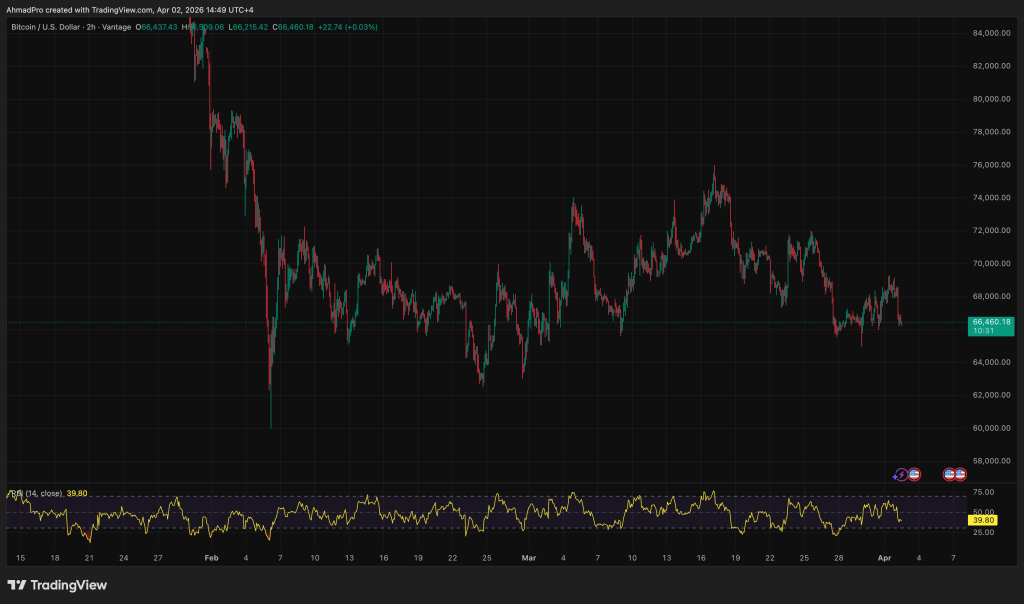
On the upside, $68,000 and then $70,000 are the levels that need to flip for any real recovery narrative to rebuild, and neither looks easy given how heavy every bounce has been recently.
Until one of those scenarios plays out, this is a chart in damage control mode.
The broader bearish trend in BTC’s recent price history makes this inflection point more consequential than it might otherwise appear.
Bitcoin ended March up just 2%, snapping a five-month losing streak – but it remains down roughly 45% from its October peak above $126,000. Apparent demand was already negative by approximately 63,000 BTC as of late last month, per CryptoQuant.
“Stock and commodity markets continue to whipsaw according to Trump’s latest comments on geopolitical developments,” said Caroline Mauron, co-founder of Orbit Markets.
“Bitcoin is largely following stocks’ direction, though in the past few weeks it has showed reduced sensitivity to both good and bad news.” That reduced sensitivity may be the one thin positive – but it hasn’t prevented a $6,500 drop in a single session.

Notably, gold’s worst monthly performance in 17 years through March – down more than 11% – strips away the easy ‘rotate to safe havens’ narrative. Treasuries and cash are absorbing the flight-to-safety flow instead.
The 10-year U.S. Treasury yield surged as markets priced in persistent inflation driven by energy supply disruptions, creating a direct headwind for non-yielding assets like Bitcoin. Until the Iran situation resolves cleanly in either direction, Bitcoin is unlikely to decouple.
