ETH/USD: Is Ethereum’s Breakout a Bull Trap or the Real Deal?

Ethereum punches through resistance—but can it hold the line?
Ethereum's recent surge against the dollar has the crypto community buzzing. The breakout above a key technical level looks impressive on the charts, fueling bullish chatter across trading desks and social feeds. Yet, a nagging question lingers in the back of every seasoned trader's mind: Is this a genuine leg up, or just another sophisticated trap set by the market?
The Anatomy of a Breakout
Breakouts are a trader's bread and butter—a clear signal that buying pressure has overwhelmed selling at a defined price point. Ethereum's move fits the textbook definition, complete with increased volume and a decisive candle close above the level. It's the kind of action that triggers algorithmic buys and FOMO from latecomers. But in crypto, textbooks often get rewritten by whale wallets and leveraged sentiment.
Bull Trap Red Flags
History is littered with 'fakeouts.' The classic bull trap lures in optimistic buyers, only to reverse sharply and liquidate over-leveraged long positions. Watch for telltale signs: a swift rejection back below the breakout level, declining volume on follow-up rallies, or a surge in open interest that feels more speculative than conviction-based. It’s the market’s favorite party trick—getting everyone to buy the top before the real sellers show up. After all, what's finance without a little psychological warfare masquerading as price discovery?
The Bull Case: Fuel in the Tank
Ignoring the breakout's potential would be foolish. The underlying network continues to evolve, with scaling solutions gaining traction and institutional frameworks slowly solidifying. This isn't 2021's hype cycle; there's tangible, if gradual, adoption providing a firmer foundation. A sustained move here could open the path to significantly higher valuations, forcing even the skeptics to reconsider their charts.
The Verdict: Trust, but Verify
So, trap or trajectory? The smart money isn't placing blind bets. It's watching for confirmation—a successful retest of support, healthy consolidation, and fundamental catalysts aligning with the technical picture. In a market that rewards both patience and paranoia, Ethereum's next few candles will tell the real story. One thing's certain: in crypto, the only free lunch is the one you take from an overconfident trader on the wrong side of the move.
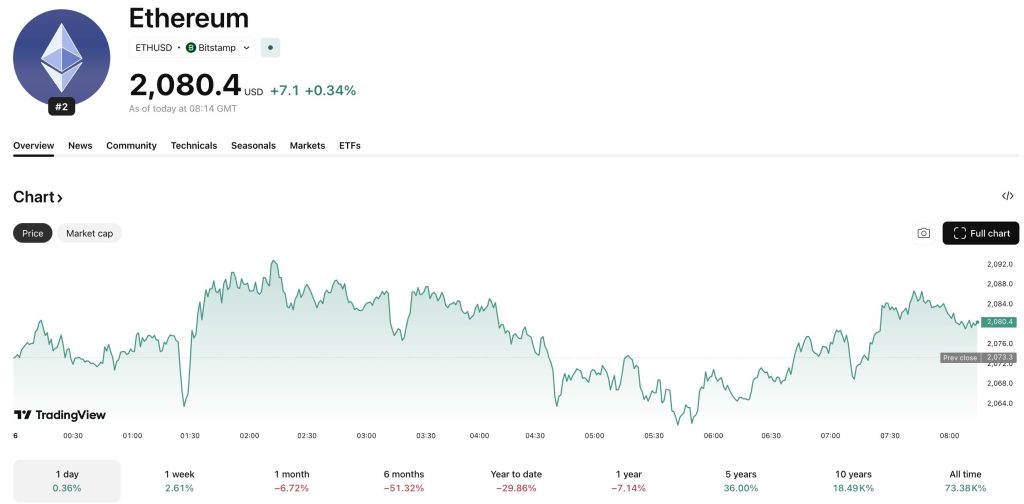 SOURCE: TradingView
Ethereum Price Analysis: What’s Next After $2,160 Rejection?
While the 12-hour timeframe is teasing a massive reversal pattern that has bulls salivating, Ethereum needs to hold above $2,000. A daily close above this level would confirm the inverse Head and Shoulders pattern, with the neckline sitting firmly at that crucial $2,160 level.
Adding to the bullish case is a clear divergence in the Relative Strength Index (RSI), which has been making higher lows while the price consolidated. This momentum shift suggests that sellers are finally becoming exhausted.
If buyers can defend the $2,000 zone and clear the $2,160 resistance level, the immediate path of least resistance flips to the upside, targeting the 200-day moving average.
However, the risk of a fakeout remains high. If ETH USD fails to clear this breakout and slips back below $2,000, the bullish structure would be invalidated.
In that scenario, the price would likely retest the $1,900 support zone. Traders watching the crypto price prediction today are acutely aware that volume must sustain this move, as a breakout on low volume is a prime candidate for a reversal.
On-Chain Data Shows Massive Accumulation for ETH USD: Is It Enough?
Vitalik Buterin: Ethereum's L1 is becoming really strong. The bottleneck now is imagination & boldness at the application & cultural layer.
Stay hardcore on the fundamentals (censorship resistance, resistance to being shut down or controlled, open source, privacy, security) →… pic.twitter.com/1y24LCxq4A
On-chain metrics reveal aggressive accumulation despite chart resistance. Data from Glassnode shows that long-term holders added 252,142 Ethereum to their holdings in February 2026.
This “averaging down” behavior indicates that investors see current prices as a buying opportunity, regardless of short-term volatility.
This accumulation trend coincides with updates on Ethereum’s long-term roadmap from Vitalik, boosting confidence among institutional investors.
The disparity between increasing holder balances and stagnant prices often signals a potential supply shock, assuming macro conditions don’t lead to liquidation.
Currently, support levels are holding, with the realized price for short-term holders aligning with market prices, suggesting that the capitulation phase may soon end.
Analysts Warn: Is This a Bull Trap?
$ETH update
Price nearing a key resistance level. Looking for a possible liquidity sweep before a bearish move. pic.twitter.com/TYkKM0k0oQ

Despite some market optimism, analysts are highlighting significant structural risks on the weekly timeframe.
Benjamin Cowen points out that Ethereum is trading below its weekly “bull market support band,” and the 50-week and 200-week moving averages are near a death cross.
This has raised concerns among seasoned traders that the current rally might be a “bull trap.” If resistance at $2,160 holds, analysts predict a potential drop to $1,320-$1,345, a level not seen since the last cycle’s early accumulation phases.
Additionally, a new Chinese AI, Kimi, forecasts volatile market conditions leading into 2026 before any sustained all-time highs can occur.
To counter this bearish outlook, bulls need a weekly close above $2,300 on ETH USD to regain structural support; without it, the macro trend remains bearish.
