Trump Administration’s CLARITY Act Clash: Banks Face Pressure Over Crypto Access

Washington draws a line in the sand—traditional finance meets digital defiance.
The Regulatory Squeeze
Federal watchdogs aren't asking anymore. They're demanding banks clarify their crypto stance—exposing a rift between innovation and institutional caution. The message cuts through bureaucratic fog: figure out your digital asset policy, or face the consequences.
Banking's Digital Dilemma
Legacy institutions juggle client demand against regulatory uncertainty. Some dive into custody services; others retreat. This isn't just about compliance—it's a battle for the future financial pipeline.
Market Reactions & Realpolitik
Every regulatory flinch sends ripples through trading desks. Behind closed doors, lobbyists push while analysts wonder if this is genuine policy or political theater—another chapter where finance meets friction, with your portfolio caught in the middle.
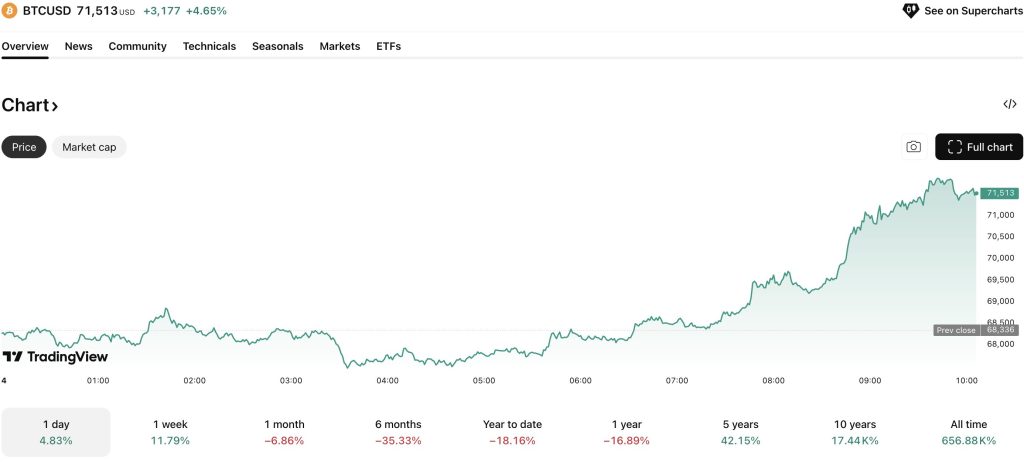
(SOURCE: TradingView)
The Battle for the Clarity Act: Trump Vs. The Banks
The immediate trigger for this confrontation is the stalled CLARITY Act. This market-structure bill, designed to reshape how digital assets are regulated in the US, passed the House last year but has hit a wall in the Senate.
Trump took to his Truth Social platform late on Tuesday to frame the delay as a national security failure:
“The Banks are hitting record profits, and we are not going to allow them to undermine our powerful Crypto Agenda,” Trump wrote. He argued that inaction WOULD cede ground to China, framing the Trump crypto policy as vital to maintaining US financial dominance.
Banks are specifically opposing provisions that would allow crypto exchanges to pay yield to users holding stablecoins. Traditional finance institutions argue this could trigger a deposit flight, draining capital from retail bank crypto accounts into higher-yielding digital asset platforms.
This follows the administration’s earlier legislative win, the Genius Act, signed in July. That law created a framework for issuers but remained silent on whether intermediaries could offer yield. The CLARITY Act aims to close that loop, and banks are scared.
BILLIONAIRE KEVIN O'LEARY SAID THE CLARITY ACT WILL PASS AND SEND bitcoin TO $200,000
TRILLIONS INCOMING pic.twitter.com/FffPLwwXSv
Reversing Operation Choke Point
The administration is not relying solely on legislation. The WHITE House is actively moving to dismantle the legacy of Operation Choke Point 2.0.
This informal regulatory strategy, utilized during the previous administration under Joe Biden, pressured banks to sever ties with crypto clients under the guise of risk management.
On March 1, the OCC repealed Interpretive Letter #1179. This removed the requirement for banks to seek pre-approval before engaging in crypto activities. Yet, industry reports suggest that despite the regulatory green light, banks remain hesitant.
Trump’s latest comments signal he could be set to go on the offensive to push the CLARITY Act through once and for all. And by now, we all know what Donald wants; he seemingly gets it.
The stakes for the industry are existential. Without reliable banking rails, crypto firms face higher operational costs and settlement risks. While the US struggles with basic access issues, other nations are integrating blockchain at the central bank level.
A similar contrast is evident globally, as the Bank of Japan explores blockchain-based reserve settlement, highlighting that traditional institutions elsewhere are adapting rather than obstructing.
As the CLARITY Act Nears, the Bitcoin Price Surges Past $70,000: What Next for BTC USD?
$BTC/usdt 8 hours
Imagine being brainwashed by bears and 4 year cyclers into waiting for $40k
$80k is NEXT https://t.co/OZZ1IlWcnK pic.twitter.com/OTpv5PsP8W
Bitcoin has resumed its rally, pumping more than 6% overnight and now trading at $71,200, even though sentiment across global equity markets remains risk-averse, as evidenced by falling precious metal prices.
There is a possibility that capital leaving the lagging silver market may be partially rotating into the surprisingly resilient BTC. Since the US attack on Iran, the bitcoin price has risen by around 10%, after initially dropping to roughly $63,000 in the immediate aftermath.
At the same time, USD strength has not triggered declines in the crypto market, as it often does, potentially signaling renewed belief in crypto as a store-of-value amid growing global tensions.
BTC/USD now needs to hold above $70,000 to signal further upside. A loss here would signal weakness, and a drop back toward support at $66,000 becomes likely.
However, holding $70,000 and a fresh injection of volume could see Bitcoin revisit its February high of $78,600. Macroeconomic news and volume are the two key indicators to watch when plotting BTC’s next move.
