Why Retail Is Fleeing Crypto For Stocks—And What Will Bring Them Back

Retail investors are pulling billions out of volatile digital assets and parking it in boring old equities. The great rotation is on.
The Exodus: Chasing Stability Over Moonshots
After a brutal crypto winter that saw portfolios evaporate overnight, the average investor's appetite for risk has fundamentally changed. The siren song of 1000x returns has been drowned out by the cold, hard reality of double-digit losses. Why watch your life savings swing 30% in a week when you can buy a blue-chip stock and actually sleep at night?
Traditional markets are offering something crypto currently can't: predictability. With clear regulations, quarterly earnings reports, and decades of historical data, stocks feel like a safe harbor in a storm. It's the financial equivalent of trading a motorcycle for a Volvo—less thrilling, but you're far more likely to arrive in one piece.
The Comeback Trail: What Crypto Needs to Win Them Back
This isn't a permanent divorce. It's a trial separation. For capital to flow back, the crypto sector needs to grow up. Fast.
The institutional-grade infrastructure is finally being built. Real-world asset tokenization is moving from white paper to balance sheet. Major payment networks are integrating blockchain rails. This isn't about memecoins anymore; it's about building a parallel financial system that's open, efficient, and—crucially—less prone to catastrophic failure.
The final catalyst? Regulatory clarity. Once the rulebook is written, the institutional floodgates will open, bringing legitimacy and liquidity that makes today's market look like a sandbox. Retail always follows the smart money—even if that money is now managed by a hedge fund instead of a pseudonymous Twitter account.
The cynical truth? Most of these investors aren't leaving for good. They're just waiting for the next bull run to be announced on CNBC so they can FOMO back in at the top. Some things never change.
Key Takeaways
- The Signal: Leverage Flushed: Estimated Leverage Ratios (ELR) plummeted from 0.1980 to 0.1414, wiping out speculative froth.
- The Data: Equities Rotation: Retail traders hit all-time high net inflows of $650 million into stocks and options in January 2026.
- The Outlook: Sideways Summer: Analysts predict range-bound action through mid-2026 as retail capital remains sidelined.
The Data Behind the Retail Crypto Liquidity Drain
The data is clear. The speculative engine has stalled. Estimated Leverage Ratios dropped 28%, sliding from 0.1980 to 0.1414.
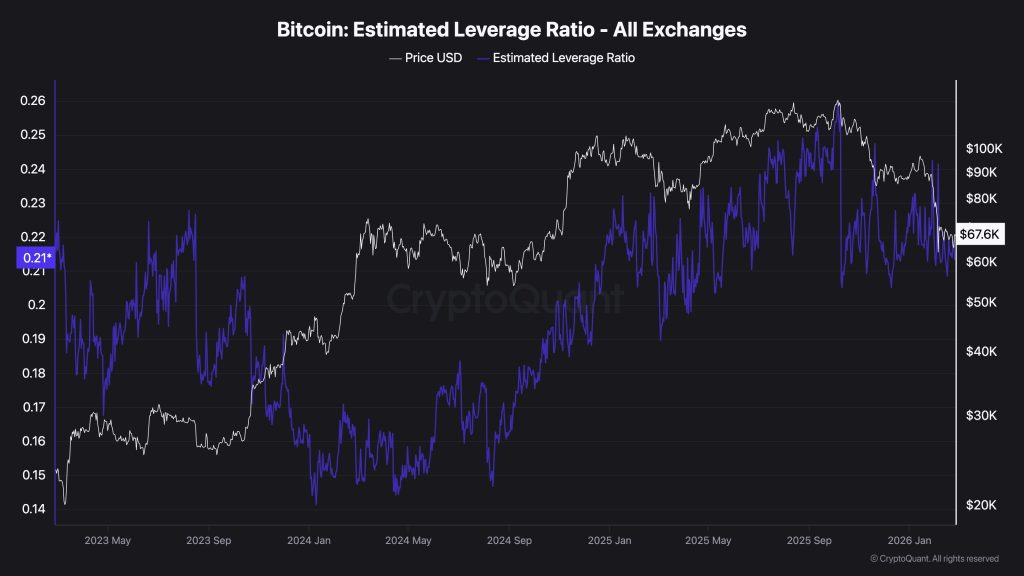
Binance activity fell by about $4.71 billion, down 16.4%, with daily volume now NEAR $24 billion. Without heavy retail participation, rebounds are weak and short-lived. Price is leaning on passive institutional flows rather than aggressive speculation.
The “digital gold” HYPE has cooled among short-term traders. After the fall from $126,000, fewer participants are willing to catch dips. The leverage reset suggests the high-risk crowd that drove the 2025 rally has either been liquidated or stepped aside.
People Are Moving From Crypto To Stocks
Retail is not moving to cash. It is moving to stocks.
In January 2026 alone, retail traders funneled $350 million into cash equities and more than $300 million into options. That is record flow. The shift is clear.

The BTC-to-Nasdaq volatility ratio has dropped below 2x. Stocks now offer comparable volatility with far smaller drawdowns. After a 46% Bitcoin correction, that trade-off looks rational to burned traders.
Institutions are still active in crypto through ETFs, but they provide floors, not frenzy. They accumulate quietly. They do not create viral rallies.
Meanwhile, the speculative energy has rotated to AI-driven equity names. Traders are using language models to dissect earnings and hunt for an edge in stocks. Compared to that, crypto currently looks opaque and momentum-starved.
Until retail risk appetite swings back, crypto is missing the explosive buy-side pressure that once fueled vertical moves.
