Bitcoin Lightning Network Smashes $1B Monthly Volume – Layer-2 Scaling Proves Its Mettle

The Bitcoin Lightning Network just crossed a billion-dollar monthly milestone—quietly proving that scaling works while Wall Street still debates theoretical risks.
A Billion-Dollar Reality Check
Forget the vaporware promises and whitepaper projections. The Lightning Network's surge past $1 billion in monthly volume isn't just a number—it's a functioning economic layer operating at a scale that makes most traditional payment rails look sluggish by comparison. This isn't testnet speculation; it's mainnet value moving at the speed of light.
How Layer-2 Cuts Through the Noise
Lightning bypasses Bitcoin's base-layer congestion entirely. It creates instant, near-zero-cost payment channels that settle back to the main blockchain only when needed. Think of it as building express lanes on the cryptocurrency highway—traffic flows freely without clogging the primary infrastructure. This architecture doesn't just handle coffee purchases; it's maturing into a backbone for cross-border remittances and microtransactions that traditional finance can't touch profitably.
The Infrastructure Nobody Saw Coming
While critics obsessed over Bitcoin's energy debate, developers were building a parallel financial system. The network now supports everything from streaming satoshis for digital content to instant retail settlements—functionality that exists as PowerPoint slides in most legacy banking innovation departments. The growth suggests users aren't waiting for permission to build the future; they're routing around the old guard entirely.
What the Volume Actually Means
That $1 billion figure represents real economic activity, not speculative token transfers. It's merchants receiving payments, creators getting paid, and individuals moving value across borders without begging for banking permission. Each transaction undercuts the narrative that Bitcoin can't scale for everyday use—while highlighting how layer-2 solutions often outpace their layer-1 ancestors in adoption curves.
The Quiet Revolution Versus the Loud Traditionalists
Here's the cynical finance jab: While traditional finance spends millions on 'blockchain innovation' committees that produce reports about potential use cases, Bitcoin's second layer just processed a billion dollars in actual use cases. The revolution isn't being televised on CNBC—it's happening in code commits and channel balances that render middlemen obsolete.
Lightning's breakthrough moment arrives not with fanfare, but with the silent efficiency of capital finding its fastest path. The network now demonstrates what happens when you stop arguing about what's possible and start building what works—even if the suits are still too busy debating risk models to notice their replacement being stress-tested in real time.
Key Takeaways
- The Milestone: Monthly volume hit an estimated $1.1 billion across 5.2 million transactions according to River Financial data.
- The Shift: Average transaction size nearly doubled year-over-year to $223, driven by exchange settlements rather than small retail purchases.
- The Catalyst: Secure Digital Markets executed a singular $1 million transfer to Kraken in under a second, proving high-value efficacy.
Why The Migration to Bitcoin’s Lightning Network?
Bitcoin is growing out of its “digital gold” narrative. As on-chain fees fluctuate effectively pricing out smaller transfers, the Lightning Network provides the necessary throughput for scalable commerce.
This utility is critical as macroeconomic headwinds and potential rate hikes force traders to seek capital efficiency.
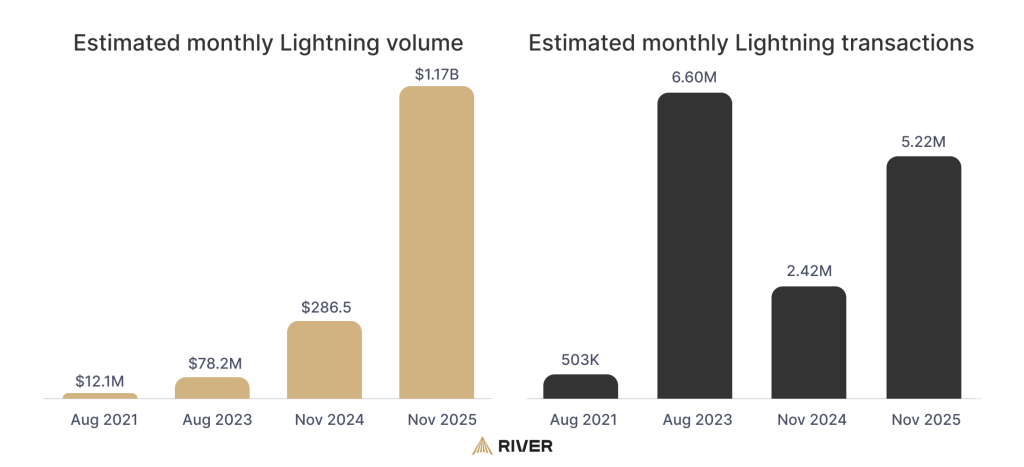
The network is no longer just a playground for developers testing one-satoshi payments. It is becoming financial infrastructure.
While total transaction counts are actually down from the 2023 peak of 6.6 million, the economic value settled has exploded. The market is maturing, prioritizing high-value speed over low-value volume.
Breaking Down the Numbers
River Financial’s latest analysis paints a bullish picture of Layer-2 adoption. The estimated $1.17 billion in November volume represents a roughly 400% increase year-over-year. Data indicates the network is successfully capturing commercial flow.
Secure Digital Markets highlighted this capacity by engaging a sending $1 million to crypto exchange Kraken via the lightning network earlier this year. The settlement was instant.
Network capacity, the total coins locked to facilitate these payments, reached a recordin December 2025, according to data by Bitcoin Visuals.

This liquidity depth is essential for preventing payment failures on larger transfers. Node operators like ACINQ and specialized infrastructure providers are stabilizing the grid, making five-figure transfers reliable.
What Does This Mean for Bitcoin Adoption?
The narrative is shifting from speculation to settlement. Sam Wouters forecasts the next major volume surge will come from AI agents utilizing Lightning for automated, high-frequency machine payments, opening an entirely new economy of autonomous financial actors.
We are seeing a broader trend of financializing Bitcoin’s utility layers. Just as Ledn is scaling Bitcoin-backed bonds for yield, Lightning is scaling Bitcoin for velocity.
The payments landscape is rapidly integrating these Layer-2 solutions, evidenced by Ether.fi moving consumer card products to Layer-2 networks to bypass mainnet congestion.
Discover: The best new crypto on the market
